About This Image
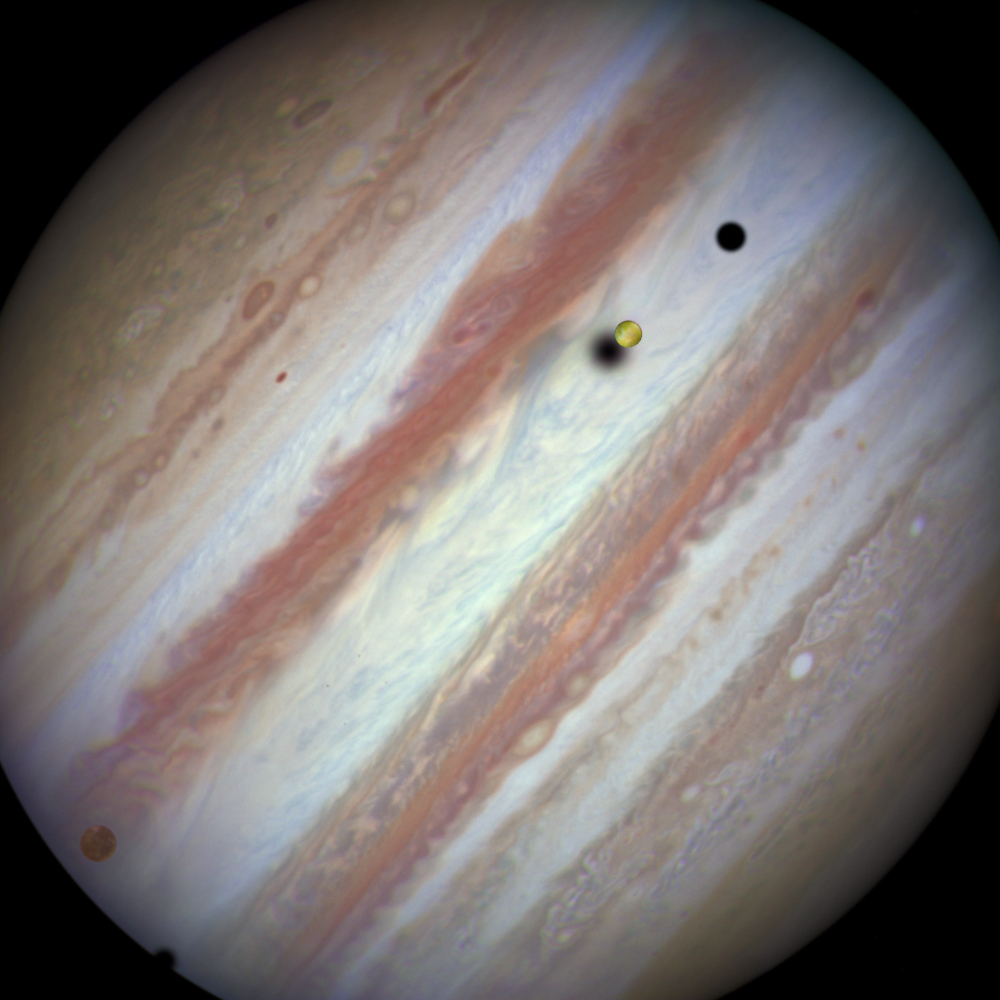
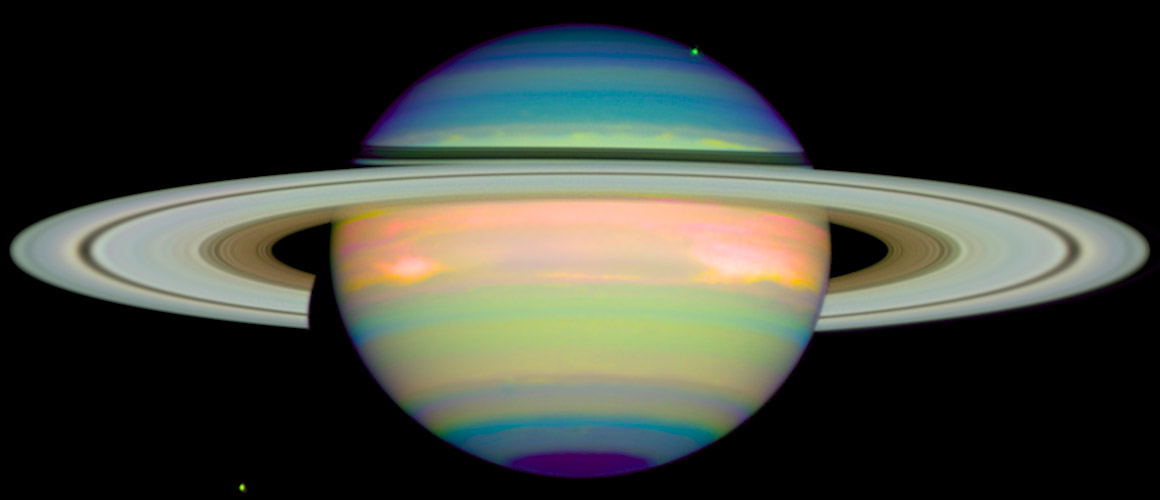
This stunning false-color image reveals Saturn as seen through infrared wavelengths, capturing heat radiation and reflected infrared light from the ringed giant. Infrared imaging allows astronomers to peer through Saturn's atmospheric hazes and study the planet's temperature variations, cloud structures, and chemical composition in ways impossible with visible light alone. The image showcases Saturn's magnificent ring system in exquisite detail, while also capturing two of the planet's fascinating icy moons: Dione, visible in the lower left, and Tethys in the upper right. These moons, composed primarily of water ice and rock, orbit within Saturn's complex system of over 80 known satellites, offering glimpses into the diverse worlds that populate our solar system's second-largest planet.
Scientific Significance
Hubble's infrared observations of Saturn have been essential for understanding the planet's atmospheric dynamics, ring structure, and satellite system in ways that complement spacecraft missions like Cassini. Infrared wavelengths penetrate Saturn's upper atmospheric hazes, revealing deeper cloud layers, temperature gradients, and the distribution of chemical species such as ammonia, phosphine, and methane. These observations track seasonal changes across Saturn's 29.5-year orbit, providing long-baseline monitoring that no single spacecraft mission can achieve. The infrared view of Saturn's rings discloses compositional variations across the ring system, distinguishing water ice from rocky contaminants and revealing thermal properties that constrain particle sizes. Observations of moons like Dione and Tethys in the infrared help characterize their surface compositions and thermal properties. Hubble's ability to observe Saturn repeatedly over decades has made it an indispensable tool for planetary science, filling gaps between dedicated planetary missions and enabling discoveries about atmospheric storms, auroral activity, and ring dynamics.
Observation Details
This image was captured using Hubble's Near Infrared Camera and Multi-Object Spectrometer (NICMOS) at wavelengths between 1.0 and 2.5 micrometers. The false-color rendering assigns visible colors to different infrared bands, with blue representing shorter near-infrared wavelengths and red representing longer wavelengths that are more sensitive to thermal emission. NICMOS was uniquely suited for this observation because its cryogenically cooled detectors minimized thermal noise, enabling precise measurement of Saturn's faint heat signature against the reflected sunlight from the rings and atmosphere. The exposure timing was carefully planned to capture both Saturn and its moons in a single frame.
Location in the Universe
Constellation
N/A (Solar System)
Distance from Earth
746 million to 1 billion miles (varies)
Fun Facts
- 1
In infrared light, Saturn's rings reveal their varying compositions and particle sizes — regions that look uniform in visible light break into distinct bands of icy particles ranging from tiny grains to house-sized boulders.
- 2
Saturn's moon Dione, visible in this image, has an oxygen atmosphere so thin that its total mass is roughly equivalent to the air inside a small building on Earth.
- 3
Saturn radiates nearly twice as much energy as it receives from the Sun, and infrared imaging like this directly captures that excess heat escaping from the planet's interior — a lingering remnant of its gravitational contraction during formation.
Image credit: NASA, ESA, Hubble Space Telescope