About This Image
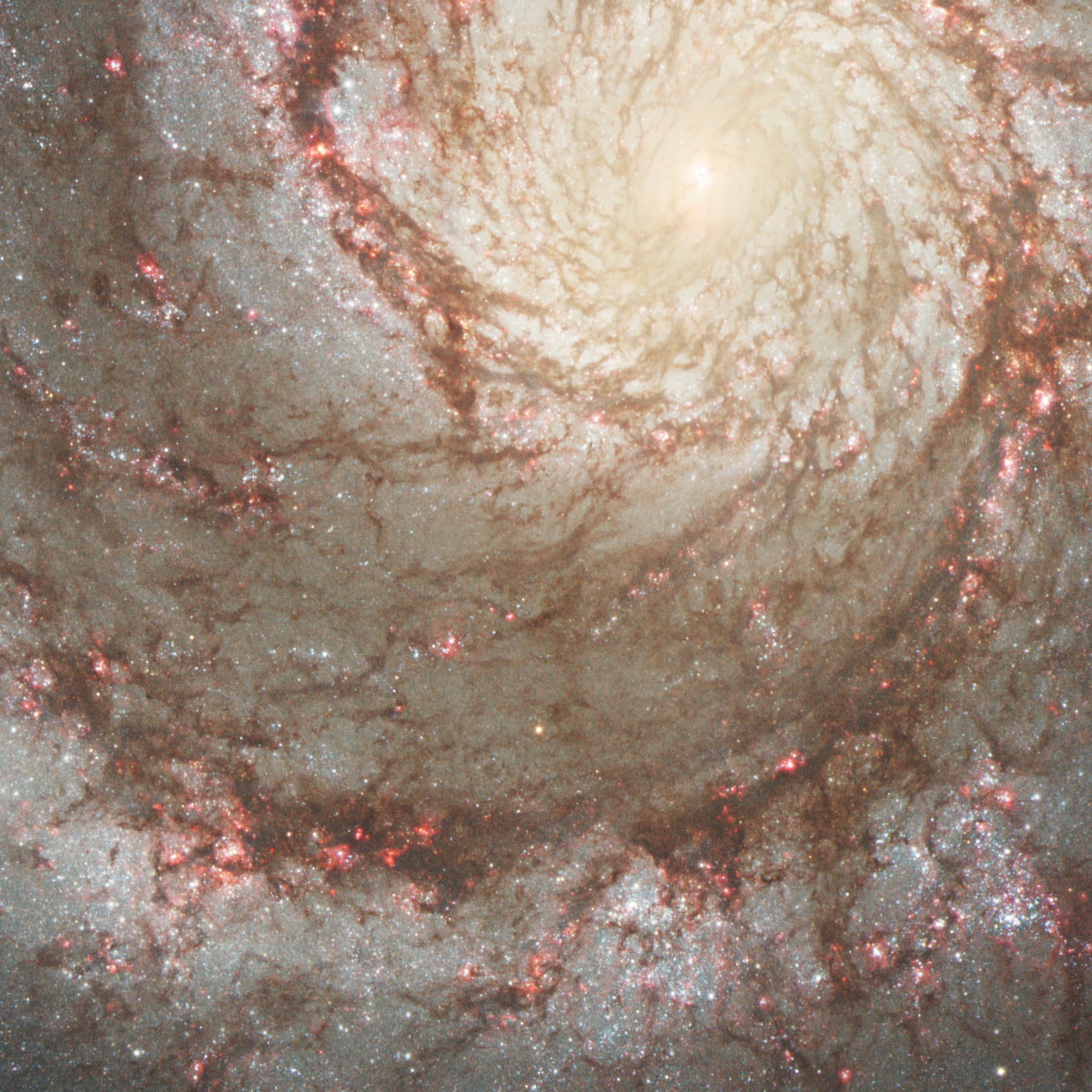
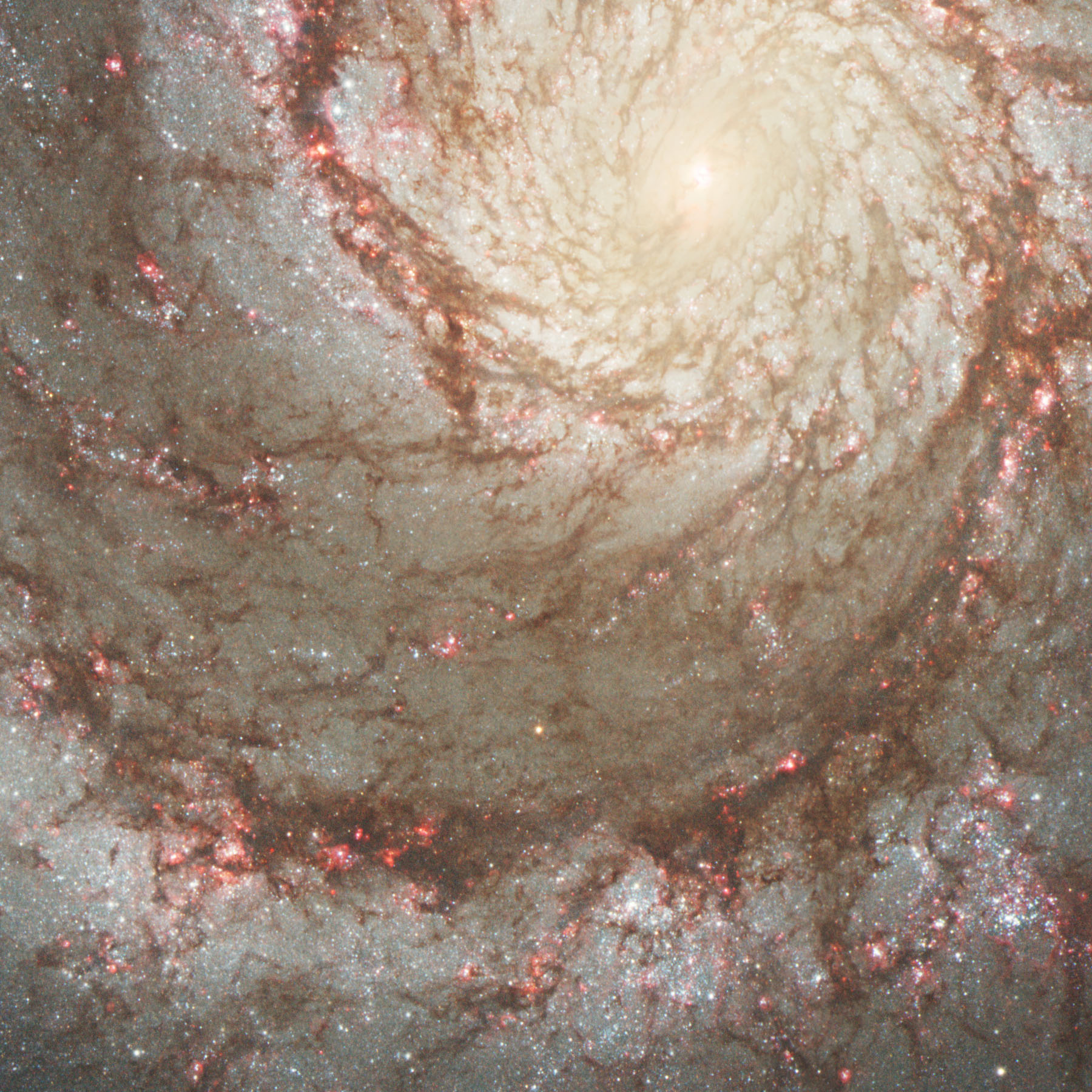
This stunning close-up image reveals intricate details within some of the winding spiral arms of the magnificent Whirlpool Galaxy. Tracing the graceful curves of the galaxy's arms are red-colored clouds of hydrogen gas—the raw material for star formation—which are actively giving birth to new stars in brilliant stellar nurseries. The spiral arms act as cosmic assembly lines, compressing gas and dust as they sweep through the galactic disk, triggering waves of star formation that light up the arms in vivid hues. Young, hot blue stars punctuate these red nebulae, their intense radiation ionizing the surrounding hydrogen and causing it to glow. This detailed view showcases the elegant structure and ongoing stellar genesis within one of the most photogenic galaxies in the sky, located approximately 23 million light-years away in the constellation Canes Venatici.
Scientific Significance
This image captures the same view of M51 as the January 19 entry, but its repeated appearance underscores the galaxy's extraordinary scientific value. The Whirlpool Galaxy has been one of Hubble's most frequently observed extragalactic targets, with data spanning decades that enable time-domain studies of variable stars, supernovae, and evolving H II regions. The three supernovae observed in M51 between 1994 and 2011 have provided critical data on different supernova types and their progenitor stars, with Hubble's archival images allowing astronomers to identify the stars before they exploded. M51's well-ordered spiral structure also serves as a benchmark for testing numerical simulations of galaxy interactions, as the encounter with NGC 5195 has been modeled extensively to reproduce the observed arm morphology, gas kinematics, and enhanced star formation. These simulations have yielded insights into the timescales and mechanics of tidal interactions that are applicable to galaxy mergers throughout the universe.
Observation Details
This Hubble image of the Whirlpool Galaxy used the same ACS dataset as the January 19 image, drawn from a comprehensive multi-filter survey of M51 conducted in 2005. The observations combined broadband filters (F435W, F555W, F814W) to produce a natural-color composite and narrowband filters (F658N for hydrogen-alpha) to highlight star formation activity. The total exposure time across all filters exceeded 50 hours. Point-spread function fitting photometry was performed on the resulting images to extract brightness measurements for millions of individual sources, including foreground stars, background galaxies, and M51's own stellar populations and compact star clusters.
Location in the Universe
Constellation
Canes Venatici
Distance from Earth
23 million light-years
Fun Facts
- 1
The Whirlpool Galaxy's companion, NGC 5195, has already passed through M51's disk at least once and is now located slightly behind it from our perspective, connected by a tidal bridge of stars and gas.
- 2
M51 has hosted three observed supernovae in the modern era — SN 1994I, SN 2005cs, and SN 2011dh — making it one of the most prolific nearby galaxies for supernova studies.
- 3
If you could travel at the speed of light, it would take you roughly 76,000 years just to cross from one edge of the Whirlpool Galaxy to the other.
Image credit: NASA, ESA, Hubble Space Telescope