About This Image
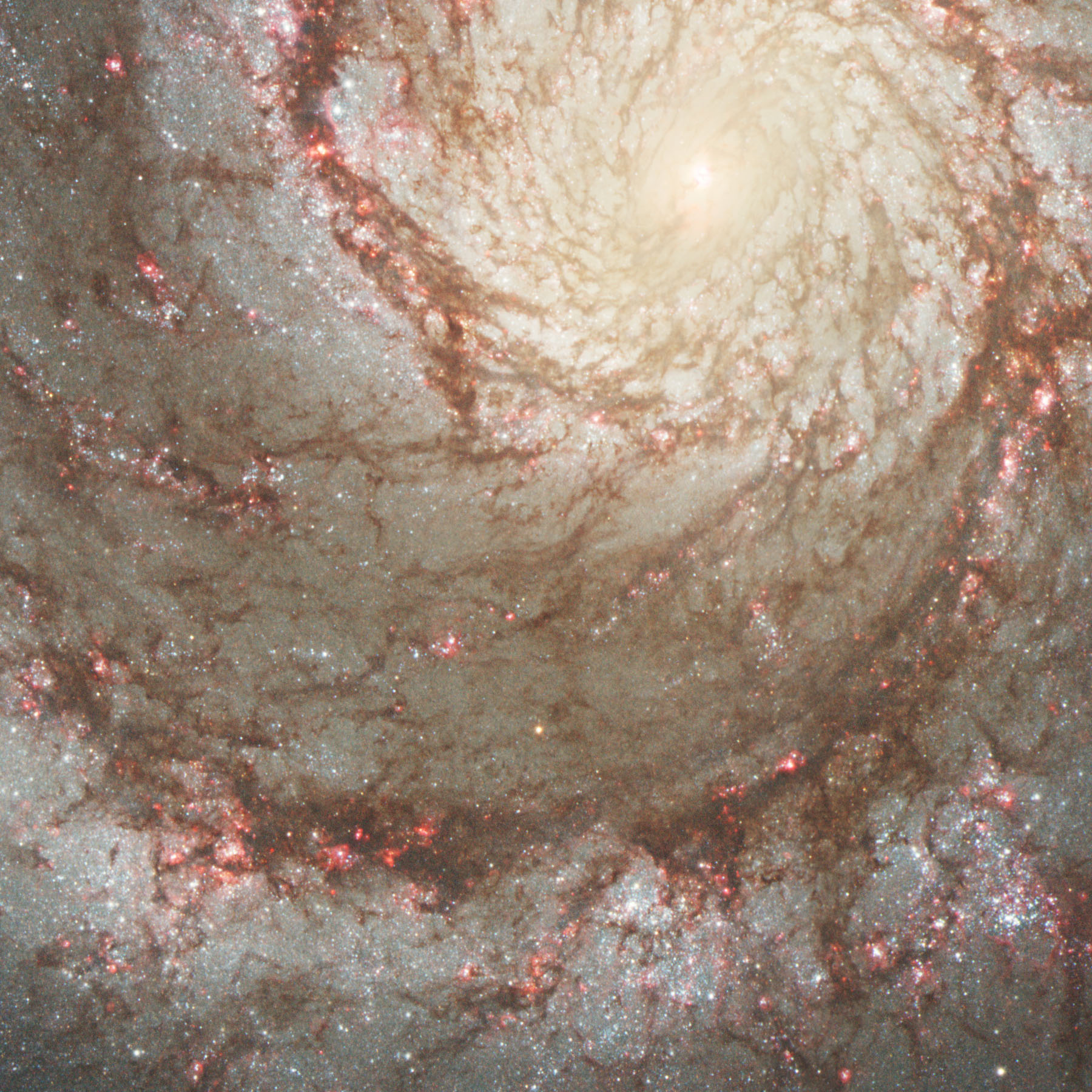
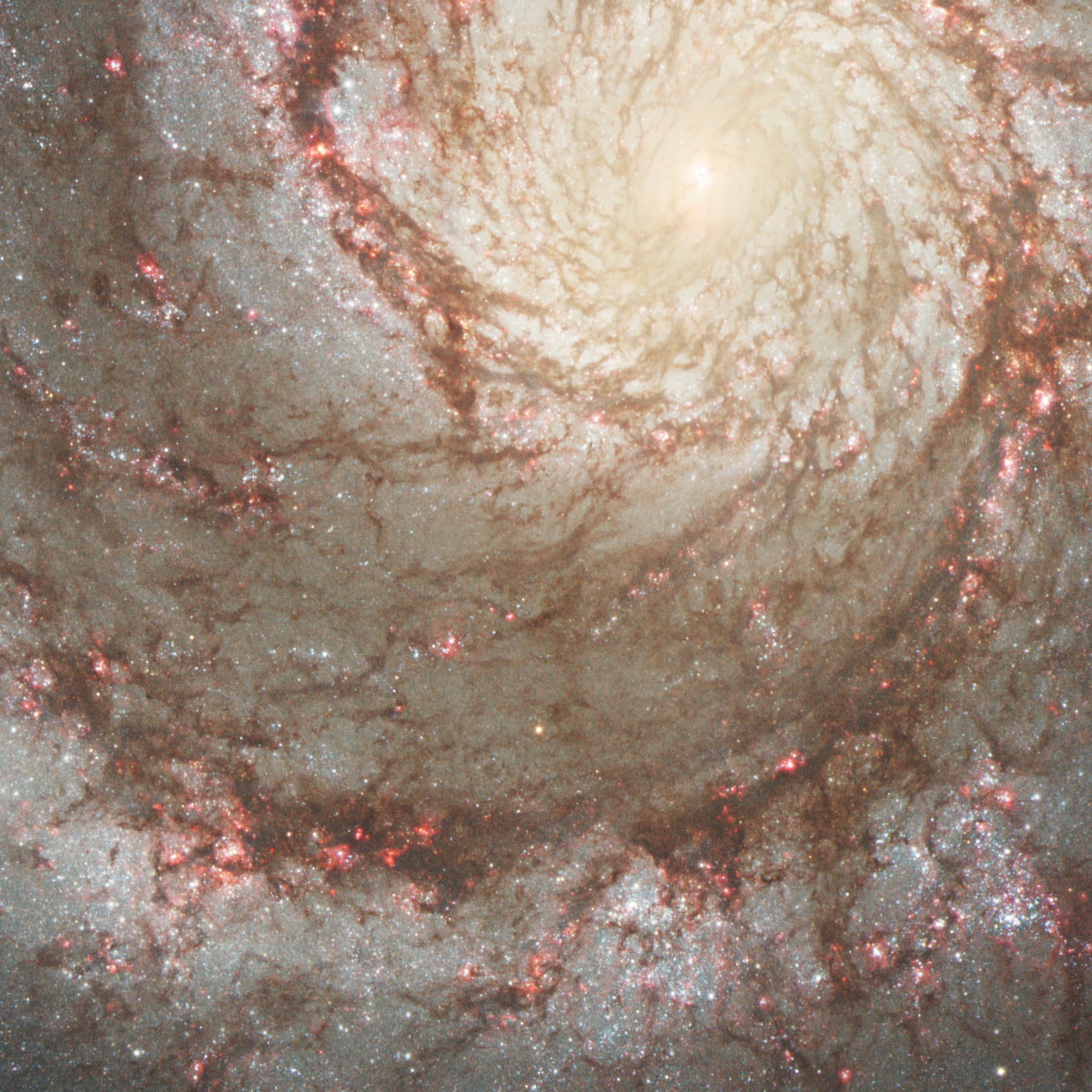
This stunning close-up image reveals intricate details within some of the winding spiral arms of the magnificent Whirlpool Galaxy. Tracing the graceful curves of the galaxy's arms are red-colored clouds of hydrogen gas—the raw material for star formation—which are actively giving birth to new stars in brilliant stellar nurseries. The spiral arms act as cosmic assembly lines, compressing gas and dust as they sweep through the galactic disk, triggering waves of star formation that light up the arms in vivid hues. Young, hot blue stars punctuate these red nebulae, their intense radiation ionizing the surrounding hydrogen and causing it to glow. This detailed view showcases the elegant structure and ongoing stellar genesis within one of the most photogenic galaxies in the sky, located approximately 23 million light-years away in the constellation Canes Venatici.
Scientific Significance
The Whirlpool Galaxy (M51a) is one of the most important galaxies for understanding spiral structure and tidally triggered star formation. Its ongoing gravitational interaction with companion galaxy NGC 5195 has produced textbook-perfect spiral arms, making M51 the premier laboratory for testing density wave theory — the leading explanation for why spiral arms persist in galaxies rather than winding up and disappearing over time. The interaction has also enhanced the star formation rate along the arms, providing opportunities to study how galaxy mergers drive starburst activity. Hubble's detailed imaging has resolved thousands of individual star-forming regions, H II regions, and star clusters across the disk, enabling statistical studies of the stellar initial mass function and cluster formation efficiency in an interacting environment. The galaxy's relatively face-on orientation and moderate distance make it ideal for multi-wavelength studies combining optical, infrared, radio, and X-ray data to build a comprehensive picture of the interstellar medium and star formation cycle.
Observation Details
This close-up of the Whirlpool Galaxy was captured using Hubble's Advanced Camera for Surveys (ACS) in multiple broadband and narrowband filters. The broadband filters in blue, green, and near-infrared wavelengths mapped the distribution of stellar populations of different ages, while the narrowband hydrogen-alpha filter isolated the red glow of ionized gas in star-forming H II regions. The mosaic required multiple ACS pointings stitched together to cover a significant portion of the galaxy's disk at Hubble's full resolution. The resulting images resolved structures as small as individual giant molecular cloud complexes and young stellar associations.
Location in the Universe
Constellation
Canes Venatici
Distance from Earth
23 million light-years
Fun Facts
- 1
The Whirlpool Galaxy (M51) was the first celestial object recognized as having a spiral structure, identified by Lord Rosse in 1845 using his 72-inch telescope at Birr Castle in Ireland.
- 2
M51 is gravitationally interacting with its smaller companion galaxy NGC 5195, which is being pulled through one of the Whirlpool's spiral arms — this tidal interaction is what makes the spiral arms so prominent and well-defined.
- 3
A supermassive black hole at the center of M51 is surrounded by a striking X-shaped pattern of dust, which Hubble resolved in detail and which may be caused by the interaction between the black hole's radiation and the surrounding dusty disk.
Image credit: NASA, ESA, Hubble Space Telescope