About This Image
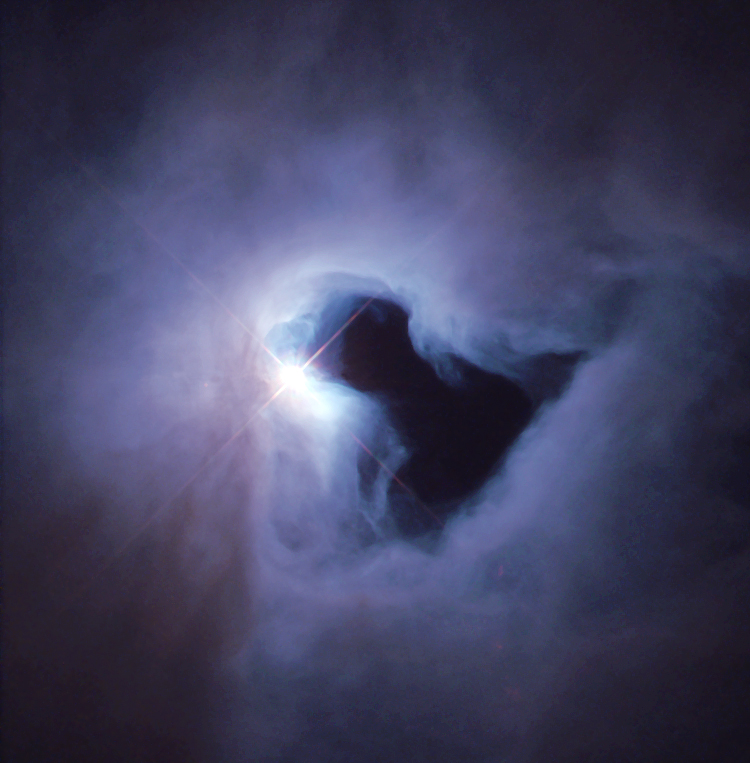
NGC 1999 is a captivating reflection nebula that showcases one of the more subtle ways cosmic clouds can shine. Unlike emission nebulae that glow by emitting their own light, NGC 1999 does not emit any visible light of its own but instead shines purely because starlight from a nearby star—visible just to the left of the nebula's center—illuminates and reflects off the nebula's dust particles. This dust acts like cosmic fog in a spotlight, scattering the star's blue light and creating a ghostly luminous cloud. The nebula is located in the Orion star-forming region, one of the most active stellar nurseries in our galactic neighborhood. The bright variable star at its heart, V380 Orionis, is a young T Tauri star still in the process of formation, surrounded by the remnants of the cloud from which it was born, offering astronomers a window into the early stages of stellar evolution.
Scientific Significance
NGC 1999 is a scientifically rich object that provides insights into the earliest stages of star formation and the interaction between newborn stars and their natal environments. The nebula's illuminating star, V380 Orionis, is a Herbig Ae/Be star — a young, intermediate-mass star still surrounded by an accretion disk and actively driving powerful bipolar jets. These jets slam into the surrounding molecular cloud, creating Herbig-Haro objects that trace the outflow activity. The mysterious dark void in NGC 1999, initially classified as a dense Bok globule, was revealed by far-infrared observations to be a genuine cavity in the molecular cloud, likely evacuated by the combined effect of stellar winds and jets from V380 Orionis and other nearby young stellar objects. This discovery changed understanding of how feedback from young stars shapes their surrounding medium. NGC 1999's location within the Orion star-forming complex makes it part of one of the best-studied regions of active star formation in the entire galaxy.
Observation Details
Hubble observed NGC 1999 using the Wide Field and Planetary Camera 2 (WFPC2) in broadband optical filters that captured the characteristic blue scattered light of the reflection nebula. The blue-dominated color of the nebula arises because small dust grains scatter shorter-wavelength blue light more efficiently than longer-wavelength red light — the same process that makes Earth's sky blue. Additional narrowband imaging in emission lines such as hydrogen-alpha and sulfur helped distinguish between the reflected continuum light and any faint emission from shocked gas associated with Herbig-Haro outflows in the vicinity. The high angular resolution of Hubble resolved fine structure in the nebula, including the sharp boundary of the central dark void.
Location in the Universe
Constellation
Orion
Distance from Earth
1,500 light-years
Fun Facts
- 1
The dark patch near the center of NGC 1999 was long thought to be a dense Bok globule blocking background light, but Herschel Space Observatory observations in 2010 revealed it is actually an empty hole in the nebula, possibly carved by jets from nearby young stars.
- 2
V380 Orionis, the star illuminating NGC 1999, is only about 2 million years old and roughly 3.5 times the mass of our Sun — it has not yet settled onto the main sequence and is still contracting from its birth cloud.
- 3
NGC 1999 lies in the same star-forming complex as the famous Orion Nebula, just about 2 degrees south of it in the sky, and is part of the enormous Orion Molecular Cloud spanning hundreds of light-years.
Image credit: NASA, ESA, Hubble Space Telescope