About This Image
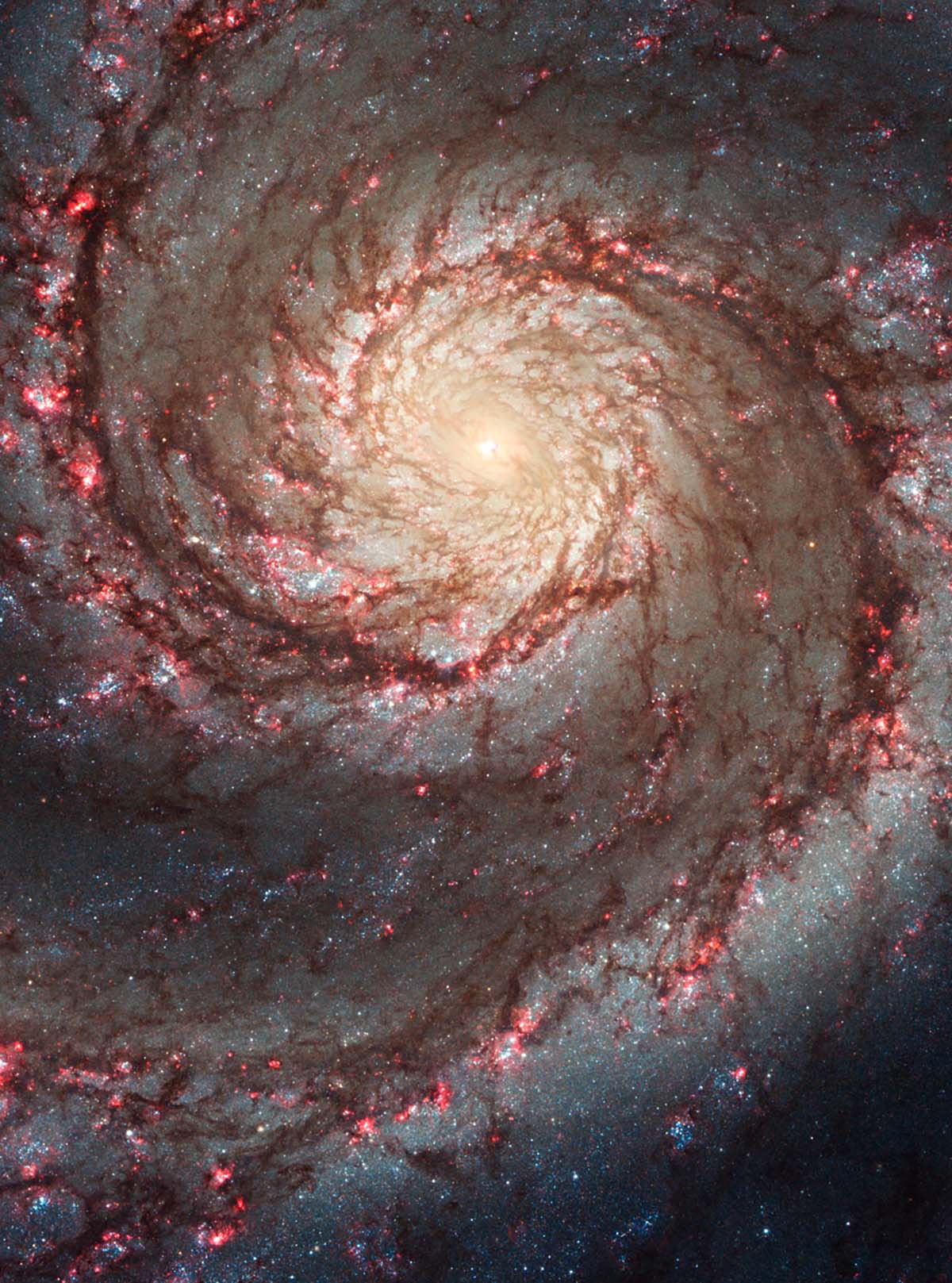
The heart of the Orion Nebula reveals one of the most spectacular stellar nurseries in our galaxy, where massive young stars are sculpting their surroundings with intense ultraviolet radiation and powerful stellar winds. At the center lies the Trapezium Cluster, a tight grouping of four luminous hot stars whose combined energy illuminates the entire nebula, causing the surrounding hydrogen gas to glow in vivid shades of red and pink. Hubble's sharp vision has revealed hundreds of protoplanetary disks — flattened cocoons of gas and dust surrounding newborn stars — that may one day form planetary systems similar to our own. As the closest massive star-forming region to Earth at just 1,344 light-years away, the Orion Nebula serves as an unparalleled laboratory for studying how stars and planets are born. The intricate interplay of radiation, gravity, and turbulence within this cosmic cradle continues to yield groundbreaking discoveries about the processes that shape stellar and planetary evolution throughout the universe.
Scientific Significance
The Orion Nebula is arguably the single most important object for understanding how stars and planetary systems form. As the nearest massive star-forming region to Earth, it provides an unmatched combination of proximity and activity that allows astronomers to study every stage of stellar birth in extraordinary detail. Hubble's observations have been transformative, revealing the Trapezium Cluster's role in ionizing and shaping the surrounding gas, and discovering hundreds of protoplanetary disks that demonstrate planet formation is a common byproduct of star birth. The nebula spans approximately 24 light-years across and contains enough gas and dust to form thousands of new stars. Studies of the Orion Nebula have provided critical constraints on the initial mass function — the distribution of stellar masses at birth — which governs the evolution of galaxies across cosmic time. The nebula's relatively young age of approximately two million years means astronomers can observe stars in their earliest evolutionary stages, including protostars still embedded in their natal cocoons and T Tauri stars undergoing violent accretion events.
Observation Details
Hubble has observed the Orion Nebula extensively using multiple instruments, including the Advanced Camera for Surveys (ACS) and the Wide Field Camera 3 (WFC3), across ultraviolet, visible, and near-infrared wavelengths. The mosaic images required multiple pointings stitched together to capture the nebula's full extent. Near-infrared observations have been particularly valuable for penetrating the dense dust clouds to reveal embedded protostars and protoplanetary disks that are invisible in optical light. These multi-wavelength datasets have enabled astronomers to construct detailed three-dimensional models of the nebula's structure and map the distribution of different chemical elements within it.
Location in the Universe
Constellation
Orion
Distance from Earth
1,344 light-years
Fun Facts
- 1
The Trapezium Cluster at the nebula's core contains four massive stars that are so luminous they would be visible to the naked eye from over 1,000 light-years away, and their combined ultraviolet output illuminates the entire nebula.
- 2
Hubble has identified over 150 protoplanetary disks (proplyds) in the Orion Nebula — flattened disks of gas and dust around young stars that are believed to be solar systems in the making.
- 3
The Orion Nebula is visible to the naked eye as a fuzzy patch in Orion's sword, making it one of the few deep-sky objects that humans have observed for thousands of years without telescopes.
Image credit: NASA, ESA, Hubble Space Telescope