About This Image
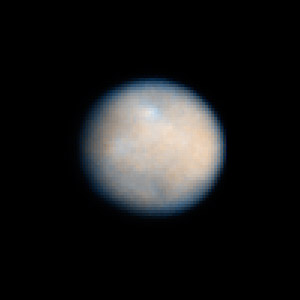
The largest known asteroid, Ceres, is approximately 590 miles (950 kilometers) across—roughly the size of Texas—making it a true giant among the rocky bodies of the solar system. Ceres resides in the main asteroid belt between Mars and Jupiter, sharing space with tens of thousands of other asteroids of varying sizes. In fact, Ceres is so massive that it contains nearly one-third of the total mass of the entire asteroid belt and has enough gravity to pull itself into a spherical shape, a characteristic that led to its reclassification as a dwarf planet in 2006. Hubble's observations have revealed intriguing features on Ceres' surface, including possible water ice and mysterious bright spots that hint at geological activity. This ancient world serves as a pristine time capsule from the early solar system, preserving clues about planetary formation and the processes that shaped our cosmic neighborhood over 4.5 billion years ago.
Scientific Significance
Ceres occupies a unique position in planetary science as the largest body in the asteroid belt and the only dwarf planet in the inner solar system. Its study bridges the gap between rocky terrestrial planets and the icy worlds of the outer solar system. Hubble's early observations of Ceres provided the first hints of surface features and compositional variations that were later confirmed in stunning detail by NASA's Dawn mission. The discovery of water ice, organic molecules, and salt deposits on Ceres suggests it experienced significant aqueous alteration — meaning liquid water once flowed through its interior, chemically transforming its rocks and minerals. This makes Ceres an invaluable window into the early solar system's water budget and the delivery of volatiles to the inner planets. Furthermore, Ceres' composition and structure provide constraints on models of planet formation and migration, helping astronomers understand why a full-sized planet never formed in the asteroid belt despite Jupiter's gravitational influence.
Observation Details
Hubble observed Ceres using the Advanced Camera for Surveys (ACS) and the Wide Field and Planetary Camera 2 (WFPC2) in visible and ultraviolet wavelengths. Although Ceres appears as only a few pixels across even in Hubble's sharpest images, astronomers used sophisticated image processing techniques to map surface albedo variations and identify bright and dark regions on its surface. These observations, conducted over multiple rotational periods of Ceres, enabled the construction of crude surface maps that guided the planning of NASA's Dawn mission. Hubble also measured Ceres' precise shape, confirming its oblate spheroidal form consistent with hydrostatic equilibrium.
Location in the Universe
Constellation
N/A (Solar System)
Distance from Earth
257 million miles (average from Earth)
Fun Facts
- 1
Ceres contains nearly one-third of the total mass of the entire asteroid belt, yet it is still 6,000 times less massive than Earth — a testament to how little material exists between Mars and Jupiter.
- 2
NASA's Dawn spacecraft discovered over 300 bright spots on Ceres' surface, the most prominent being Occator Crater's deposits of sodium carbonate, a type of salt left behind by briny water that seeped to the surface and evaporated.
- 3
Ceres may harbor a subsurface ocean of liquid water beneath its icy crust, making it one of the few places in the solar system besides Europa and Enceladus where conditions might support microbial life.
Image credit: NASA, ESA, Hubble Space Telescope