About This Image
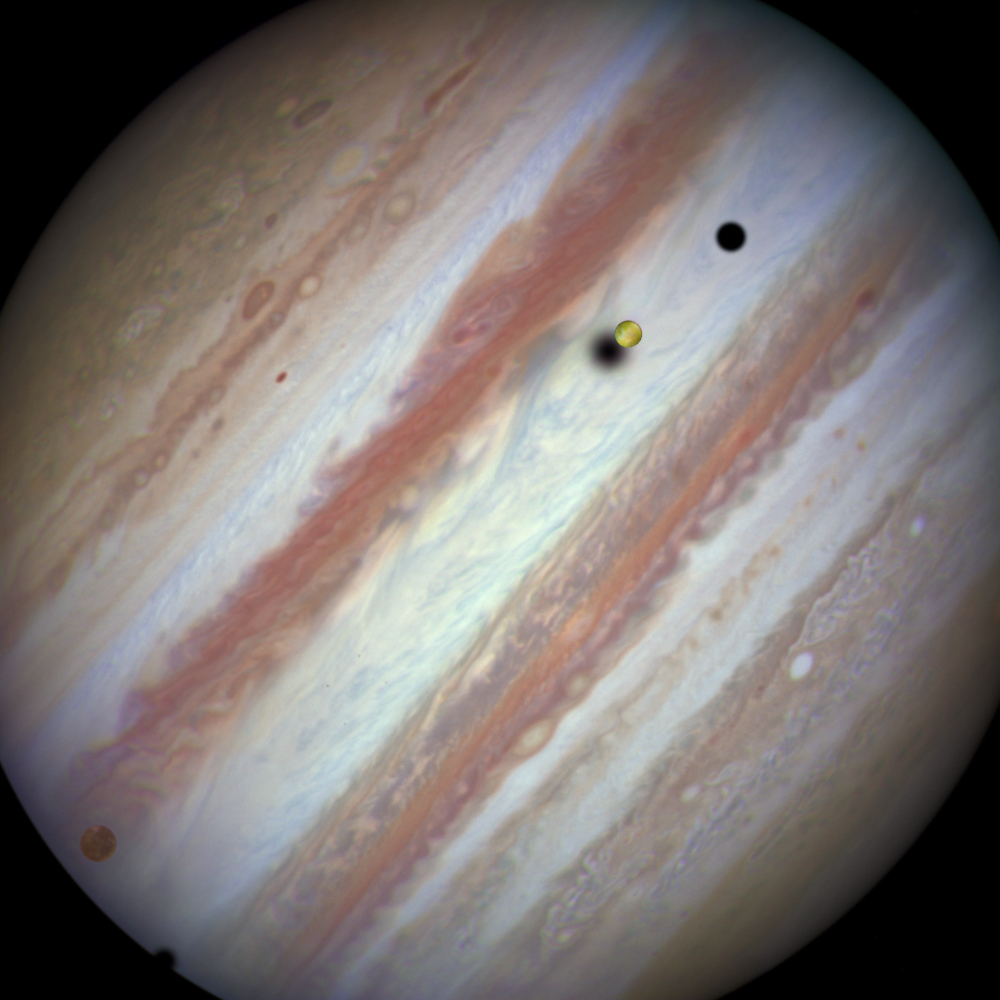
This remarkable image captures a rare celestial alignment as three of Jupiter's four largest Galilean moons simultaneously cast their shadows onto the planet's cloud tops in a cosmic triple shadow transit. Callisto and Io are visible in the lower left and upper right of the image, respectively, appearing as small dark dots against Jupiter's banded atmosphere or the black backdrop of space. Europa, whose shadow is visible on Jupiter's left edge as a dark circular spot, is positioned outside the frame during this observation. These shadow transits occur because the moons orbit in nearly the same plane as Jupiter's equator, occasionally passing directly between the Sun and Jupiter from our viewpoint. Such triple transits are relatively uncommon events that offer astronomers opportunities to study the moons' orbits and Jupiter's atmospheric dynamics. This image showcases the complex choreography of Jupiter's miniature solar system and provides a stunning demonstration of orbital mechanics in action.
Scientific Significance
Jupiter is the most massive planet in our solar system, containing more than twice the mass of all other planets combined, and its study is fundamental to understanding planetary formation and atmospheric dynamics. Hubble's long-term monitoring of Jupiter has provided invaluable data on the planet's evolving weather systems, including the shrinking of the Great Red Spot, the formation of new storm systems, and changes in the banded cloud structure driven by powerful jet streams. The Galilean moons — Io, Europa, Ganymede, and Callisto — constitute a miniature planetary system that mirrors the formation of planets around the Sun. Europa's subsurface ocean, detected partly through Hubble observations of water vapor plumes, is considered one of the most promising environments for extraterrestrial life in the solar system. Shadow transit events like the one captured in this image allow precise measurements of the moons' orbital parameters, testing gravitational models and refining our understanding of tidal interactions in multi-body systems.
Observation Details
This image was captured using Hubble's Wide Field Camera 3 (WFC3) in visible light wavelengths, taking advantage of Jupiter's opposition — when the planet is closest to Earth and fully illuminated by the Sun. The high angular resolution of Hubble allowed the telescope to clearly distinguish the shadows of three separate moons on Jupiter's cloud tops, each shadow appearing as a distinct dark circle. Timing observations of shadow ingress and egress provided precise measurements of each moon's position and velocity. Hubble regularly monitors Jupiter's atmosphere to track long-term changes in storm systems, cloud bands, and auroral activity at the poles.
Location in the Universe
Constellation
N/A (Solar System)
Distance from Earth
484 million miles (average from Earth)
Fun Facts
- 1
A triple shadow transit like the one captured here occurs only once or twice per decade, requiring precise orbital alignment of three of Jupiter's four Galilean moons at the same time.
- 2
Jupiter's Great Red Spot is a storm larger than Earth that has been raging for at least 350 years, and Hubble has tracked its gradual shrinkage from 25,000 miles wide in the 1800s to about 10,000 miles today.
- 3
Jupiter acts as a cosmic vacuum cleaner, using its massive gravity to deflect or capture asteroids and comets that might otherwise threaten the inner planets, potentially making life on Earth possible.
Image credit: NASA, ESA, Hubble Space Telescope