About This Image
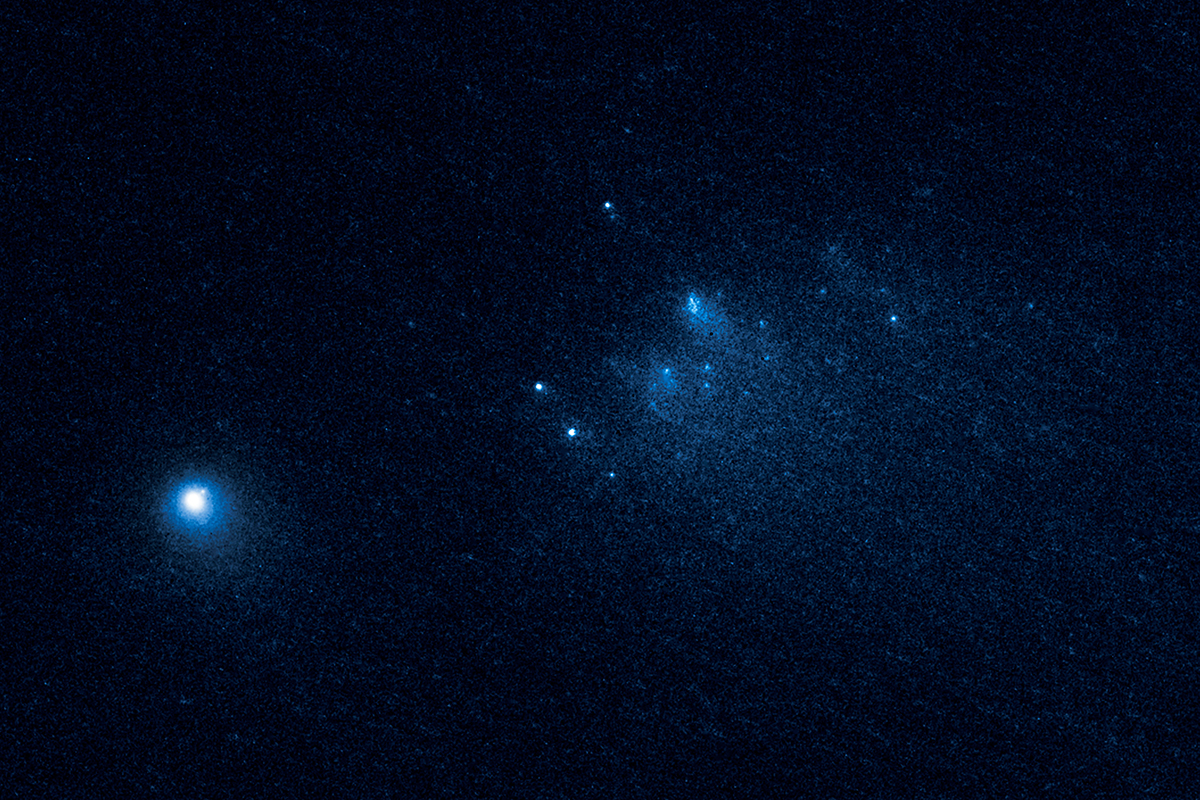
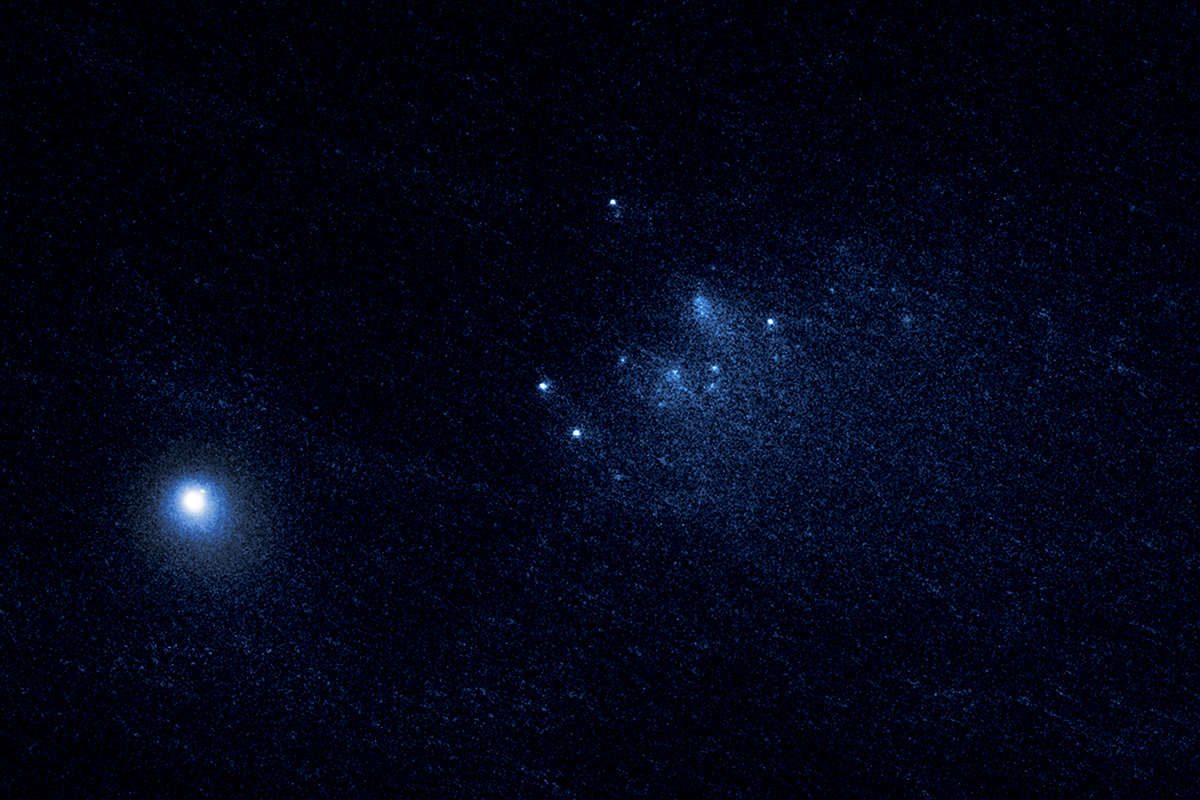
This remarkable image reveals the ancient comet 332P/Ikeya-Murakami in the dramatic process of disintegrating as it approaches the Sun, providing one of the sharpest views ever captured of an icy comet breaking apart. Comets are fragile objects composed of ice, dust, and rocky material left over from the solar system's formation over 4.5 billion years ago. As they venture close to the Sun, solar heating causes their ices to vaporize and internal stresses can tear them apart, especially if they have been weakened by previous passages or structural flaws. The disintegration of 332P offers astronomers a rare opportunity to study the internal structure and composition of these primordial frozen bodies. The fragments visible in this image will continue to drift apart along the comet's orbit, gradually dispersing into space and potentially creating meteor showers if Earth's orbit intersects their debris stream in the future.
Scientific Significance
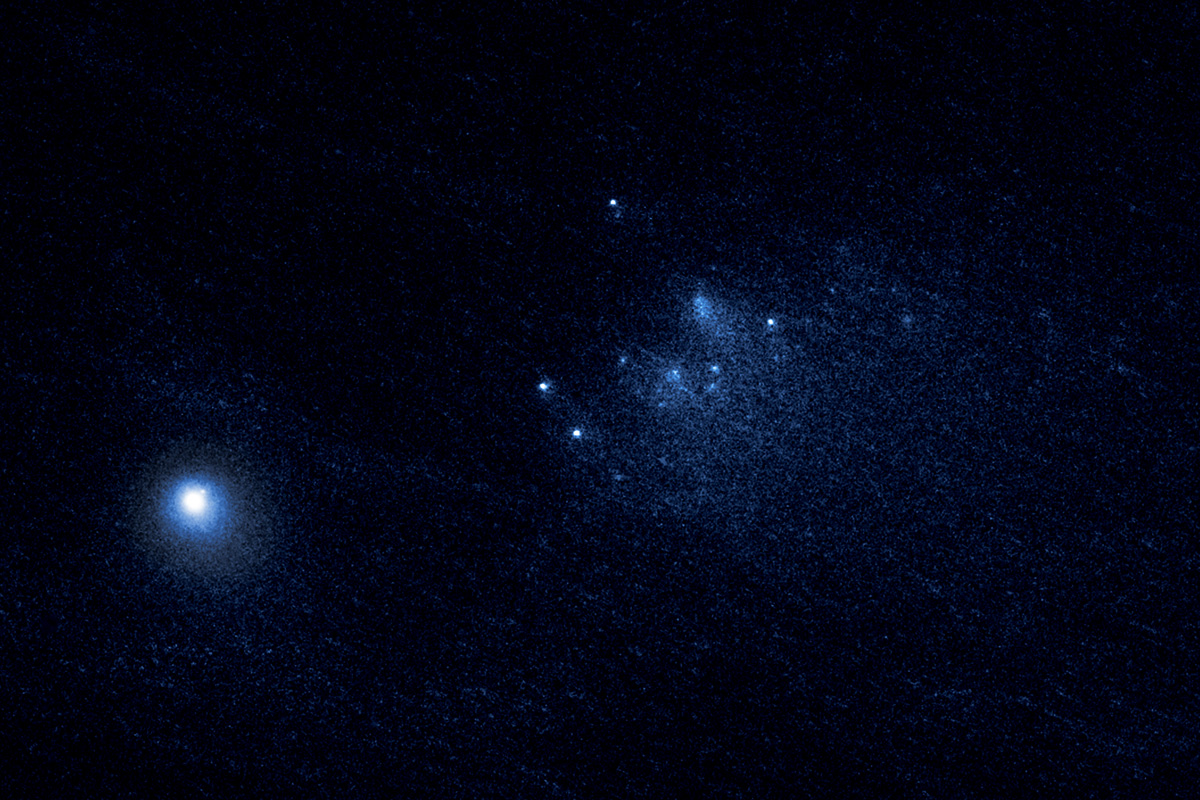
This second perspective on Comet 332P's disintegration complements the primary observation by capturing the evolving fragment field at a different epoch, allowing astronomers to measure how the debris cloud expanded over time. By comparing multiple observations, researchers determined that about 25 fragments were produced during the breakup event, with the largest pieces measuring up to 200 feet across. The time-series data revealed that material was ejected preferentially from the comet's sunward-facing hemisphere, consistent with thermal stress fracturing driven by solar heating. These observations contributed to the broader understanding of how short-period comets lose mass and eventually become extinct, either disintegrating completely or forming dormant, asteroid-like bodies. The study of 332P also informed models of how cometary debris streams form and evolve, which is essential for predicting meteor shower activity and understanding the population of small bodies in the inner solar system.
Observation Details
This follow-up observation was made with Hubble's Wide Field Camera 3 (WFC3) at a different point in the comet's orbit compared to the January 26 image, capturing the fragment field after additional dispersal time. The telescope tracked the comet's non-sidereal motion to keep the fragments sharp while background stars trailed. Multiple exposures were combined to increase signal-to-noise and reveal the faintest fragments. Photometric measurements of individual fragments allowed astronomers to estimate their sizes and albedos, while astrometric analysis of their positions relative to the main nucleus provided velocity measurements that constrained the ejection mechanism.
Location in the Universe
Constellation
N/A (Solar System)
Distance from Earth
150 million miles (at time of observation)
Fun Facts
- 1
This alternate view of Comet 332P captures a different phase of its disintegration, showing how the fragment field evolved over time as pieces drifted apart along the comet's orbital path at just a few miles per hour.
- 2
Comets like 332P originate from the Kuiper Belt, a vast region of icy bodies beyond Neptune, and are nudged into the inner solar system by gravitational interactions with the giant planets over millions of years.
- 3
The total amount of material shed by Comet 332P during its observed breakup would fill roughly 15 Olympic swimming pools — a tiny fraction of the comet's original mass but enough to create a spectacular debris trail.
Image credit: NASA, ESA, Hubble Space Telescope