About This Image
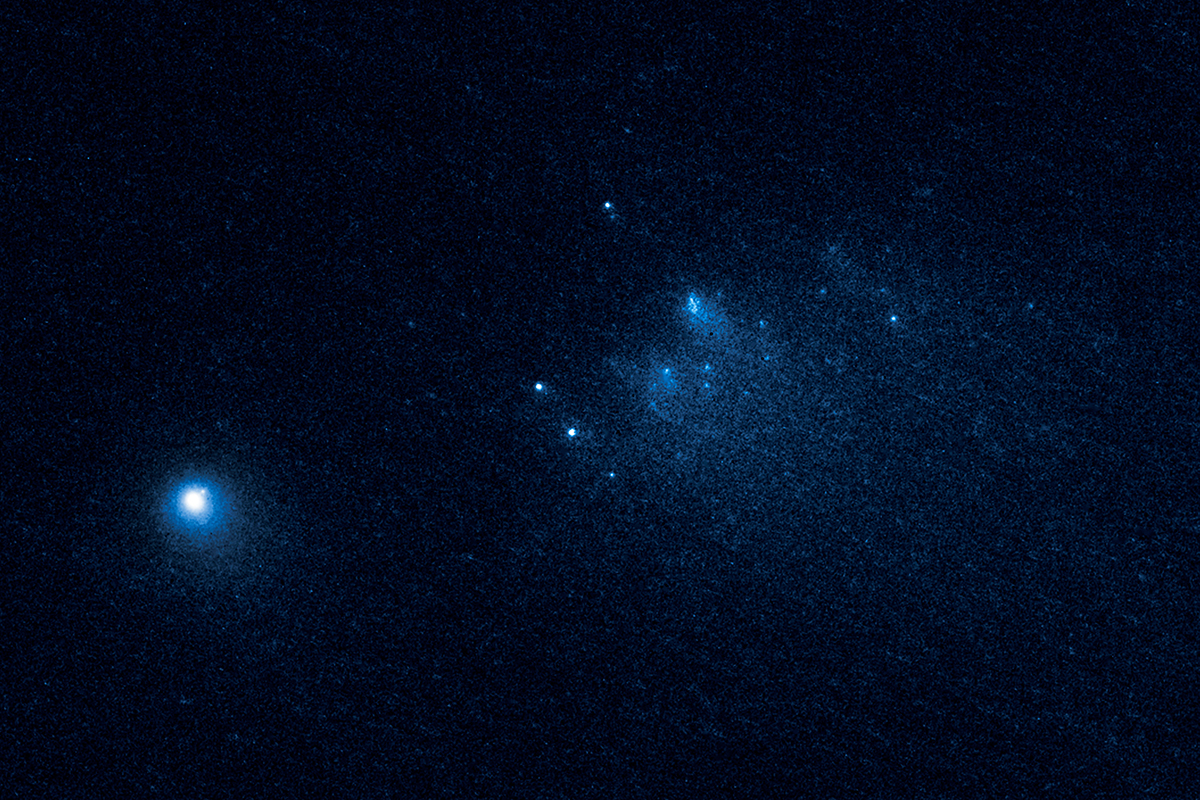
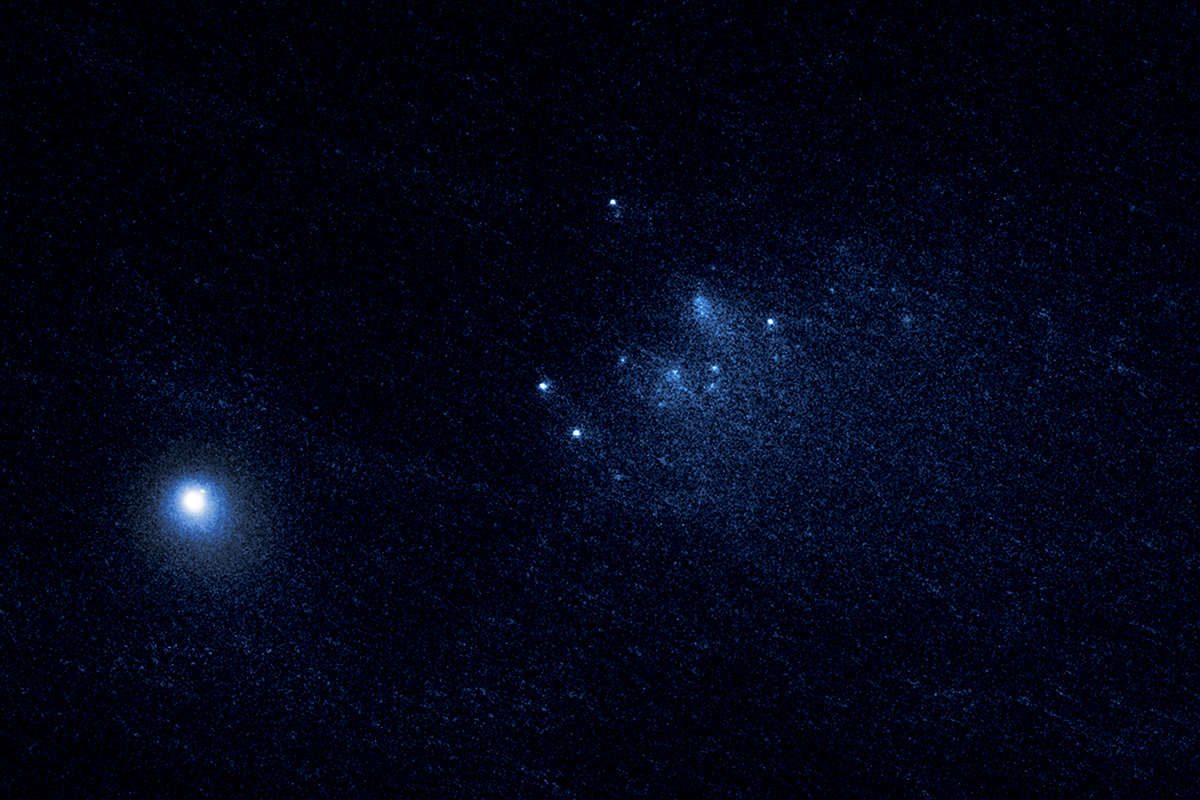
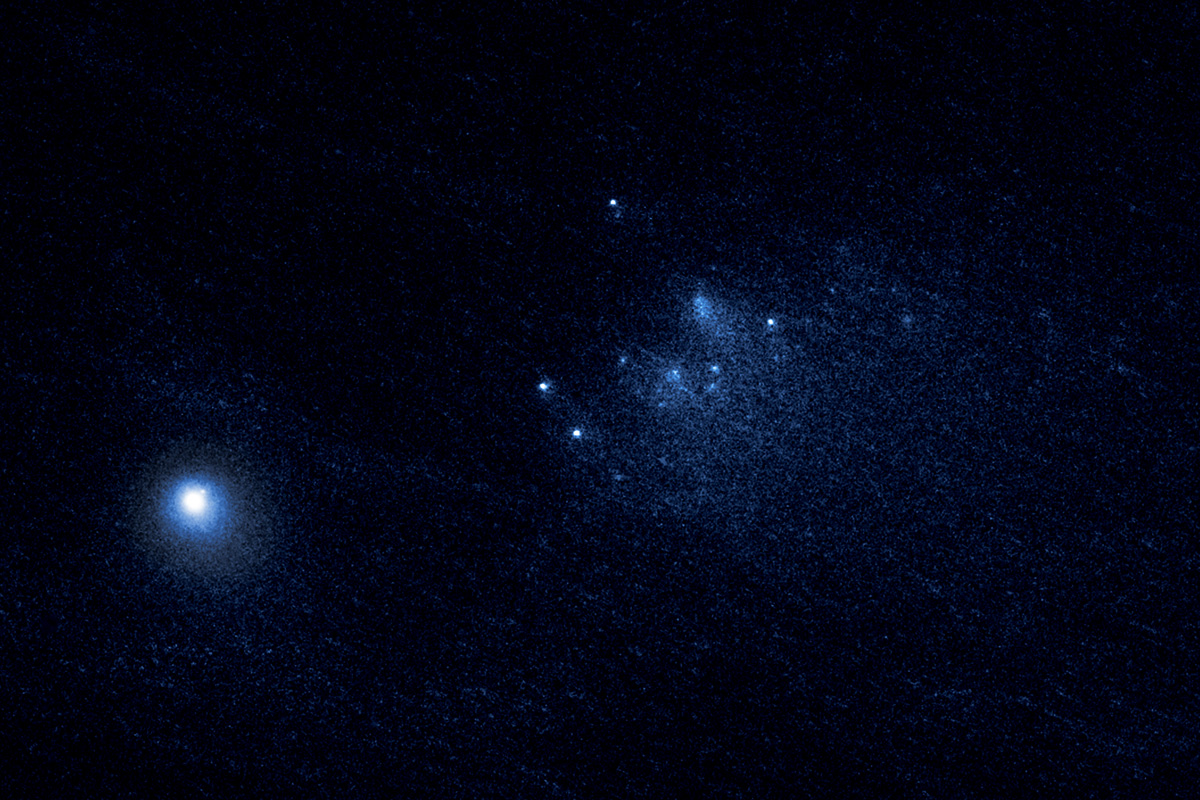
This extraordinary image reveals the ancient comet 332P/Ikeya-Murakami disintegrating as it approached the Sun in 2016, capturing one of the most detailed views of a comet's catastrophic breakup. The comet debris field consists of building-size chunks of primordial ice and rock near the center of the image, each fragment representing a piece of material that has remained virtually unchanged since the solar system's formation 4.5 billion years ago. The bright object at lower left is the main nucleus of the comet, the largest remaining piece of the original body. As solar heating weakened the comet's structure, it shattered into dozens of fragments that now drift along its orbital path. This disintegration event provides astronomers with an unprecedented opportunity to study the internal composition and structural properties of these ancient icy wanderers, revealing clues about the conditions in the early solar nebula and the building blocks that formed our planetary system.
Scientific Significance
This debris field view of Comet 332P/Ikeya-Murakami provides the most detailed look at the aftermath of a cometary disintegration event ever captured by a space telescope. The spatial distribution and size range of the fragments offer direct evidence for the rubble-pile model of cometary nuclei, which proposes that comet cores are not solid monolithic bodies but rather loosely bound aggregates of smaller icy and rocky pieces held together by weak self-gravity and cohesive forces. The observation that fragments were produced in discrete batches rather than a continuous spray suggests that the nucleus has a layered or heterogeneous internal structure, with zones of varying strength and volatile content. This finding has profound implications for planetary defense strategies, as understanding whether hazardous objects are solid or loosely bound rubble piles determines whether deflection techniques such as kinetic impactors or gravity tractors would be effective. The chemical analysis of the debris also revealed pristine water ice and carbon-rich compounds dating back to the solar system's formation.
Observation Details
This wide-field image was obtained with Hubble's Wide Field Camera 3 (WFC3) and captures both the main nucleus and the extended debris trail in a single frame. The telescope was guided at the comet's rate of motion to keep the fragments sharp while allowing background stars to trail. The image required careful processing to separate the faint fragment signals from the diffuse coma — the hazy envelope of gas and dust surrounding the comet. Color information was derived from observations through multiple broadband filters, allowing astronomers to assess the dust composition and particle sizes within the debris field. The positions of fragments were measured with sub-pixel precision to determine their ejection velocities and reconstruct the timeline of the breakup sequence.
Location in the Universe
Constellation
N/A (Solar System)
Distance from Earth
150 million miles (at time of observation)
Fun Facts
- 1
The debris field shown in this image stretches across roughly 3,000 miles of space — about the distance from New York to London — yet each individual fragment is only the size of a house or small building.
- 2
Comet 332P was originally discovered independently by two Japanese amateur astronomers, Kaoru Ikeya and Shigeki Murakami, in 2010, demonstrating that amateur astronomers continue to make significant contributions to solar system science.
- 3
The main nucleus visible at lower left has lost an estimated 4% of its total mass during this single breakup event, suggesting the comet could completely disintegrate within just 25 more orbits around the Sun.
Image credit: NASA, ESA, Hubble Space Telescope