About This Image
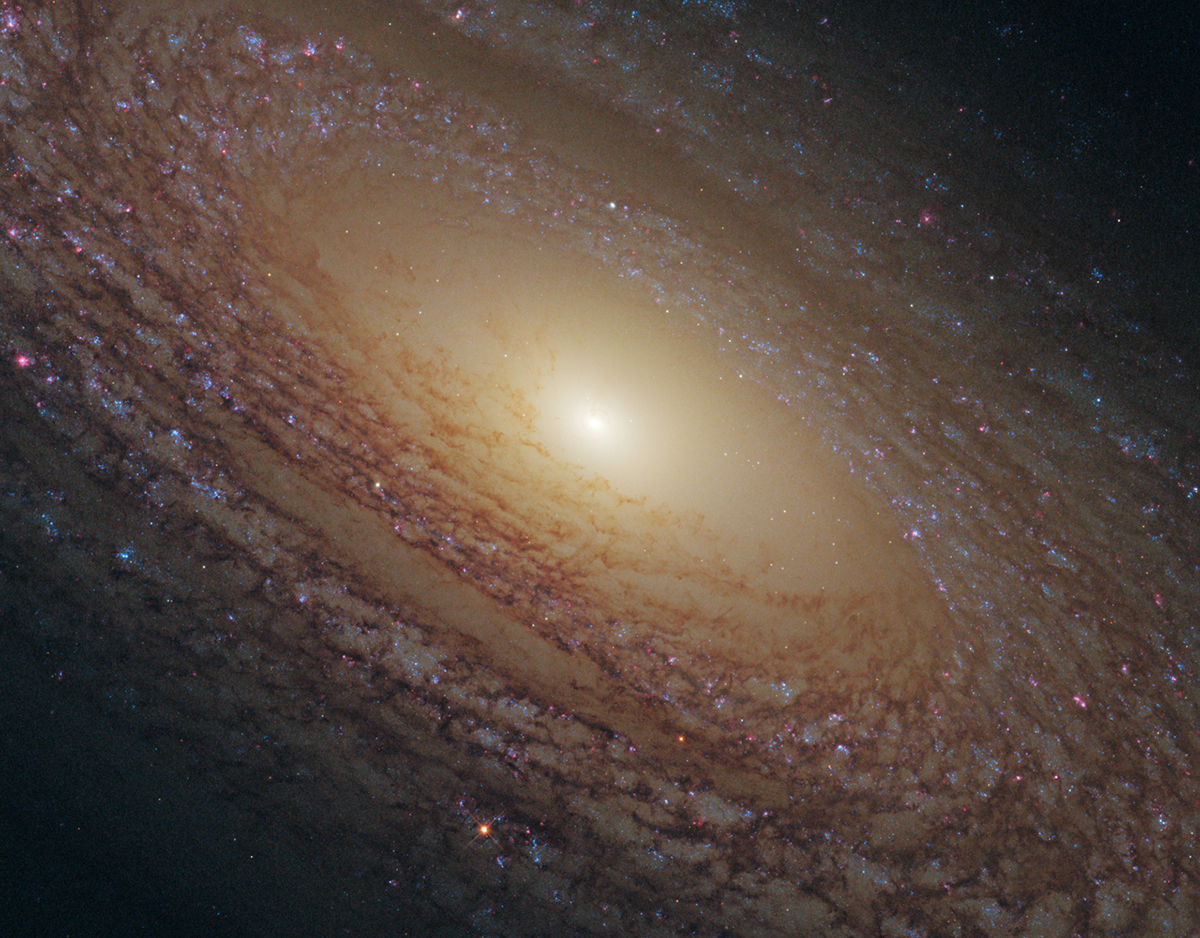
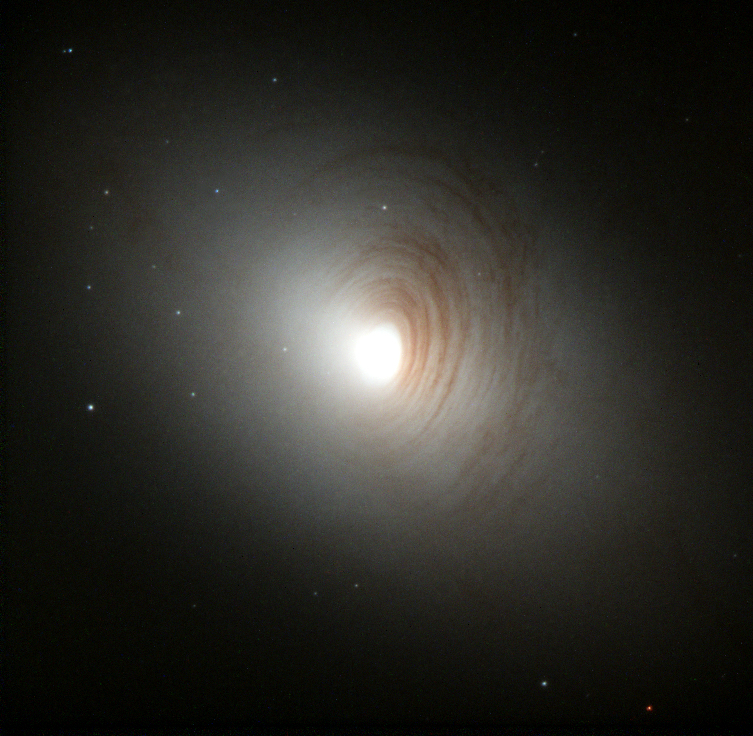
Galaxy NGC 2787 is located 24 million light-years from Earth in the constellation Ursa Major, the celestial home of the Big Dipper. This unique galaxy displays dramatic arms of dark dust that encircle its bright, luminous center like cosmic ribbons, creating a striking contrast between the dusty lanes and the brilliant stellar core. The dust lanes trace the galaxy's spiral structure and mark regions where future generations of stars may form. Scattered throughout and around the galaxy are numerous points of light representing globular clusters—huge, ancient collections of hundreds of thousands to millions of old stars bound tightly together by gravity. These globular clusters orbit the galaxy in a spherical halo and are among the oldest objects in the universe, containing stars that formed over 10 billion years ago. NGC 2787's combination of dust lanes and globular clusters provides astronomers with insights into both ongoing galactic evolution and ancient stellar populations.
Scientific Significance
NGC 2787 is a key object for understanding the evolutionary transition between spiral and elliptical galaxies. Lenticular galaxies represent a morphological halfway point — they retain the disk structure of spirals but have exhausted or lost most of their gas, causing star formation to slow dramatically or cease entirely. The prominent dust lanes in NGC 2787 are particularly intriguing because they suggest that some cold gas and dust remain, possibly acquired through a minor merger with a gas-rich companion galaxy. The galaxy's supermassive black hole, with its well-measured mass, contributes to the fundamental relationship between black hole mass and host galaxy properties, helping calibrate the scaling laws that govern galaxy and black hole co-evolution. The rich system of globular clusters surrounding NGC 2787 provides age and metallicity constraints that trace the galaxy's assembly history, revealing whether it formed through a single monolithic collapse or through the gradual accumulation of smaller stellar systems over billions of years.
Observation Details
Hubble imaged NGC 2787 using the Wide Field and Planetary Camera 2 (WFPC2) in multiple visible-light filters, revealing the intricate dust lane structure with exquisite clarity. The high angular resolution was essential for resolving individual globular clusters in the galaxy's halo, which appear as compact, slightly fuzzy points of light distinct from foreground stars. Spectroscopic observations of the galaxy's central region measured stellar velocities within the inner few hundred light-years, providing the kinematic evidence for the supermassive black hole. The dust lanes were analyzed using color maps that compared the galaxy's appearance in blue and red filters, allowing astronomers to map the distribution and optical depth of the obscuring dust.
Location in the Universe
Constellation
Ursa Major
Distance from Earth
24 million light-years
Fun Facts
- 1
NGC 2787 is classified as a barred lenticular galaxy (SB0), placing it in the transitional zone between spiral and elliptical galaxies — it has a disk and dust lanes like a spiral but has largely stopped forming new stars like an elliptical.
- 2
The galaxy harbors a supermassive black hole at its center with an estimated mass of about 41 million times that of our Sun, detected through the high-speed orbital motion of stars near the galactic nucleus.
- 3
NGC 2787's dust rings are remarkably well-organized and concentric, resembling the grooves of a vinyl record, which is unusual for lenticular galaxies and suggests a past interaction or merger event that funneled gas into these orderly structures.
Image credit: NASA, ESA, Hubble Space Telescope