About This Image
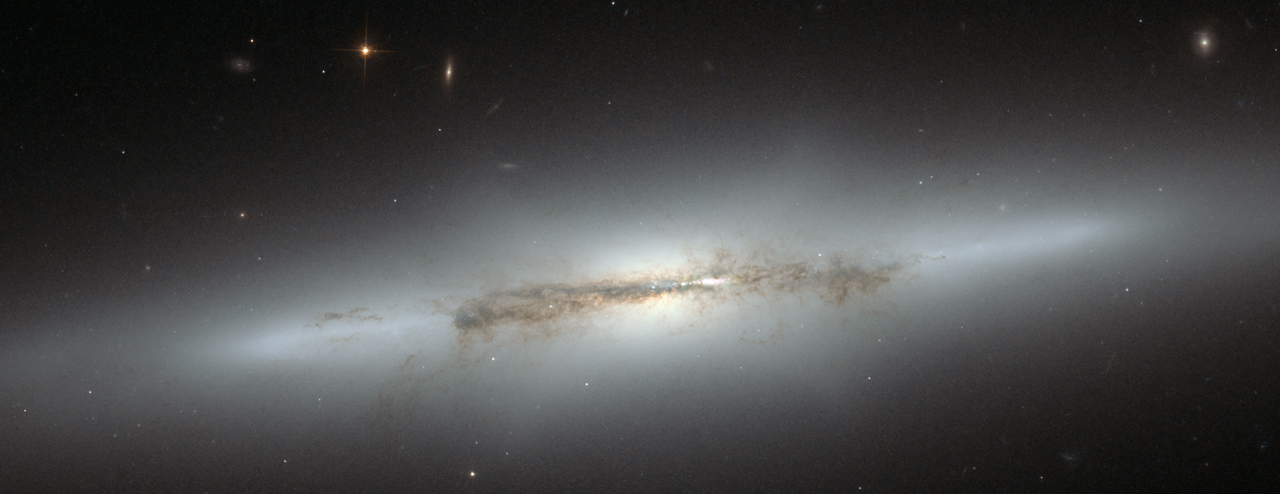
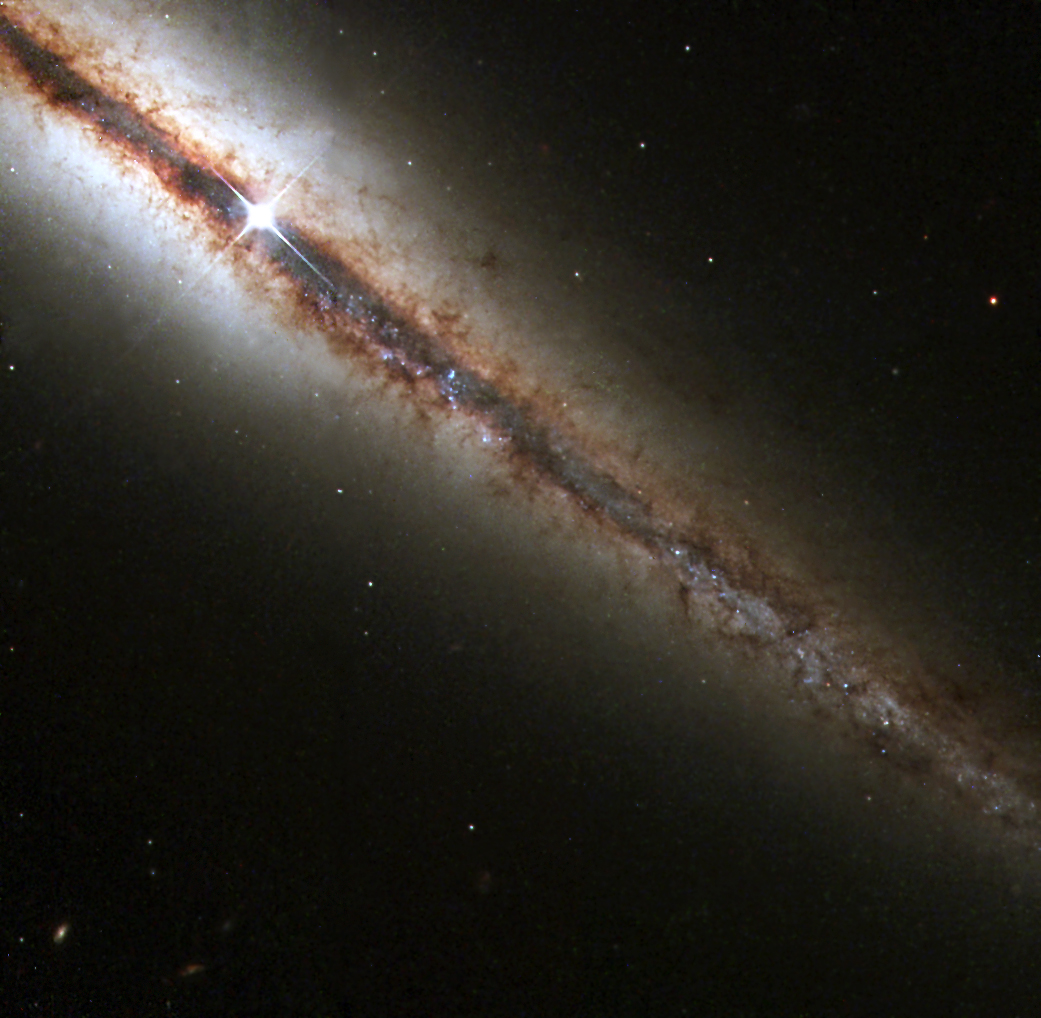
A striking dark band of dust dramatically bisects the spiral galaxy NGC 4013 in this edge-on view, creating a sharp division that reveals the galaxy's flattened disk structure. Located 55 million light-years away in the constellation Ursa Major, home to the Big Dipper, NGC 4013 presents itself to us nearly perfectly edge-on, offering astronomers a unique perspective to study the vertical structure and dust distribution within spiral galaxies. The prominent dust lane running along the galaxy's midplane appears as an opaque ribbon, blocking the light from stars behind it and highlighting the concentration of interstellar material in the galactic plane. This orientation allows scientists to examine how dust, gas, and stars are distributed at different heights above and below the disk, providing insights into galactic dynamics, magnetic fields, and the processes that maintain the thin structure of spiral galaxy disks over billions of years.
Scientific Significance
Edge-on spiral galaxies like NGC 4013 are critically important for understanding the three-dimensional structure of disk galaxies, including our own Milky Way. Because we live inside the Milky Way's disk, we cannot easily study its vertical structure from our embedded perspective, but edge-on galaxies like NGC 4013 provide a clear cross-sectional view. Hubble's observations have revealed the detailed layering of stellar populations at different heights above the galactic midplane — young stars and dust concentrated in the thin disk, while older stars form a thicker, more extended component. The discovery of a stellar tidal stream around NGC 4013 provided compelling evidence that galaxies grow through the accretion and disruption of smaller satellite galaxies, a key prediction of the hierarchical model of galaxy formation. Studies of the dust lane's opacity and extent have also contributed to our understanding of interstellar dust grain properties and the cycle of material between stars and the interstellar medium.
Observation Details
Hubble captured this image using the Wide Field and Planetary Camera 2 (WFPC2) in multiple visible-light filters. The edge-on orientation made it possible to measure the scale height of the galaxy's thin and thick disk components by analyzing how stellar light intensity decreases with distance from the midplane. Deep exposures revealed the faint stellar tidal stream extending beyond the galaxy's main body, requiring careful subtraction of scattered light and background contamination. The dust lane's properties were characterized by comparing the galaxy's brightness on either side of the midplane, allowing astronomers to estimate the total dust mass and grain size distribution.
Location in the Universe
Constellation
Ursa Major
Distance from Earth
55 million light-years
Fun Facts
- 1
NGC 4013 possesses a faint stellar stream — a ribbon of stars torn from a smaller galaxy that was gravitationally shredded as it was absorbed — wrapping around the galaxy like a cosmic scarf, providing direct evidence of galactic cannibalism.
- 2
If you could view NGC 4013 face-on instead of edge-on, it would likely resemble our own Milky Way, with prominent spiral arms and a central bar structure hidden behind the dust lane.
- 3
The dust lane in NGC 4013 is so dense that it blocks virtually all visible light from stars behind it, yet infrared telescopes can peer through this dust curtain to reveal the hidden stellar populations on the far side of the galaxy.
Image credit: NASA, ESA, Hubble Space Telescope