About This Image
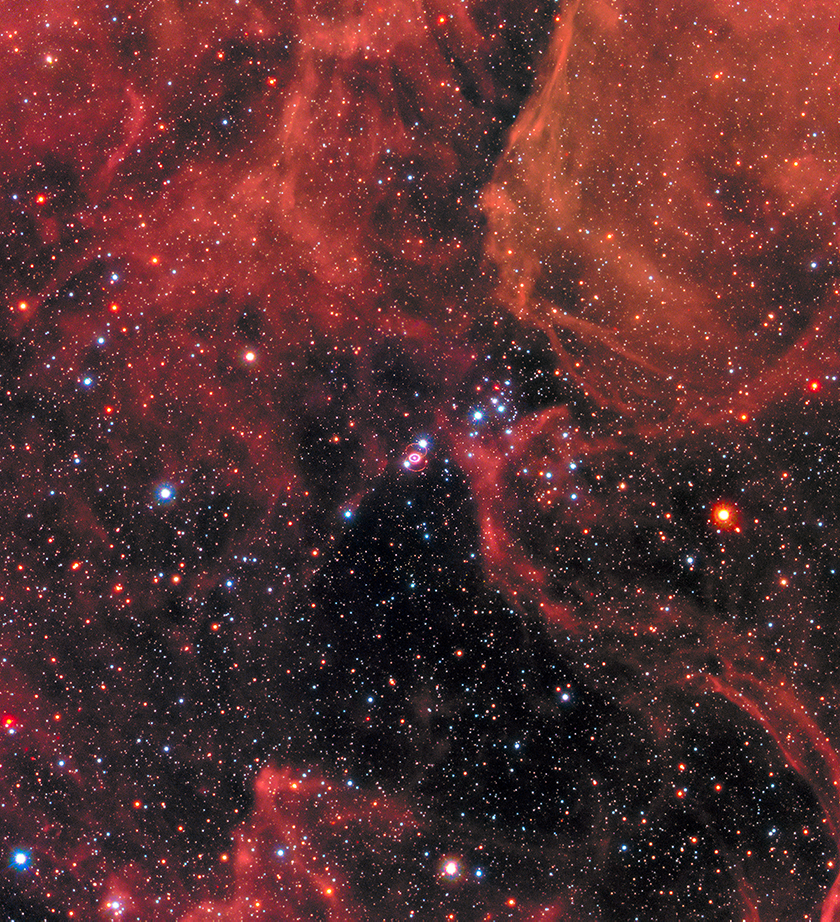
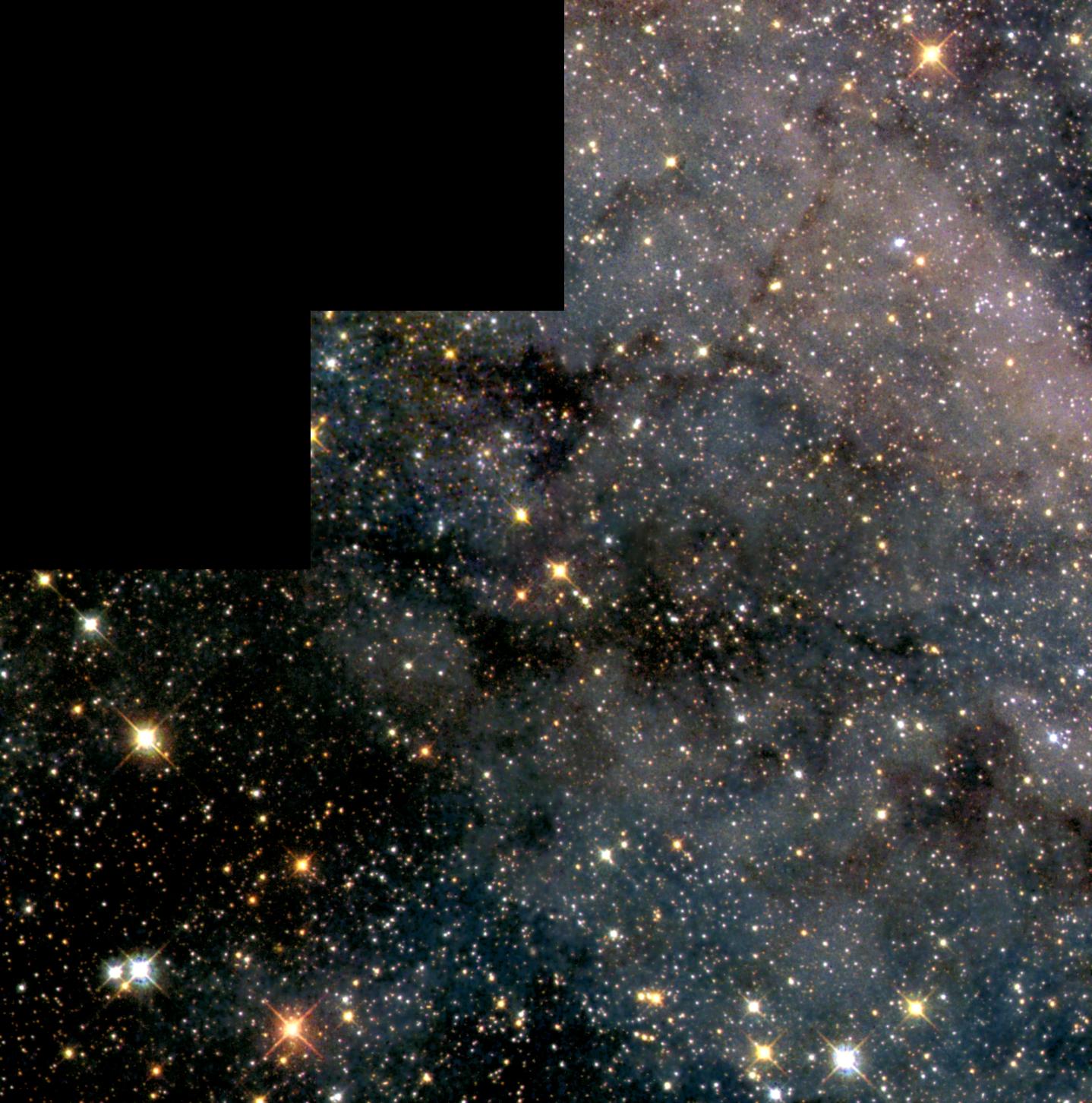
Over 10,000 stars appear in this breathtaking stellar census, which covers a region about 130 light-years wide in the Large Magellanic Cloud, a nearby dwarf galaxy that orbits our Milky Way at a distance of approximately 160,000 light-years. This dense concentration of stars represents just a tiny fraction of the hundreds of millions of stars in the LMC, yet it showcases the incredible resolving power of Hubble's optics. The faintest stars visible in this image are some 100 million times dimmer than what the human eye can detect, pushing the boundaries of astronomical observation and revealing stellar populations that would otherwise remain hidden. The variety of star colors and brightnesses in this field reflects different stellar masses, ages, and evolutionary stages, from young, hot blue stars to cooler, older red stars. This stellar tapestry provides astronomers with invaluable data for studying stellar evolution, galactic structure, and the star formation history of our galactic neighbor.
Scientific Significance
Deep stellar surveys of the Large Magellanic Cloud like this one are fundamental to our understanding of stellar evolution. Because all stars in this field are at essentially the same distance from Earth, differences in their apparent brightness directly correspond to differences in their intrinsic luminosity, simplifying the analysis enormously. This allows astronomers to construct precise color-magnitude diagrams — the stellar equivalent of a population census — that reveal the star formation history of the LMC over billions of years. The data shows distinct episodes of enhanced star formation, possibly triggered by past interactions between the LMC and the Milky Way or its companion, the Small Magellanic Cloud. Furthermore, the LMC's lower metallicity compared to the Milky Way provides a different chemical environment for studying how stellar evolution processes vary with composition, offering insights applicable to galaxies throughout the universe.
Observation Details
This image was captured using Hubble's Wide Field and Planetary Camera 2 (WFPC2) in multiple optical filters spanning ultraviolet to red wavelengths. The combination of filters allowed astronomers to determine the temperature and luminosity of each resolved star, enabling detailed color-magnitude diagram analysis. The exceptional angular resolution of Hubble was critical for resolving individual stars in this crowded field where ground-based telescopes would see only a blurred glow. Long exposure times were required to detect the faintest dwarf stars at the bottom of the main sequence.
Location in the Universe
Constellation
Dorado / Mensa
Distance from Earth
160,000 light-years
Fun Facts
- 1
The faintest stars in this image are 100 million times dimmer than what the naked eye can see — equivalent to spotting a birthday candle on the Moon from Earth.
- 2
The Large Magellanic Cloud is visible to the naked eye from the Southern Hemisphere and was named after explorer Ferdinand Magellan, whose crew documented it during their 1519 circumnavigation of the globe.
- 3
The LMC is on a collision course with the Milky Way and will merge with our galaxy in approximately 2.4 billion years — well before the Andromeda collision expected in 4.5 billion years.
Image credit: NASA, ESA, Hubble Space Telescope