About This Image
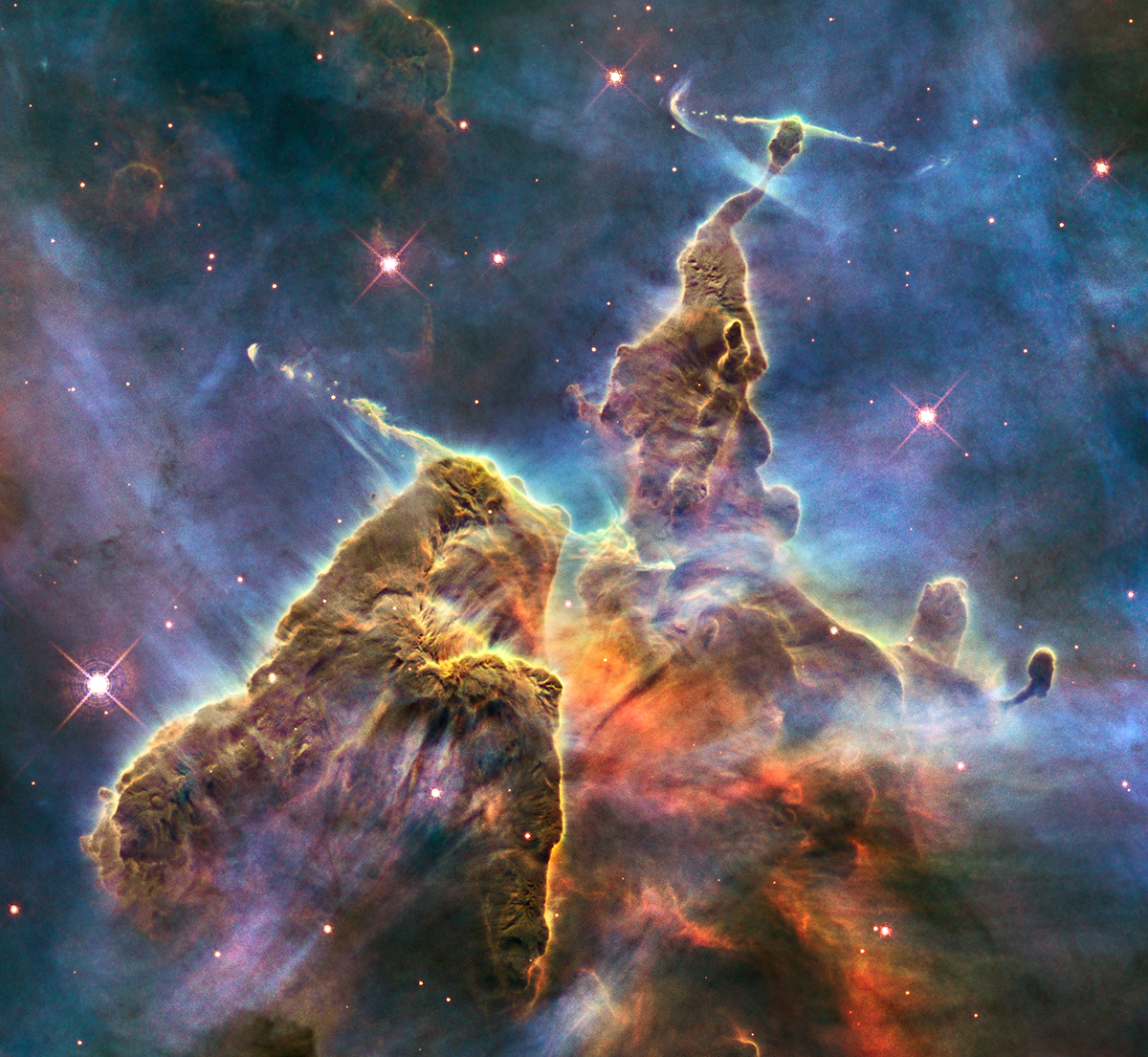
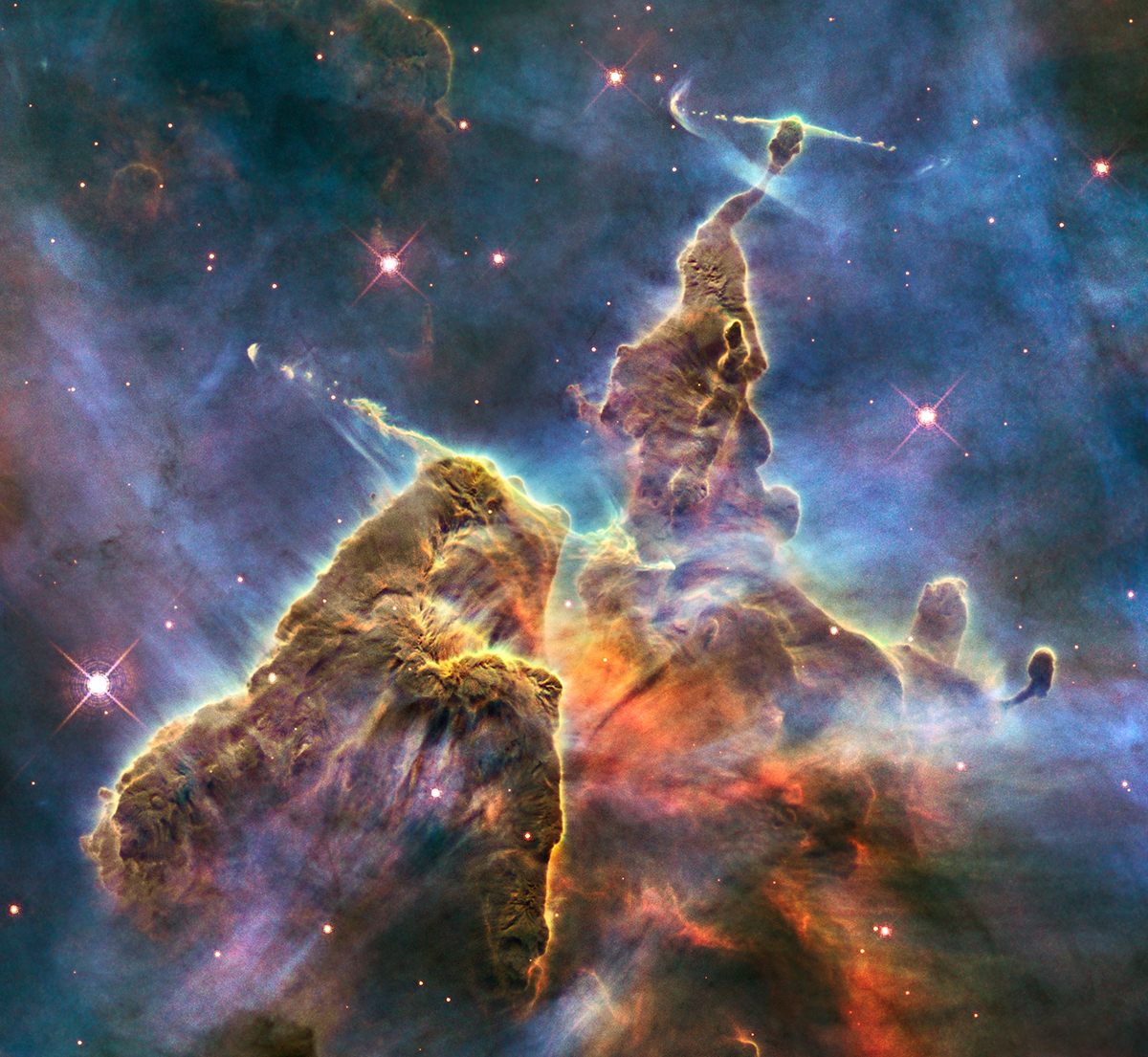
These cosmic pinnacles lie within a tempestuous stellar nursery called the Carina Nebula, one of the largest and brightest nebulae in the southern sky. Towering columns of cool hydrogen gas and dust rise like skyscrapers against a backdrop of glowing, superheated gas. Infant stars buried deep inside the pillars fire off powerful jets of gas that stream away from the towering peaks, carving dramatic shapes into the surrounding material. The intense ultraviolet radiation and fierce stellar winds from nearby massive stars, particularly the luminous and unstable Eta Carinae, are slowly eroding these pillars from the outside in. Yet within their dense interiors, gravity continues to pull gas together, giving birth to new generations of stars. This dynamic interplay between stellar creation and destruction makes the Carina Nebula one of the most scientifically rich regions in our galaxy, offering astronomers a front-row seat to the processes that shape stellar nurseries throughout the universe.
Scientific Significance
The Carina Nebula pillars represent one of the most dramatic examples of triggered star formation observable in our galaxy. The process at work here — where radiation and winds from massive stars compress nearby gas clouds, causing them to collapse and form new stars — is a key mechanism in understanding how star formation propagates through giant molecular clouds. These pillars are analogous to the famous 'Pillars of Creation' in the Eagle Nebula but are being sculpted by far more energetic forces due to the presence of some of the most massive stars in the Milky Way. Detailed study of these structures reveals how the interstellar medium transitions from diffuse gas to dense, star-forming cores. The Carina Nebula also serves as a nearby analog for the extreme star-forming environments found in starburst galaxies, making it a critical benchmark for understanding star formation across cosmic scales.
Observation Details
This image was captured using Hubble's Wide Field Camera 3 (WFC3) in both visible and infrared light. The visible-light observations reveal the glowing ionized gas and dark dust lanes that define the pillar structures, while infrared imaging penetrates the dusty outer layers to reveal embedded protostars and young stellar objects hidden within. Multiple narrowband filters isolated specific emission lines from hydrogen, sulfur, and oxygen, allowing astronomers to map the physical conditions and chemical composition throughout the pillars.
Location in the Universe
Constellation
Carina
Distance from Earth
7,500 light-years
Fun Facts
- 1
The Carina Nebula spans roughly 300 light-years across, making it about four times larger than the more famous Orion Nebula — yet it is far less well known because it is only visible from the Southern Hemisphere.
- 2
The pillars in this image are being sculpted by the radiation of Eta Carinae, one of the most massive and luminous stars known, which is expected to explode as a supernova within the next few hundred thousand years.
- 3
Some of the jets fired by newborn stars within these pillars extend for several light-years and travel at speeds exceeding 700,000 miles per hour.
Image credit: NASA, ESA, Hubble Space Telescope