About This Image
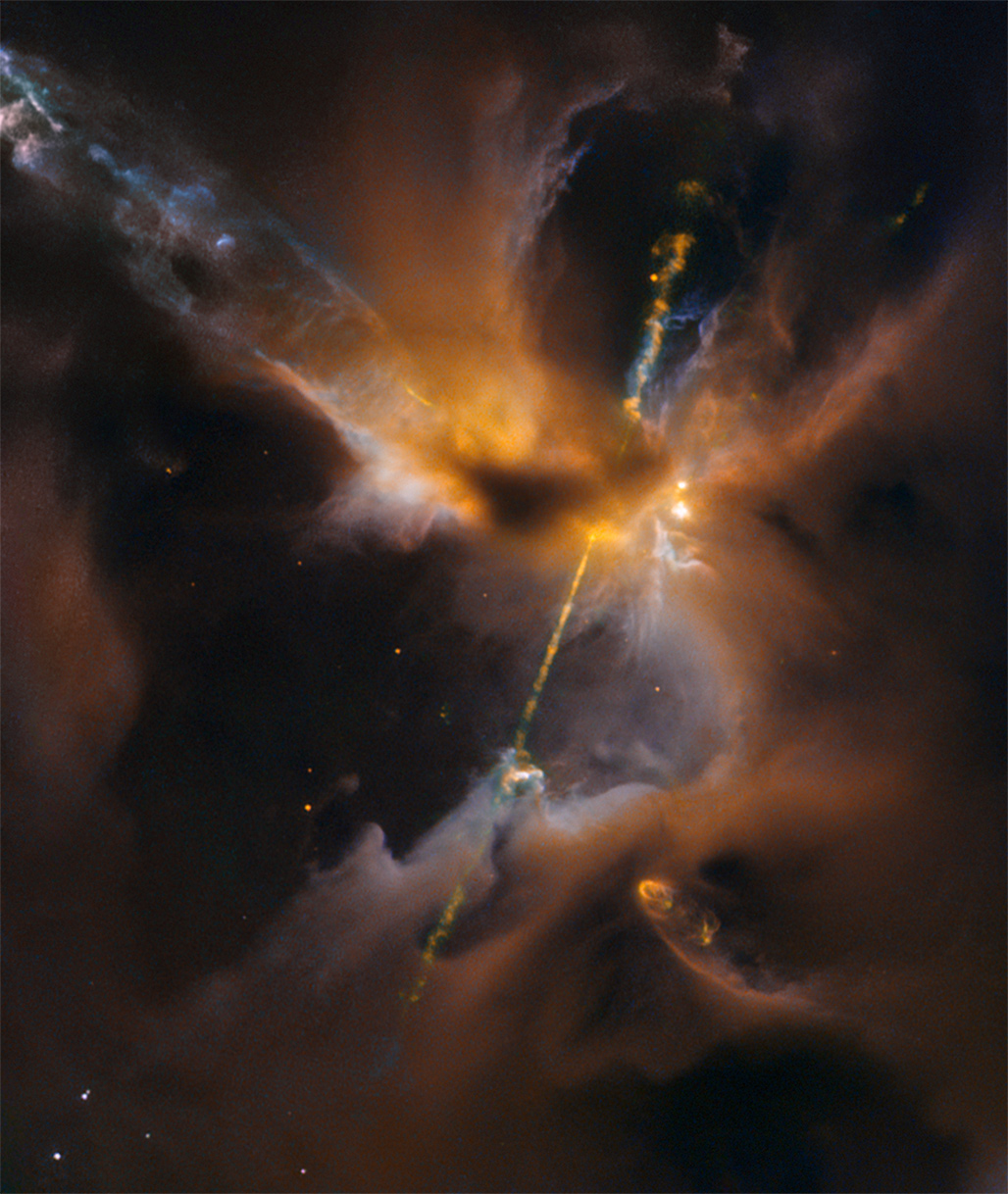
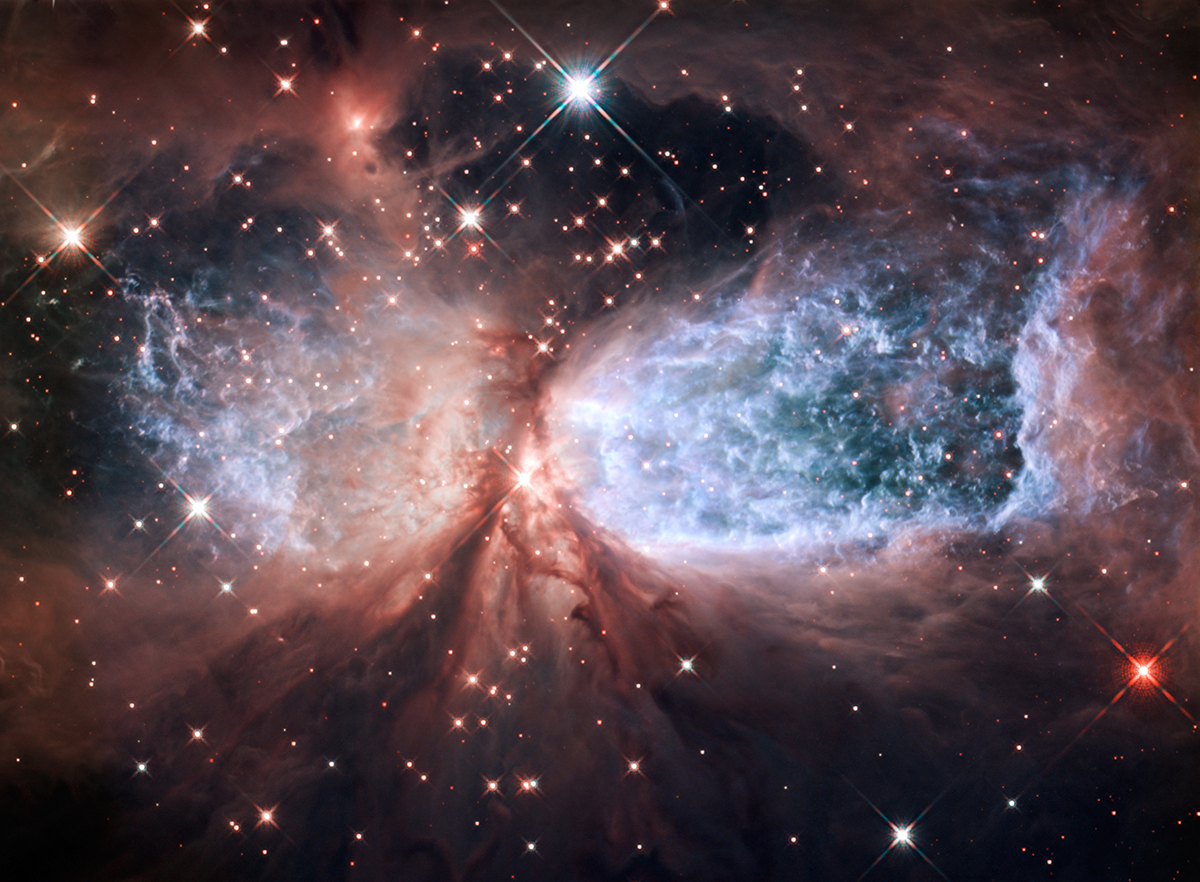
This remarkable star-forming region, called Sharpless 2-106 (S106), bears a striking resemblance to a celestial snow angel with outstretched wings. The "wings" of the nebula are twin lobes of superheated gas, each stretching several light-years outward from a massive, young star called S106 IR near the center of the image. This central star, estimated at roughly 15 times the mass of our Sun, is still in the process of forming and has not yet reached the main sequence — the stable phase of hydrogen fusion that defines a star's adult life. The star's powerful outflow of gas is constricted into two opposing lobes by a dense disk of dust and gas that encircles it like a belt, creating the distinctive bipolar shape. Within the expanding lobes, temperatures reach an estimated 10,000 degrees Celsius, causing the gas to glow brilliantly. The region surrounding S106 also contains hundreds of low-mass brown dwarfs and protostars, making it a remarkably rich nursery hidden within the larger molecular cloud complex in Cygnus.
Scientific Significance
Sharpless 2-106 is one of the best-studied examples of a bipolar HII region, providing key insights into how massive protostars interact with their natal molecular clouds during the final stages of formation. The bipolar morphology demonstrates the critical role that circumstellar disks play in collimating stellar outflows — without the confining disk, the expanding gas would form a spherical bubble rather than two directed lobes. The sharp boundaries of the lobes trace shock fronts where the outflowing gas impacts the ambient molecular cloud at supersonic speeds, heating and compressing the surrounding material. These interactions may trigger additional star formation at the lobe boundaries, creating a positive feedback loop. The rich population of low-mass objects discovered within S106 also challenges models of star formation that predict massive stars should inhibit nearby low-mass star formation, suggesting instead that massive and low-mass stars can form simultaneously in close proximity.
Observation Details
Hubble captured this image using the Wide Field Camera 3 (WFC3) in four infrared filters spanning 1.05 to 1.66 micrometers. Infrared wavelengths were essential for this observation because the dense molecular cloud surrounding S106 is highly opaque at visible wavelengths. The infrared filters penetrate the dust, revealing the central protostar, the hot gas in the bipolar lobes, and hundreds of embedded low-mass stars invisible in optical images. A false-color rendering assigns blue to shorter infrared wavelengths and red to longer wavelengths, highlighting temperature and extinction variations across the field.
Location in the Universe
Constellation
Cygnus
Distance from Earth
2,000 light-years
Fun Facts
- 1
The central star S106 IR is so deeply embedded in dust that it is virtually invisible at optical wavelengths — it was discovered through infrared observations, hence the 'IR' designation in its name.
- 2
The bipolar shape of S106 is created by a disk of dust around the central star that acts like a nozzle, channeling the star's outflow into two opposing jets — similar to how squeezing the middle of a balloon forces air out from both ends.
- 3
Over 600 previously unknown low-mass stars and brown dwarfs were discovered within S106 during infrared surveys, revealing that the 'angel' hides an entire stellar nursery within its wings.
Image credit: NASA, ESA, Hubble Space Telescope