About This Image
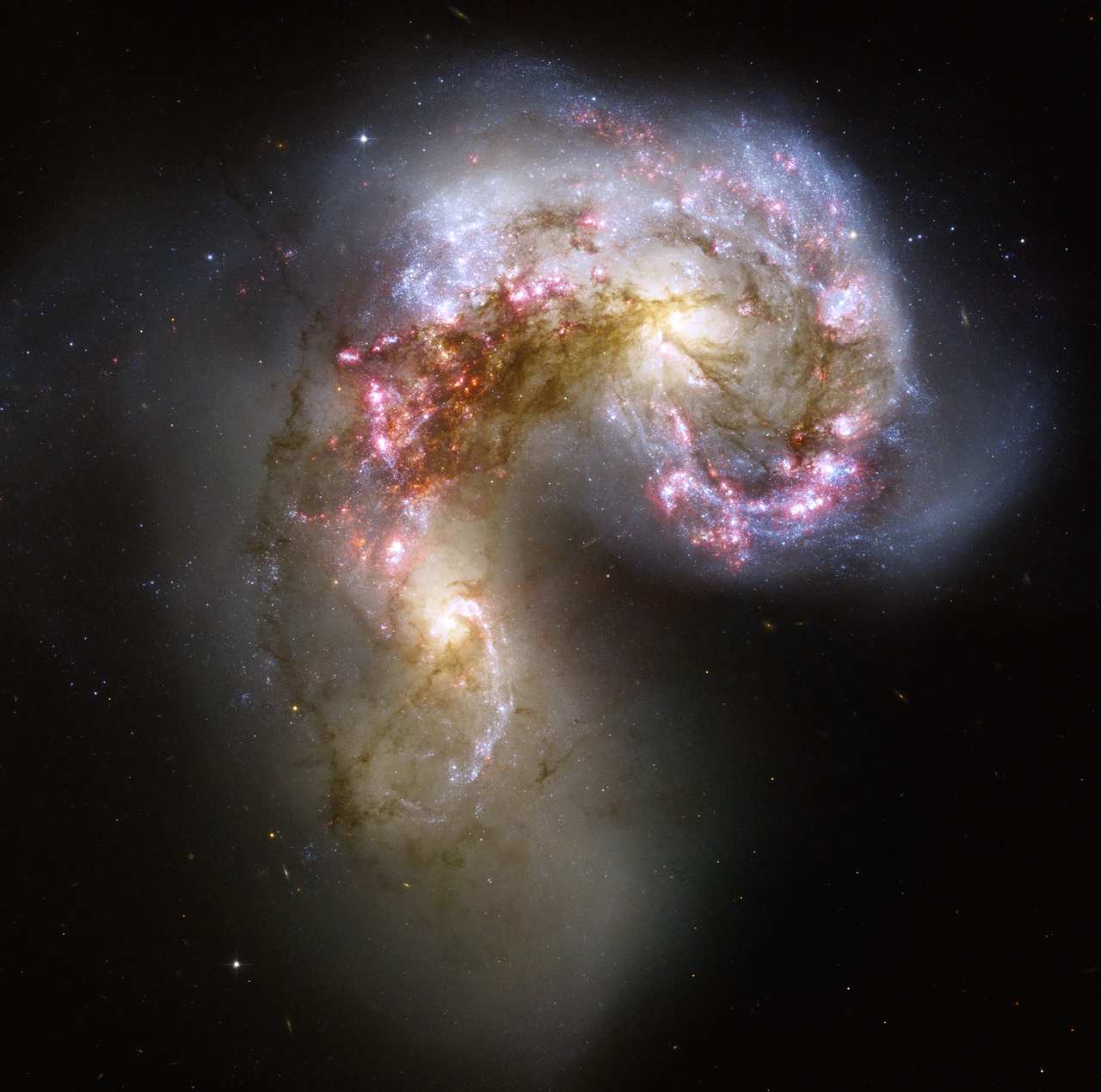
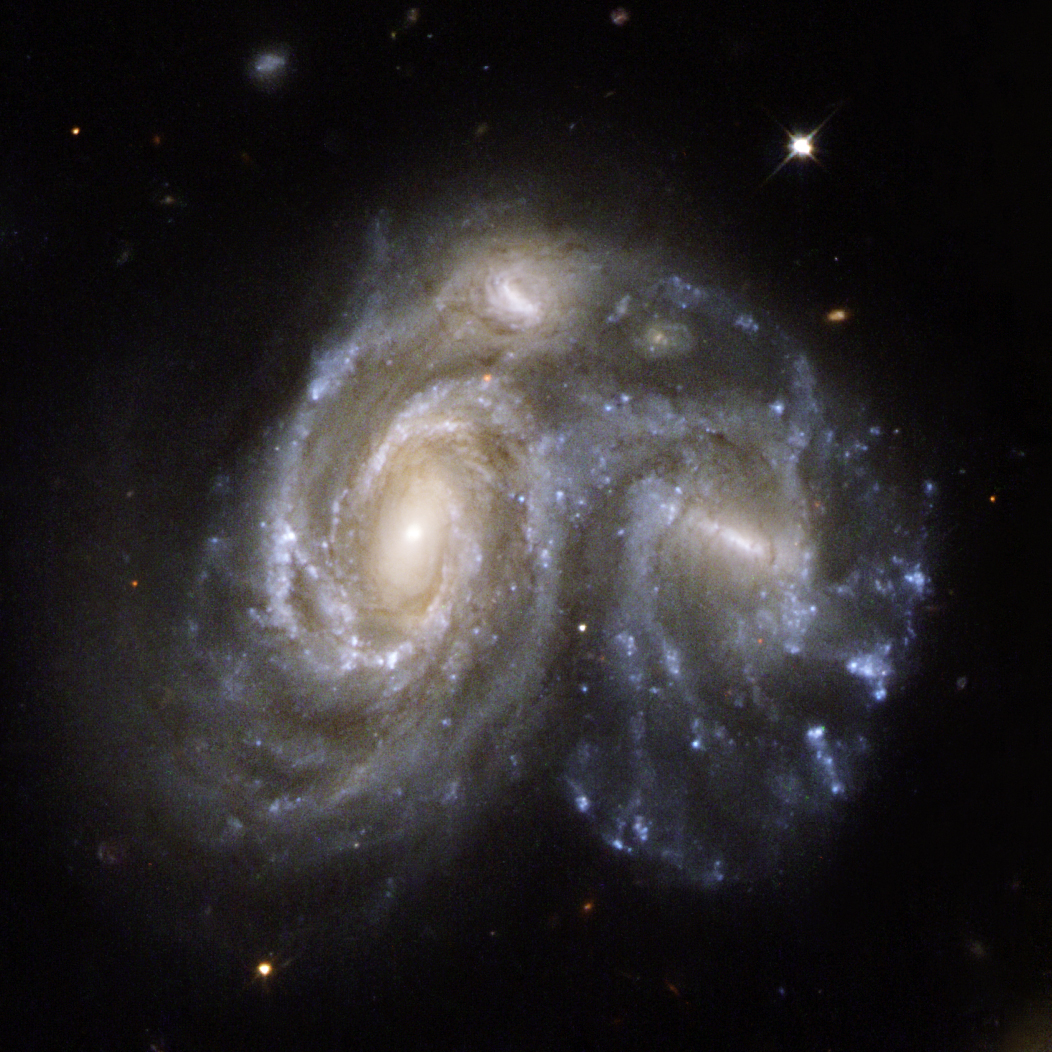
Arp 272 captures a dramatic cosmic embrace between two spiral galaxies — NGC 6050 and IC 1179 — linked by their swirling arms in a gravitational dance that has been unfolding over hundreds of millions of years. Located roughly 450 million light-years from Earth in the constellation Hercules, these interacting galaxies are members of the Hercules Galaxy Cluster (Abell 2151), one of the nearest rich galaxy clusters. As the galaxies draw ever closer together under the pull of mutual gravity, tidal forces stretch and distort their graceful spiral structures, pulling long streamers of stars and gas from each galaxy into a tangled bridge connecting the two. This gravitational interaction triggers bursts of intense star formation as gas clouds in the galaxies' arms are compressed by the tidal forces. The collision will continue for hundreds of millions more years until the two galaxies eventually merge into a single, larger elliptical galaxy — a fate that awaits our own Milky Way when it collides with the Andromeda Galaxy in about 4.5 billion years.
Scientific Significance
Arp 272 provides a valuable snapshot of an intermediate-stage galaxy merger, capturing the transition period after the initial approach but before the final coalescence. This stage is characterized by the formation of tidal tails, bridges of shared material, and enhanced star formation — all visible in this image. By studying systems like Arp 272 at different merger stages, astronomers construct a timeline of how galaxy collisions proceed, from first contact to final merger. The system also provides observational constraints on dark matter halo interactions, as the dark matter halos of the two galaxies overlap and merge on a different timescale than the visible stellar components. The enhanced star formation triggered by the interaction allows measurement of how tidal compression efficiency depends on the geometry and velocity of the encounter. Arp 272's membership in the Hercules Cluster adds the additional dimension of studying how the cluster environment influences the merger process.
Observation Details
Hubble imaged Arp 272 using the Advanced Camera for Surveys (ACS) in multiple broadband filters spanning blue through near-infrared wavelengths. The blue filters highlight the young, hot stars born in the tidally triggered star-forming regions, while redder filters trace the older stellar populations and the dust-reddened galactic disks. The high resolution of Hubble allows individual giant star-forming complexes to be resolved at Arp 272's distance, providing a detailed census of the interaction-triggered stellar birth across both galaxies.
Location in the Universe
Constellation
Hercules
Distance from Earth
450 million light-years
Fun Facts
- 1
Arp 272 gets its name from the Atlas of Peculiar Galaxies compiled by astronomer Halton Arp in 1966 — a catalog of 338 unusual galaxies that looked 'wrong' compared to normal spiral and elliptical shapes.
- 2
Despite the dramatic appearance of galactic collisions, individual stars almost never physically collide because the distances between stars are so vast — it would be like two swarms of bees passing through each other without touching.
- 3
The Hercules Cluster containing Arp 272 is unusual among galaxy clusters because it contains a higher than expected proportion of spiral and interacting galaxies, suggesting it is a relatively young, still-assembling cluster.
Image credit: NASA, ESA, Hubble Space Telescope