About This Image
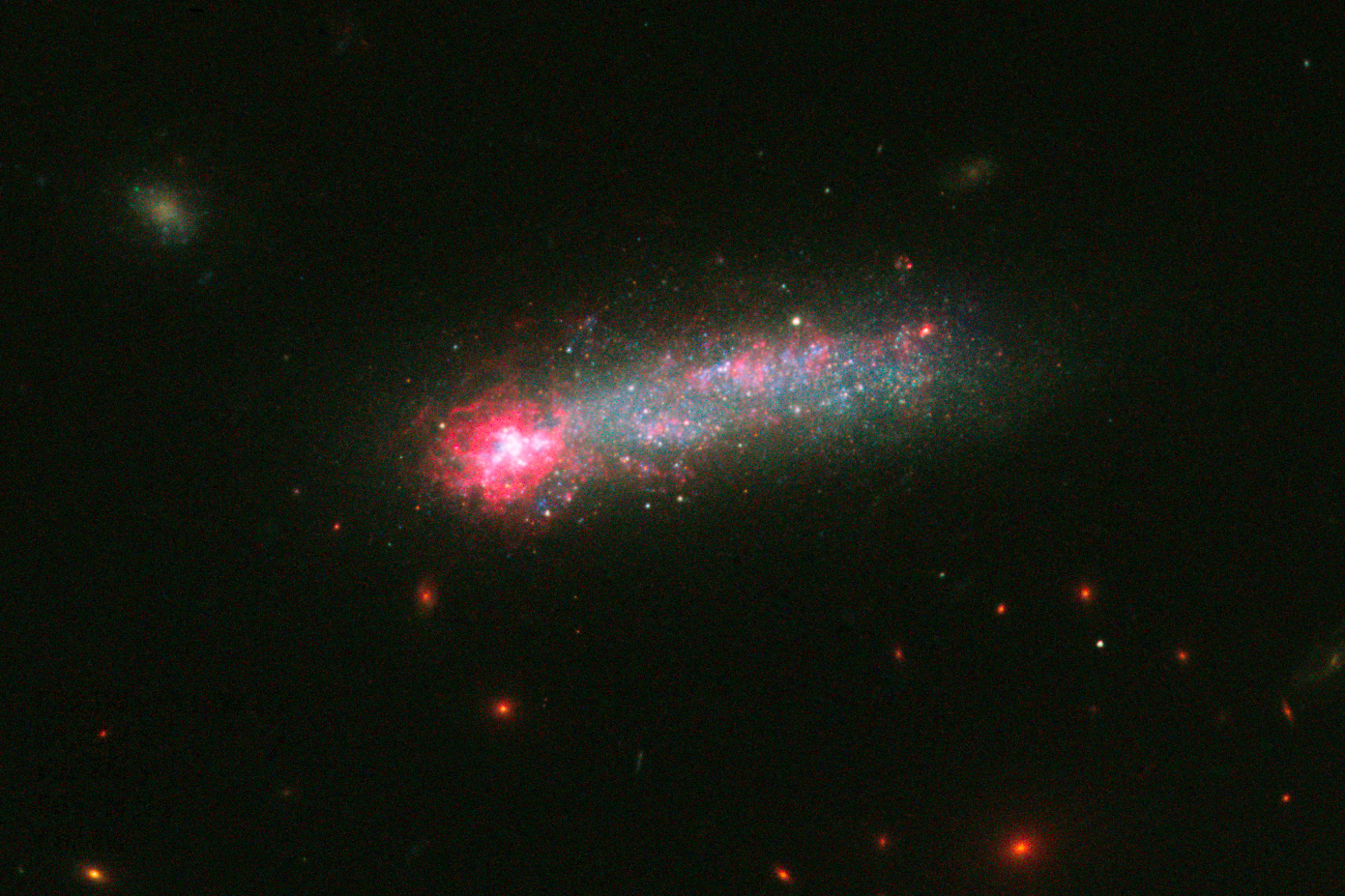
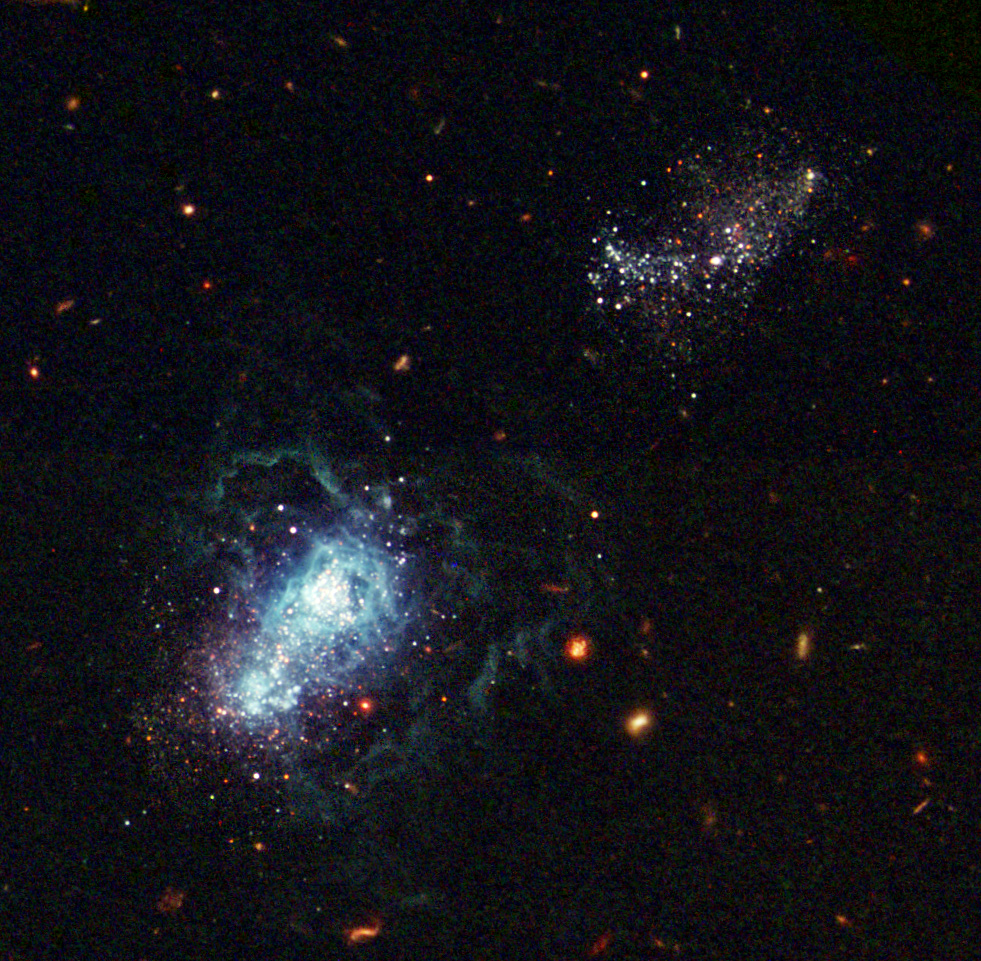
This image captures the irregular dwarf galaxy I Zwicky 18, a genuinely puzzling object that has challenged astronomers' understanding of galaxy evolution since its discovery. Located alongside a companion galaxy visible to its upper right, I Zwicky 18 has one of the lowest metallicities (abundance of elements heavier than helium) of any known galaxy, suggesting that its gas is nearly as pristine as the primordial material that existed shortly after the Big Bang. The two galaxies are interacting gravitationally, and this interaction has triggered vigorous bursts of star formation in I Zwicky 18, evidenced by the brilliant blue knots of newly formed massive stars embedded in its irregular structure. For decades, astronomers debated whether I Zwicky 18 was the youngest galaxy in the nearby universe, having only recently begun forming stars. However, deep Hubble observations eventually revealed a faint population of old red giant stars lurking beneath the dazzling young star clusters, proving the galaxy is actually billions of years old but has somehow managed to retain most of its primordial, unprocessed gas throughout cosmic history.
Scientific Significance
I Zwicky 18 is one of the most important nearby laboratories for studying star formation under conditions resembling the early universe. Its extremely low metallicity means that cooling processes, dust formation, and chemical enrichment pathways differ fundamentally from those in metal-rich galaxies like the Milky Way, providing observational constraints on how the first galaxies formed stars. The discovery of old red giant stars by Hubble resolved a long-standing debate by proving that I Zwicky 18 is not a truly young galaxy, but rather one that has experienced intermittent, widely separated bursts of star formation interspersed with long quiescent periods. This episodic star formation history, combined with the galaxy's extremely low metallicity, suggests that I Zwicky 18 is remarkably inefficient at converting its gas into stars and retaining the metals produced. Understanding why some galaxies remain chemically unevolved over billions of years is a key question in galaxy formation theory.
Observation Details
Hubble observed I Zwicky 18 using the Wide Field and Planetary Camera 2 (WFPC2) and later the Advanced Camera for Surveys (ACS) in deep broadband imaging that reached magnitudes sufficient to resolve individual red giant branch stars — a critical measurement for determining the galaxy's age. The detection of these old stars required extremely long exposures totaling many orbits because the red giants are intrinsically faint and the galaxy is more distant than initially estimated. Narrowband hydrogen-alpha imaging revealed the spatial distribution of ionized gas and active star-forming regions across the galaxy.
Location in the Universe
Constellation
Ursa Major
Distance from Earth
59 million light-years
Fun Facts
- 1
I Zwicky 18 has an oxygen abundance only about 2% of the Sun's, making its gas composition remarkably similar to the pristine material that formed the very first stars after the Big Bang.
- 2
The galaxy is named after Swiss-American astronomer Fritz Zwicky, who was also the first scientist to propose the existence of dark matter based on his observations of galaxy cluster motions in the 1930s.
- 3
Despite being only about 3,000 light-years across — roughly 30 times smaller than the Milky Way — I Zwicky 18 has produced star-forming bursts so intense that they outshine many galaxies many times its size.
Image credit: NASA, ESA, Hubble Space Telescope