About This Image
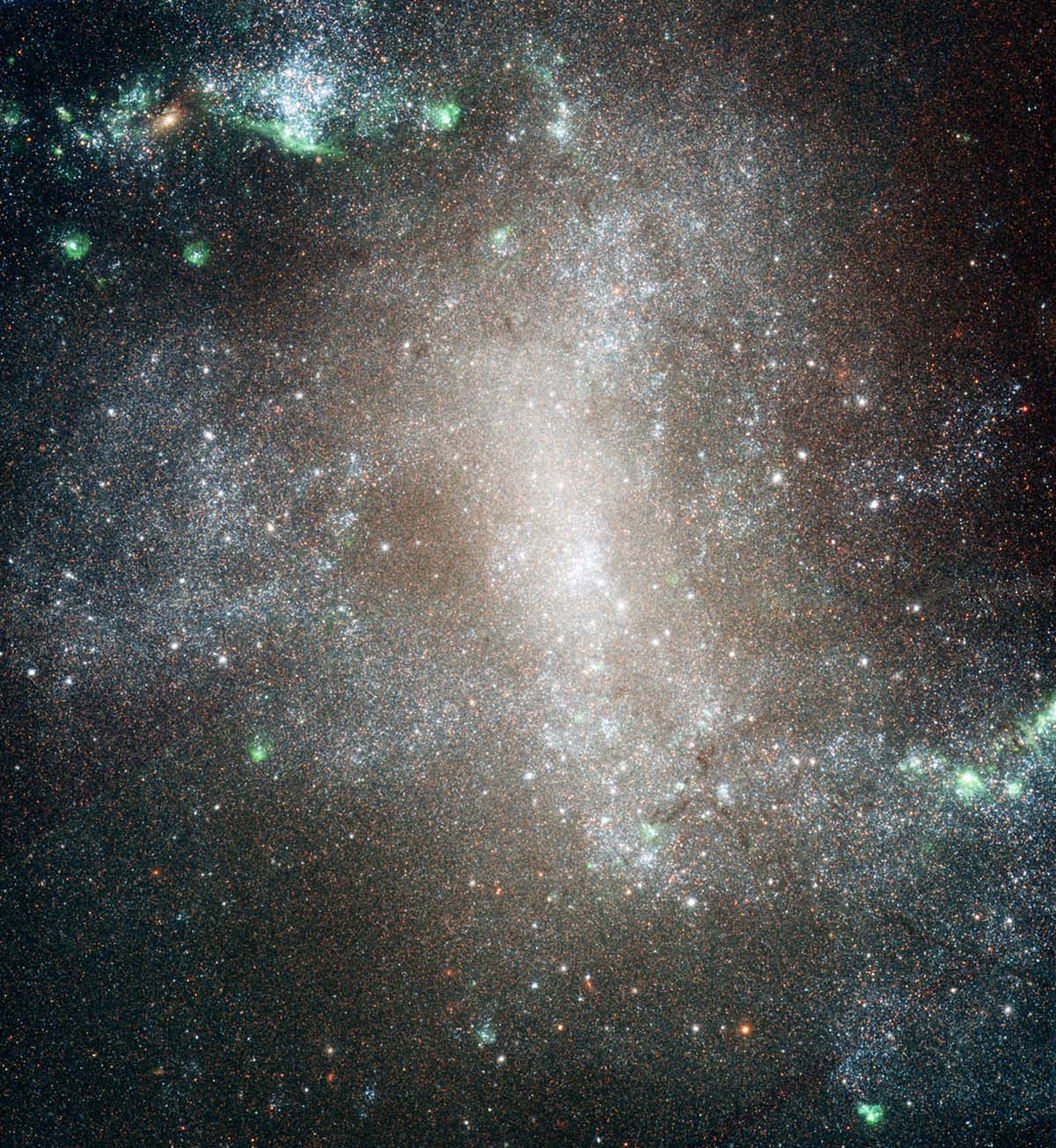
This detailed Hubble image resolves individual stars in the central region of the barred spiral galaxy NGC 1313, a vigorously star-forming galaxy located roughly 14 million light-years away in the southern constellation Reticulum. NGC 1313 is classified as a starburst galaxy, meaning it is forming stars at an exceptionally high rate compared to typical spiral galaxies. The image reveals a chaotic tapestry of blue star clusters, pink hydrogen emission regions, and dark dust lanes winding through the galactic center. Unlike the neatly organized spiral arms of galaxies like the Milky Way, NGC 1313's structure appears somewhat disheveled and irregular, with star-forming regions scattered throughout rather than confined to well-defined spiral arms. This disorganized appearance may be the result of a past gravitational interaction with another galaxy or the internal effects of the intense star formation itself, whose collective energy output of supernovae and stellar winds can stir and disturb the interstellar medium. NGC 1313 also harbors two ultraluminous X-ray sources, mysterious objects whose extreme X-ray luminosities suggest they may contain intermediate-mass black holes.
Scientific Significance
NGC 1313 is a critically important galaxy for understanding starburst activity and the relationship between star formation and galactic structure. Its proximity allows Hubble to resolve individual massive stars and star clusters, providing a detailed census of the stellar populations fueling the starburst. The galaxy's two ultraluminous X-ray sources are among the best-studied examples of these enigmatic objects, which may represent an entirely new class of black holes intermediate in mass between stellar-mass black holes and supermassive black holes found in galactic centers. Understanding ULXs in NGC 1313 constrains theories of black hole formation and growth. The galaxy's starburst activity, combined with its apparently isolated environment, challenges models that require galaxy interactions or mergers to trigger enhanced star formation, suggesting that internal processes alone — such as bar-driven gas inflows — can sustain vigorous star formation in some galaxies.
Observation Details
Hubble imaged NGC 1313 using the Advanced Camera for Surveys (ACS) in broadband filters spanning blue through near-infrared wavelengths. The ACS observations resolved individual bright stars and compact star clusters at the galaxy's distance, enabling construction of color-magnitude diagrams for different regions of the galaxy. Narrowband hydrogen-alpha observations mapped the distribution of HII regions and quantified the current star formation rate. The observations were coordinated with Chandra X-ray Observatory imaging to study the environments of the ultraluminous X-ray sources in multi-wavelength context.
Location in the Universe
Constellation
Reticulum
Distance from Earth
14 million light-years
Fun Facts
- 1
NGC 1313 contains two ultraluminous X-ray sources (ULXs) that each outshine the total X-ray output of most entire galaxies — these may be powered by black holes with masses between 100 and 10,000 times that of the Sun.
- 2
Despite its relatively small size, NGC 1313 is forming stars at a rate roughly three times higher than the Milky Way, making it a cosmic overachiever in stellar production.
- 3
NGC 1313 appears to be a truly isolated galaxy with no significant neighbors, making its disturbed structure all the more puzzling — whatever disrupted its orderly spiral pattern came from within or from a long-past interaction.
Image credit: NASA, ESA, Hubble Space Telescope