About This Image
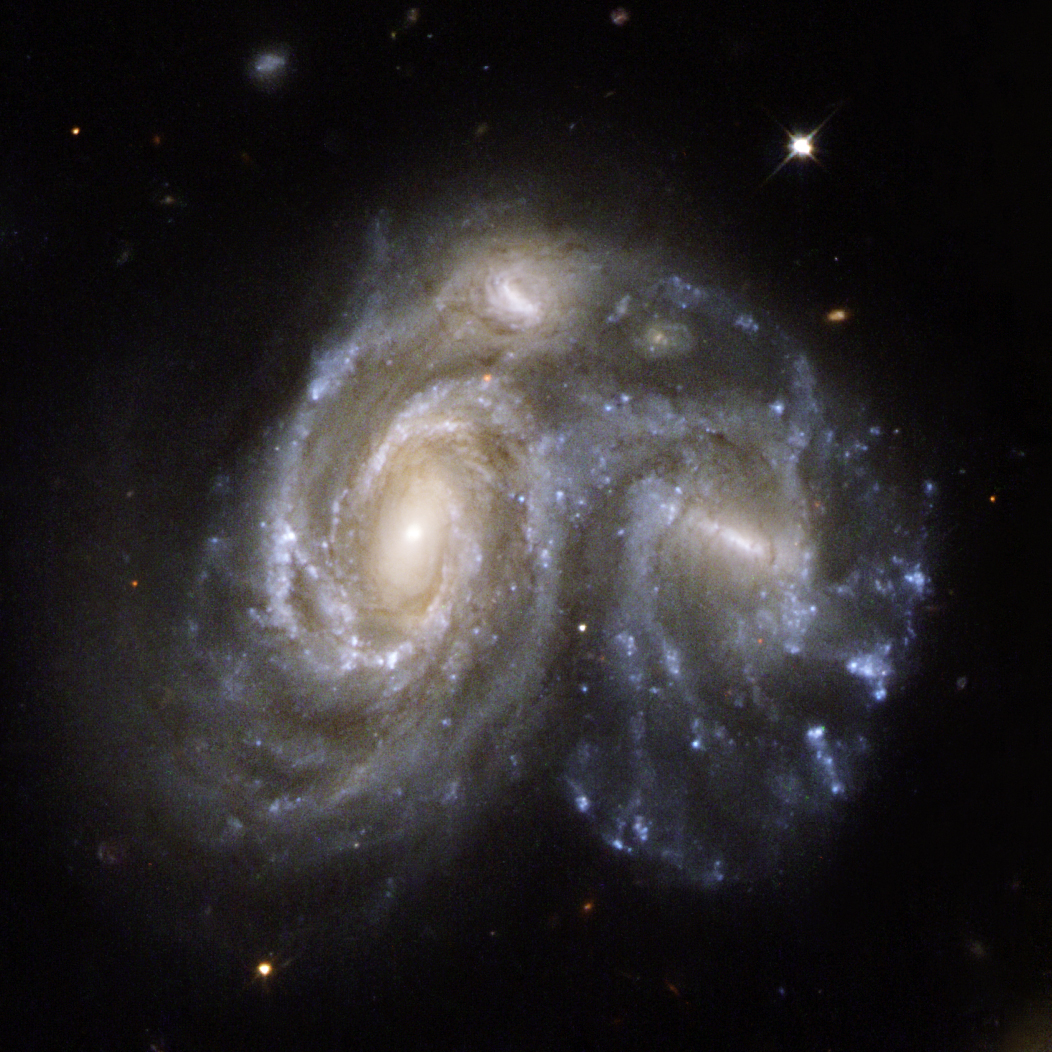
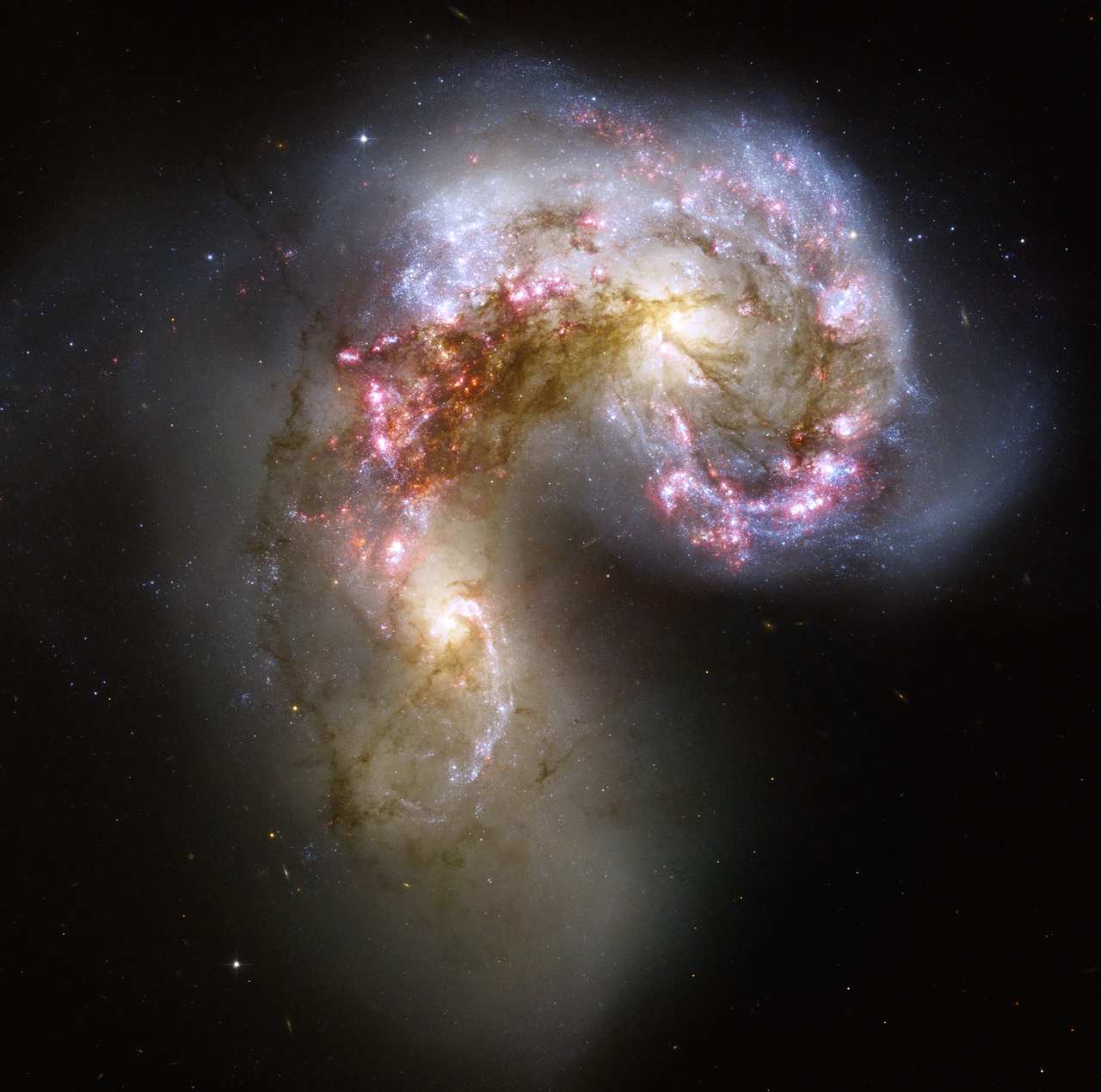
The Antennae Galaxies (NGC 4038 and NGC 4039) are two former spiral galaxies locked in a spectacular cosmic collision that began only a few hundred million years ago — a relatively recent event in astronomical terms. This breathtaking Hubble image reveals the chaos and beauty of the ongoing merger in exquisite detail, from the bright blue clusters of newborn stars ignited by the collision to the dark filaments of dust that wind through the disturbed galactic disks. The galaxies get their evocative name from the two long, arching tails of stars, gas, and dust flung outward by gravitational tidal forces — tails that resemble the antennae of an insect when seen in wider-field images. Over the course of this merger, which will continue for several hundred million more years, billions of new stars will be born as gas clouds from both galaxies collide and compress. The Antennae are the nearest and youngest example of a pair of colliding galaxies, making them the definitive laboratory for studying how galactic mergers trigger intense episodes of star formation.
Scientific Significance
The Antennae Galaxies are the most extensively studied example of a galaxy merger in progress and serve as the primary benchmark for testing theoretical models of galaxy interactions. Their proximity and the relatively early stage of their merger provide an unparalleled view of the physical processes triggered by galactic collisions. Hubble's observations have revealed that the star formation rate in the overlap region — where the two galactic disks interpenetrate — is many times higher than in the individual galaxies' undisturbed portions, directly demonstrating how collisions enhance stellar birth. The thousands of young star clusters formed during the interaction span a range of ages, masses, and sizes, providing a rich dataset for studying how super star clusters form and evolve. Many of these clusters are massive enough to eventually become globular clusters, suggesting that the ancient globular clusters orbiting the Milky Way today may have formed in similar merger events billions of years ago.
Observation Details
Hubble has observed the Antennae Galaxies multiple times using the Wide Field and Planetary Camera 2 (WFPC2) and the Advanced Camera for Surveys (ACS) in broadband and narrowband filters spanning ultraviolet to near-infrared wavelengths. Ultraviolet observations were critical for identifying the youngest, hottest star clusters, while near-infrared imaging penetrated the heavy dust obscuration in the overlap region to reveal hidden stellar populations. Hydrogen-alpha narrowband imaging mapped the distribution of ionized gas and identified HII regions associated with active star formation. Multi-epoch observations spanning years have even detected the motion of some supernova remnants within the system.
Location in the Universe
Constellation
Corvus
Distance from Earth
45 million light-years
Fun Facts
- 1
The Antennae Galaxies contain over a thousand brilliant young star clusters, some containing tens of thousands of stars each — most of which were born as a direct result of the collision compressing gas clouds.
- 2
The two tidal tails that give the Antennae their name extend over 500,000 light-years from tip to tip — more than five times the diameter of our Milky Way galaxy.
- 3
Simulations show that in about 400 million years, the two galaxies will fully merge into a single elliptical galaxy, providing a preview of what will happen when the Milky Way collides with Andromeda.
Image credit: NASA, ESA, Hubble Space Telescope