About This Image
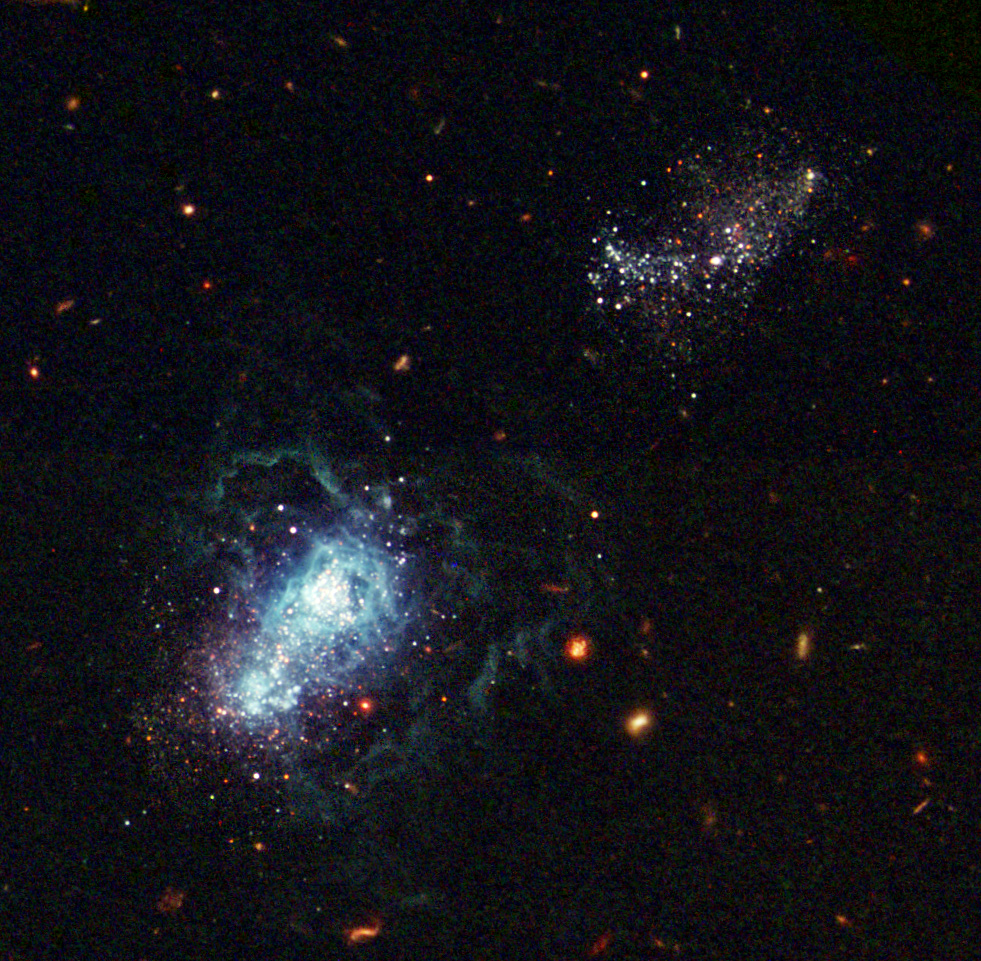
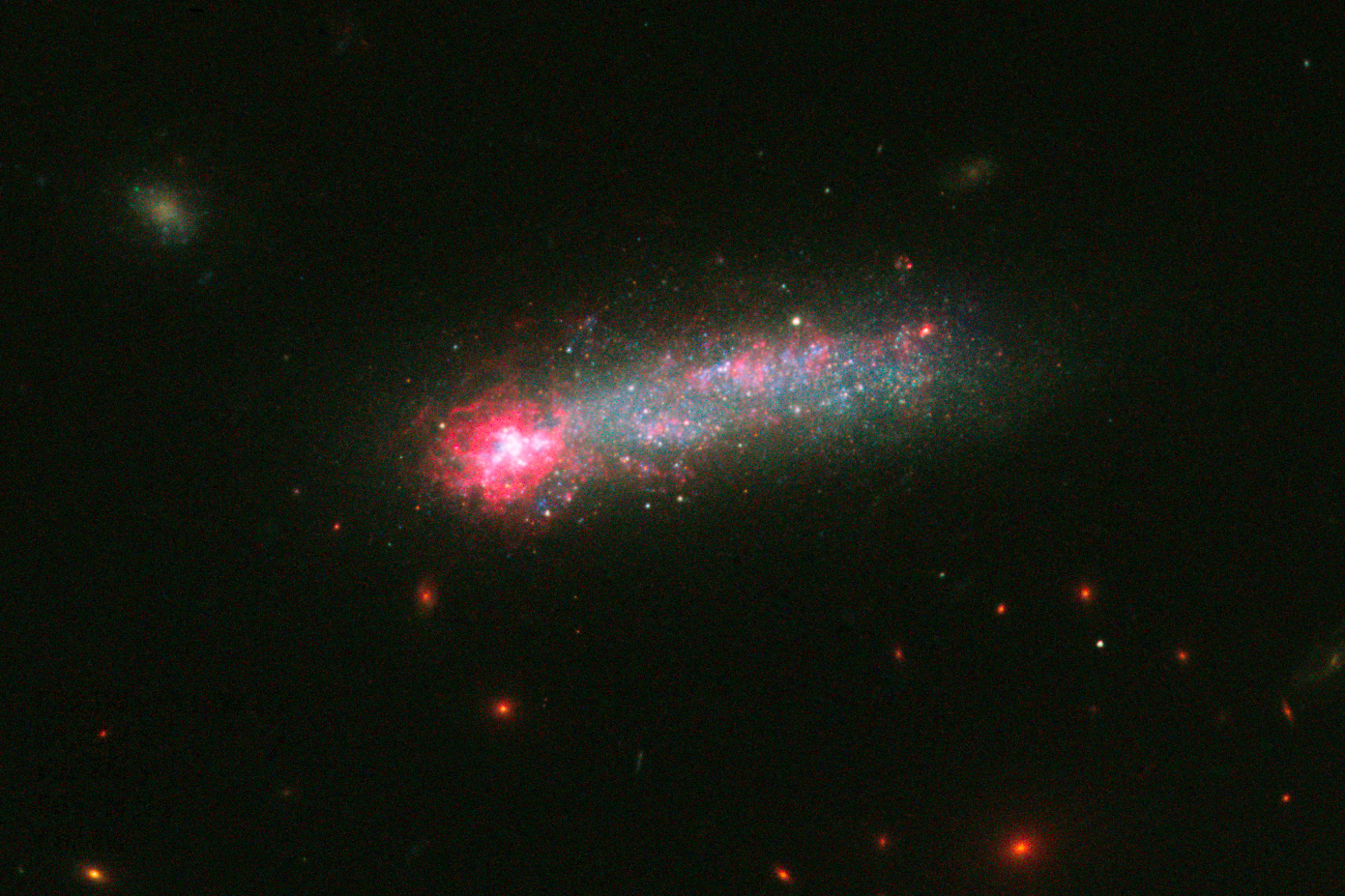
Hubble captured a dramatic firestorm of star birth lighting up one end of the dwarf galaxy Kiso 5639, a member of a rare class of objects known as "tadpole" galaxies, so named because of their bright, compact heads and elongated, tapering tails. The brilliant blaze of blue-white light at the galaxy's head is a massive burst of new star formation, where thousands of hot, young stars have ignited within a concentrated region of compressed gas. The elongated tail trails behind like a cosmic comet, composed of older, redder stars that represent the galaxy's pre-existing stellar population. Kiso 5639's peculiar shape is thought to result from the accretion of fresh, pristine gas from the intergalactic medium — gas that never previously participated in star formation. As this metal-poor gas falls onto one end of the galaxy, it triggers the intense localized star formation that creates the characteristic tadpole morphology. This process may mimic conditions common in the early universe, when galaxies routinely grew by accreting cold gas streams from the cosmic web.
Scientific Significance
Kiso 5639 provides a rare opportunity to study cold-flow accretion — a process theorized to be the primary mechanism by which galaxies grew in the early universe. In this scenario, narrow streams of cold, unprocessed gas flow along filaments of the cosmic web directly onto galaxies, triggering intense but localized star formation. While this process was dominant billions of years ago, finding a nearby example like Kiso 5639 allows detailed study with Hubble's full resolving power. The sharp boundary between the young, blue starburst region and the older, red stellar population in the tail provides direct evidence that the star formation was recently triggered by an external event rather than arising from internal galactic processes. Spectroscopic analysis of the starburst region reveals extremely low oxygen abundances in the newly forming stars, consistent with the accretion of near-pristine intergalactic gas. Kiso 5639 thus serves as a local analog for the tadpole galaxies prevalent in the early universe.
Observation Details
Hubble observed Kiso 5639 using the Wide Field Camera 3 (WFC3) in ultraviolet, visible, and near-infrared filters. The ultraviolet observations were particularly important for mapping the distribution of the youngest and hottest stars in the starburst region, as massive O and B stars emit the bulk of their energy at short wavelengths. Visible-light filters captured the older stellar populations and dust distribution, while narrowband hydrogen-alpha imaging revealed the ionized gas surrounding the young star-forming complexes. The combination of wavelengths allowed age-dating of stellar populations across the galaxy.
Location in the Universe
Constellation
Ursa Major
Distance from Earth
82 million light-years
Fun Facts
- 1
Tadpole galaxies like Kiso 5639 are rare in the nearby universe but were common in the early cosmos — surveys show they made up about 10% of all galaxies when the universe was only 2-3 billion years old.
- 2
The star-forming burst at Kiso 5639's head spans roughly 2,700 light-years across and contains stars less than a few million years old — newborns on the cosmic timescale.
- 3
The gas fueling the starburst has a very low metallicity, suggesting it is relatively pristine material flowing in from outside the galaxy rather than recycled gas from previous generations of stars.
Image credit: NASA, ESA, Hubble Space Telescope