About This Image
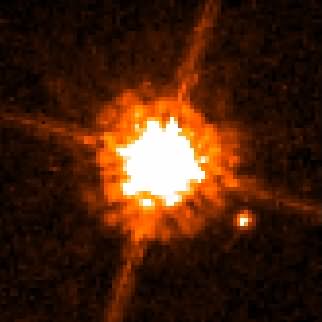
The bright spot at lower right in this image is a suspected brown dwarf — an enigmatic object that occupies the murky boundary between the largest planets and the smallest stars. Named CHXR 73 B, this substellar companion orbits a red dwarf star dubbed CHXR 73, which is itself much less massive than our Sun. Brown dwarfs are objects that formed like stars from collapsing clouds of gas and dust but never accumulated enough mass to ignite sustained hydrogen fusion in their cores — the defining process that makes a star shine. With an estimated mass roughly 12 times that of Jupiter, CHXR 73 B hovers tantalizingly close to the theoretical boundary between giant planets and brown dwarfs, making its exact classification a subject of active scientific debate. The wide separation between CHXR 73 B and its host star, approximately 200 astronomical units, suggests it formed independently from the same molecular cloud rather than accreting from a circumstellar disk like a planet would.
Scientific Significance
CHXR 73 B is a scientifically important object because it lies in the critical mass range where the distinction between giant planets and brown dwarfs becomes ambiguous. The International Astronomical Union defines the boundary at approximately 13 Jupiter masses, where deuterium fusion becomes possible, but this threshold is somewhat arbitrary and debated. CHXR 73 B's mass estimate of about 12 Jupiter masses places it right at this boundary, making it a key test case for classification schemes. Furthermore, its very wide orbital separation from the host star challenges planet formation theories, as conventional core-accretion models cannot easily produce such massive companions at such large distances. This suggests CHXR 73 B formed through direct gravitational collapse of a molecular cloud fragment, similar to how binary stars form, rather than through planetary formation processes. Understanding the formation pathways of objects at this mass boundary is essential for constructing a complete census of substellar objects in the galaxy.
Observation Details
Hubble detected CHXR 73 B using the Advanced Camera for Surveys (ACS) in near-infrared filters that are sensitive to the faint thermal emission from cool, low-mass objects. The detection required careful subtraction of the scattered light from the much brighter primary star CHXR 73, a process made possible by Hubble's stable and well-characterized point spread function. Follow-up observations at multiple epochs confirmed that CHXR 73 B shares common proper motion with its host star, proving they are physically associated rather than a chance alignment. Spectroscopic observations from ground-based telescopes provided temperature and gravity estimates consistent with a young substellar object.
Location in the Universe
Constellation
Chamaeleon
Distance from Earth
500 light-years
Fun Facts
- 1
Brown dwarfs are sometimes called 'failed stars' because they lack sufficient mass to sustain hydrogen fusion — they need at least 80 times Jupiter's mass (about 8% of the Sun's mass) to become a true star.
- 2
CHXR 73 B orbits its parent star at a distance of about 200 AU — roughly five times the distance from the Sun to Pluto — making it extraordinarily far from its stellar companion.
- 3
The Chamaeleon I star-forming region where this system is located is one of the nearest stellar nurseries to Earth, making it an ideal hunting ground for discovering faint objects like brown dwarfs.
Image credit: NASA, ESA, Hubble Space Telescope