About This Image
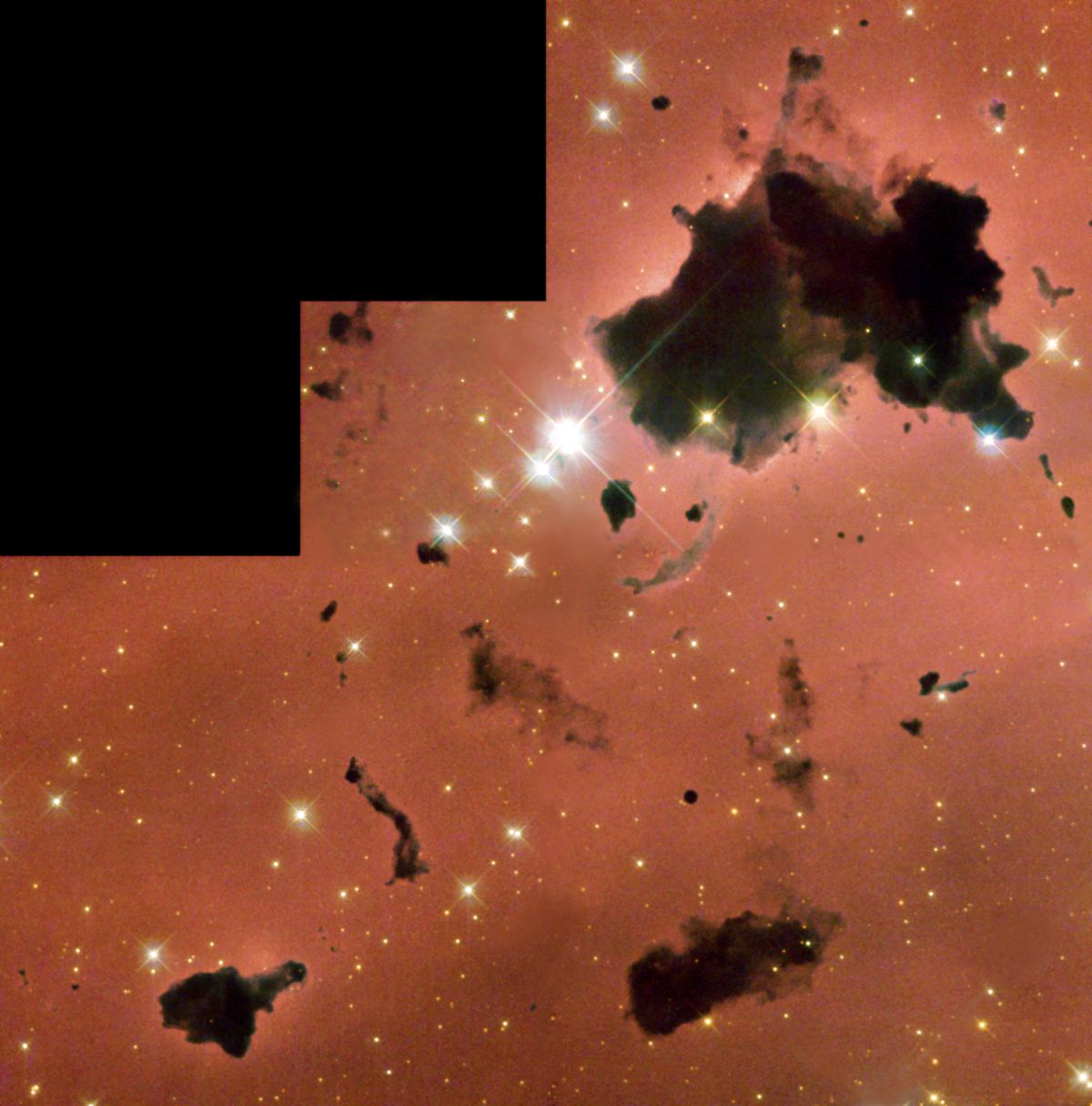
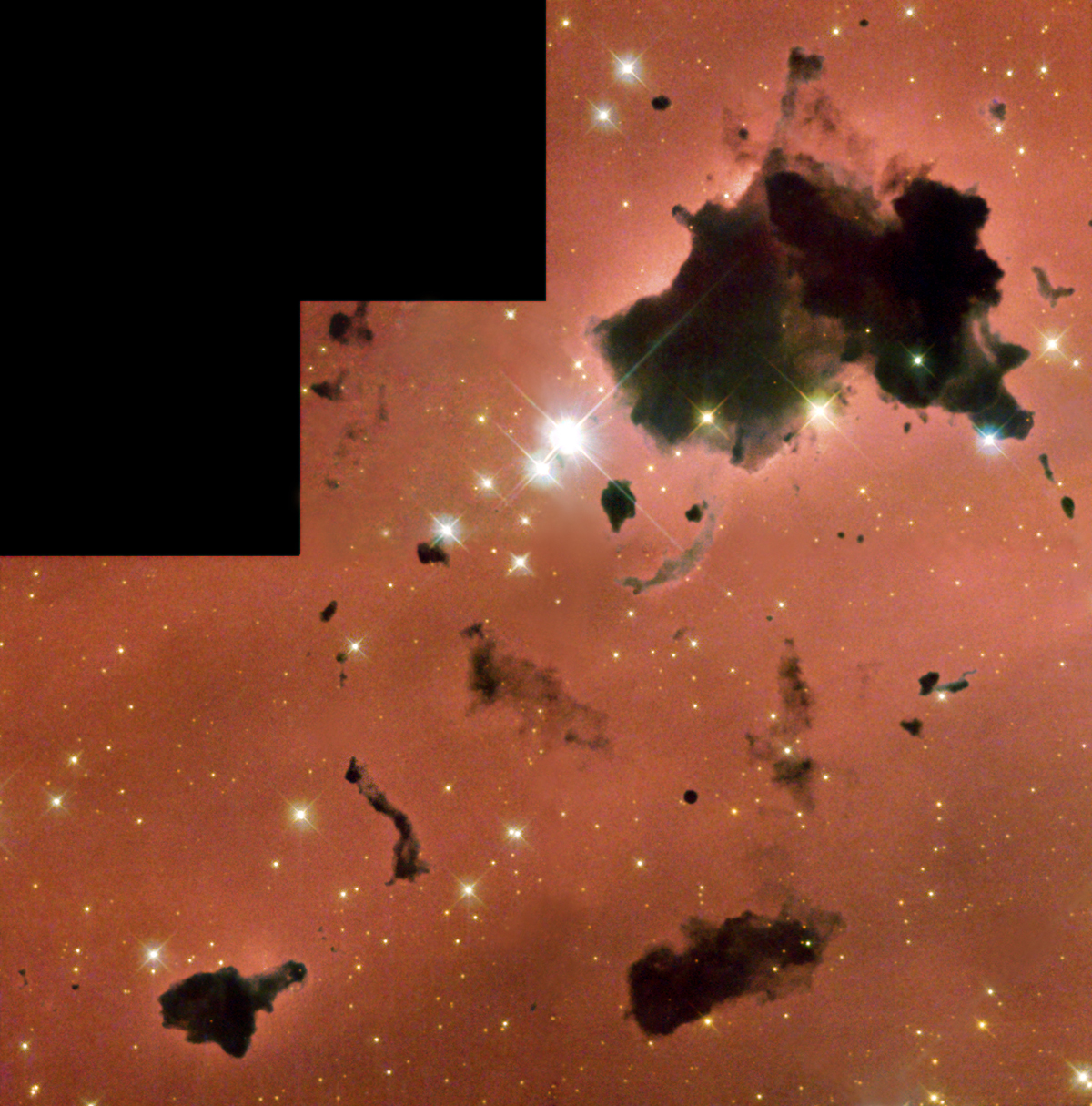
This detailed view of Thackeray's Globules in the star-forming region IC 2944 reveals the intricate structure of these dense, dark dust clouds silhouetted against a brilliant curtain of glowing gas and stars. Named after South African astronomer A.D. Thackeray who first identified them in 1950, these compact molecular clouds represent some of the densest concentrations of interstellar material known. The largest apparent globule in this image was revealed by Hubble to be two separate, overlapping clouds seen along our line of sight — a discovery that reshaped our understanding of these objects' true three-dimensional structure. The globules' sharp, dark edges contrast dramatically with the luminous hydrogen gas surrounding them, heated to incandescence by the ultraviolet radiation from nearby massive O-type and B-type stars. These dark sentinels stand as islands of cold, dense molecular gas in an ocean of hot, ionized plasma, and their ultimate fate — whether they will collapse to form new stars or be destroyed by radiation — remains one of the intriguing open questions in stellar astronomy.
Scientific Significance
This deeper Hubble observation of Thackeray's Globules provided refined measurements of the globules' masses, sizes, and erosion rates compared to the initial 1999 imaging. The higher signal-to-noise data confirmed that several of the globules are being photoevaporated on timescales of about 200,000 years, significantly shorter than the gravitational free-fall time needed for collapse into protostars. This finding strongly suggests that these particular globules will be destroyed before they can form stars, providing an important negative result for triggered star formation models. However, the detection of density enhancements within some globules leaves open the possibility that portions may survive long enough to undergo collapse. The multi-epoch comparison between the 1999 and 2001 observations also allowed upper limits to be placed on the proper motions of the globules relative to the background nebula, constraining their dynamical interactions with the surrounding environment.
Observation Details
This image was captured using Hubble's Wide Field and Planetary Camera 2 (WFPC2) with deeper exposures than the earlier 1999 observations, achieving higher signal-to-noise ratios for measuring the faint extended emission around the globule boundaries. Broadband B, V, and I filters were combined with narrowband hydrogen-alpha and oxygen III filters to separate the continuum and line emission components. The narrowband data allowed measurement of the electron density and temperature in the ionized boundary layers of the globules, providing crucial input parameters for photoevaporation models.
Location in the Universe
Constellation
Centaurus
Distance from Earth
5,900 light-years
Fun Facts
- 1
This 2001 Hubble image improved upon the 1999 observations with deeper exposures, revealing even finer details in the globule surfaces and discovering additional small knots of dense gas previously unresolved.
- 2
IC 2944, the nebula hosting these globules, is sometimes called the Running Chicken Nebula or the Lambda Centauri Nebula, and is a favorite target for amateur astronomers in the Southern Hemisphere.
- 3
The globules have internal temperatures of only about 10-20 Kelvin (-260°C), making them among the coldest objects in the galaxy — nearly as cold as the cosmic microwave background radiation.
Image credit: NASA, ESA, Hubble Space Telescope