About This Image
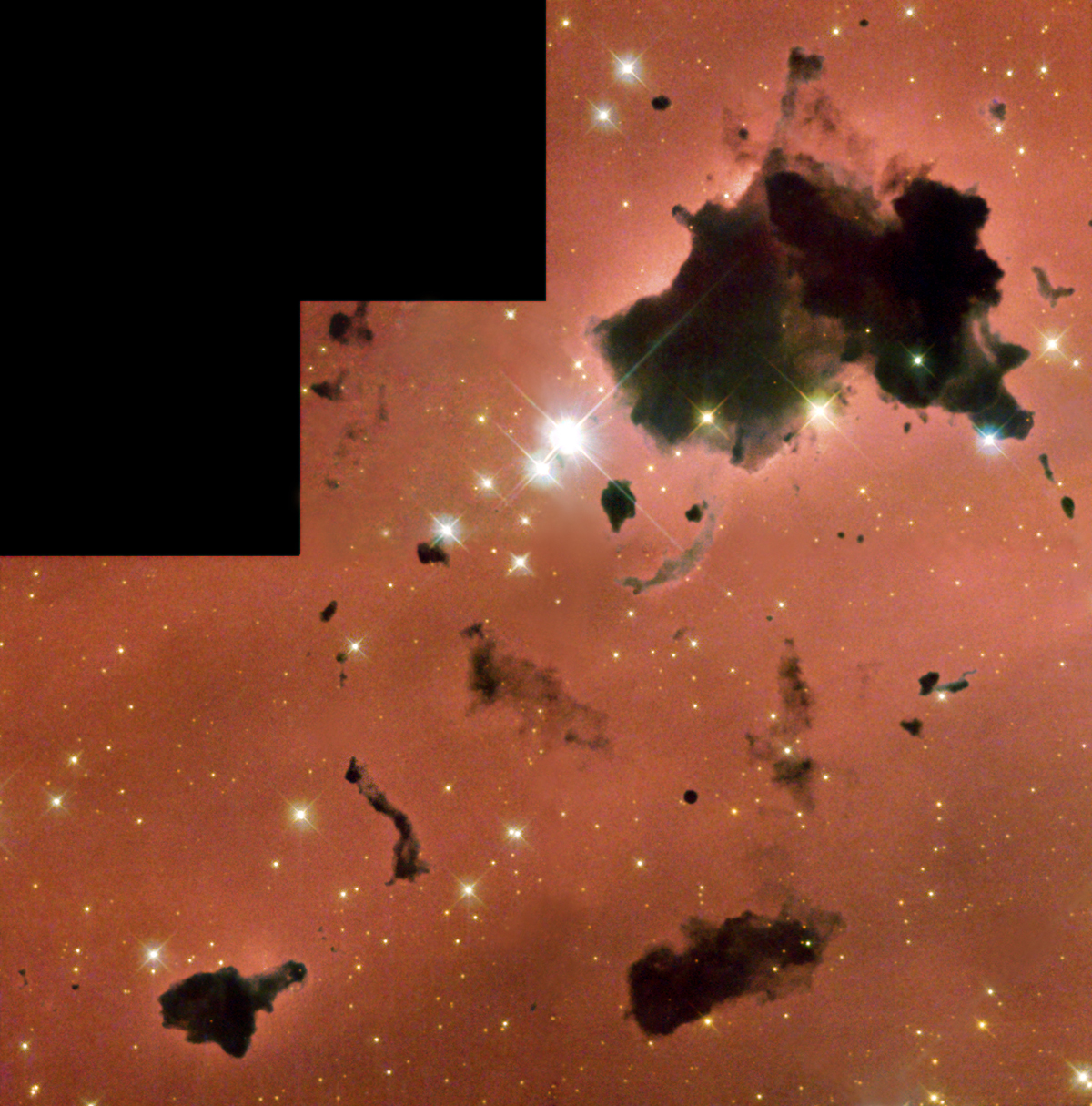
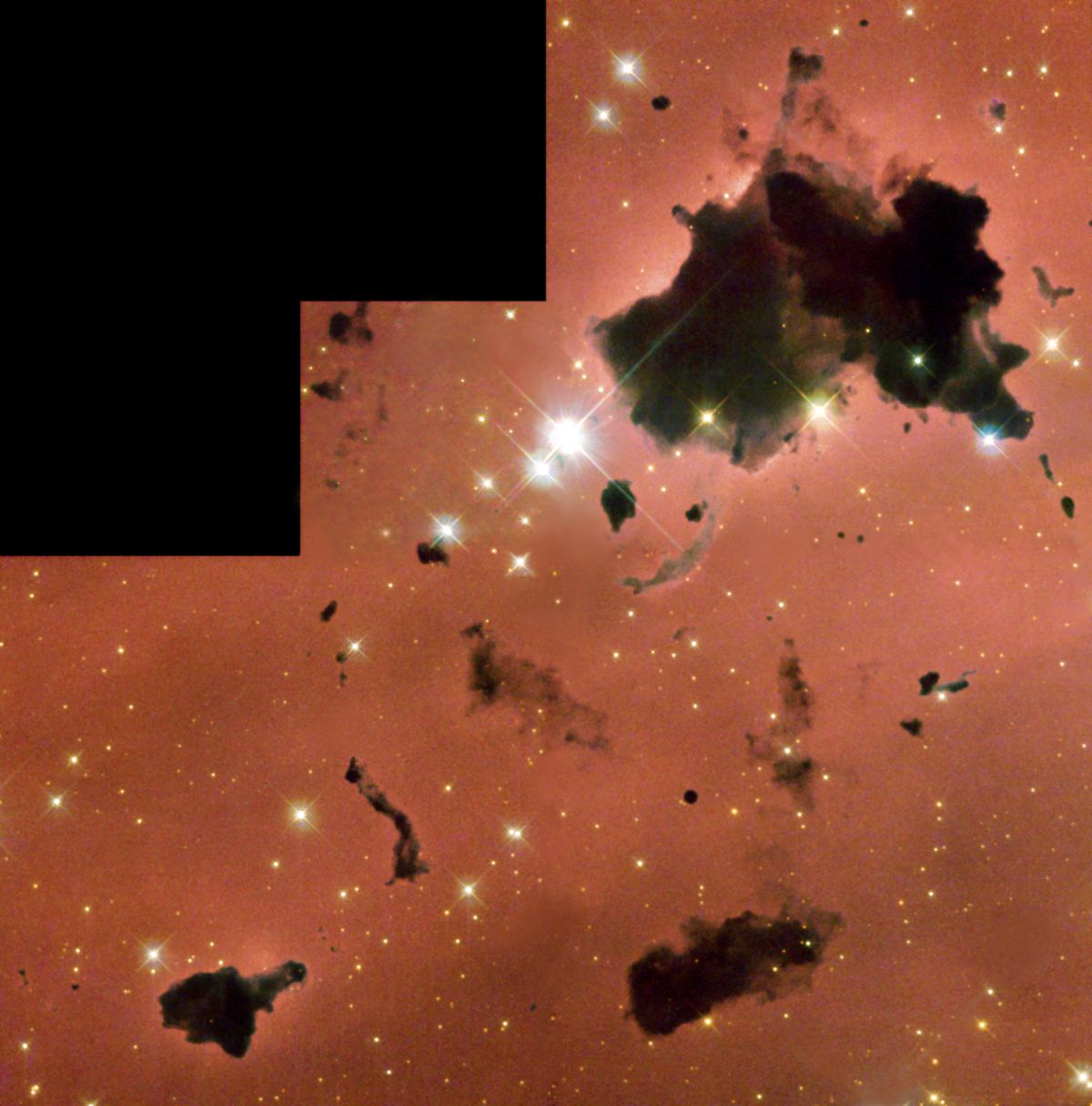
These dense, dark dust clouds, named "Thackeray's globules" after South African astronomer A.D. Thackeray who discovered them in the 1950s, are silhouetted against the bright stars and luminous gas clouds of the star-forming region IC 2944. Each globule is a compact knot of molecular gas and dust, dense enough to block the light from the glowing nebula behind it, creating stark dark silhouettes against the brilliant backdrop. The largest globule visible in this image is actually two separate, overlapping clouds seen in projection, a discovery made possible only by Hubble's exceptional resolution. These globules contain enough raw material to potentially form new stars, but their fate remains uncertain — the intense ultraviolet radiation from nearby hot stars is steadily eroding them, and it is unclear whether gravity can compress the globules into stellar seeds before they are completely photoevaporated. This cosmic tug-of-war between creation and destruction makes Thackeray's Globules a fascinating laboratory for studying the earliest stages of star formation.
Scientific Significance
Thackeray's Globules provide a crucial test case for understanding whether small molecular clouds can survive long enough in harsh radiation environments to collapse and form stars. Bok globules are among the simplest and smallest structures in which star formation can potentially occur, making them ideal for testing theories of gravitational collapse. Hubble's observations of these particular globules revealed that they possess sharp, well-defined edges characteristic of photoevaporation by external radiation, suggesting they are being actively destroyed. Mass estimates derived from dust extinction measurements indicate that the globules may not contain sufficient mass to resist the erosive forces and reach gravitational collapse. This finding has important implications for understanding star formation efficiency in HII regions, where the same massive stars that ionize the surrounding gas may also prevent nearby dense clouds from forming the next generation of stars.
Observation Details
This image was obtained using Hubble's Wide Field and Planetary Camera 2 (WFPC2) in broadband visible-light filters. The sharp contrast between the dark globules and the bright emission nebula background was enhanced using filters that capture hydrogen-alpha and oxygen III emission. Hubble's angular resolution of 0.1 arcseconds allowed astronomers to measure the precise edges of the globules and determine that the largest apparent globule is actually two overlapping objects at slightly different distances. Multi-epoch observations were used to search for signs of globule evolution and measure erosion rates.
Location in the Universe
Constellation
Centaurus
Distance from Earth
5,900 light-years
Fun Facts
- 1
Each of Thackeray's Globules is roughly 1.4 trillion miles across — about 50 times the diameter of our solar system — yet contains only about as much mass as our Sun.
- 2
The globules are being eroded by radiation from the nearby hot O-type stars at a rate that will likely destroy them completely within a few hundred thousand years, possibly before any stars can form inside them.
- 3
Bok globules like these are named after astronomer Bart Bok, who first proposed in the 1940s that such small, dark clouds could be the birthplaces of stars — a hypothesis later confirmed by infrared observations.
Image credit: NASA, ESA, Hubble Space Telescope