About This Image
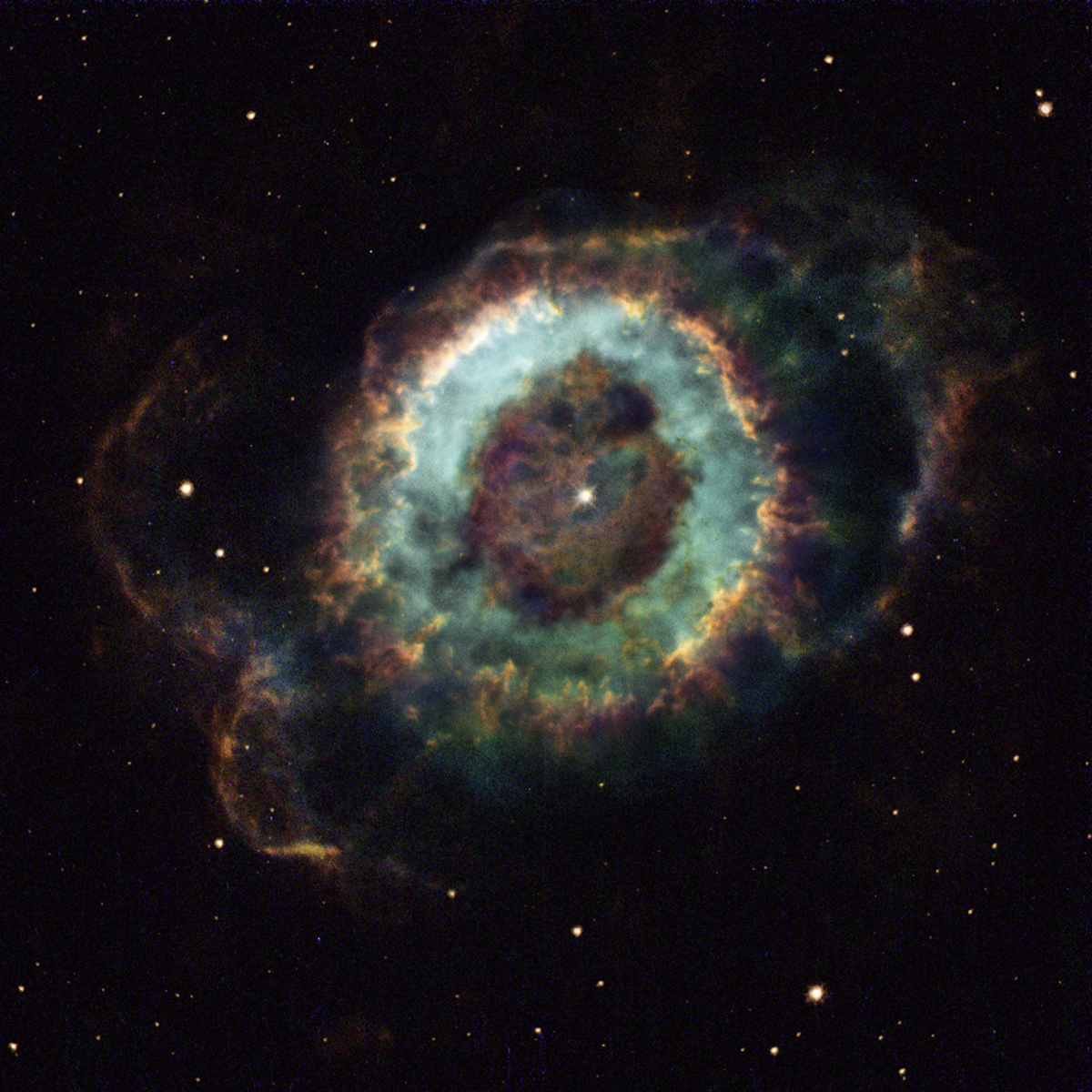
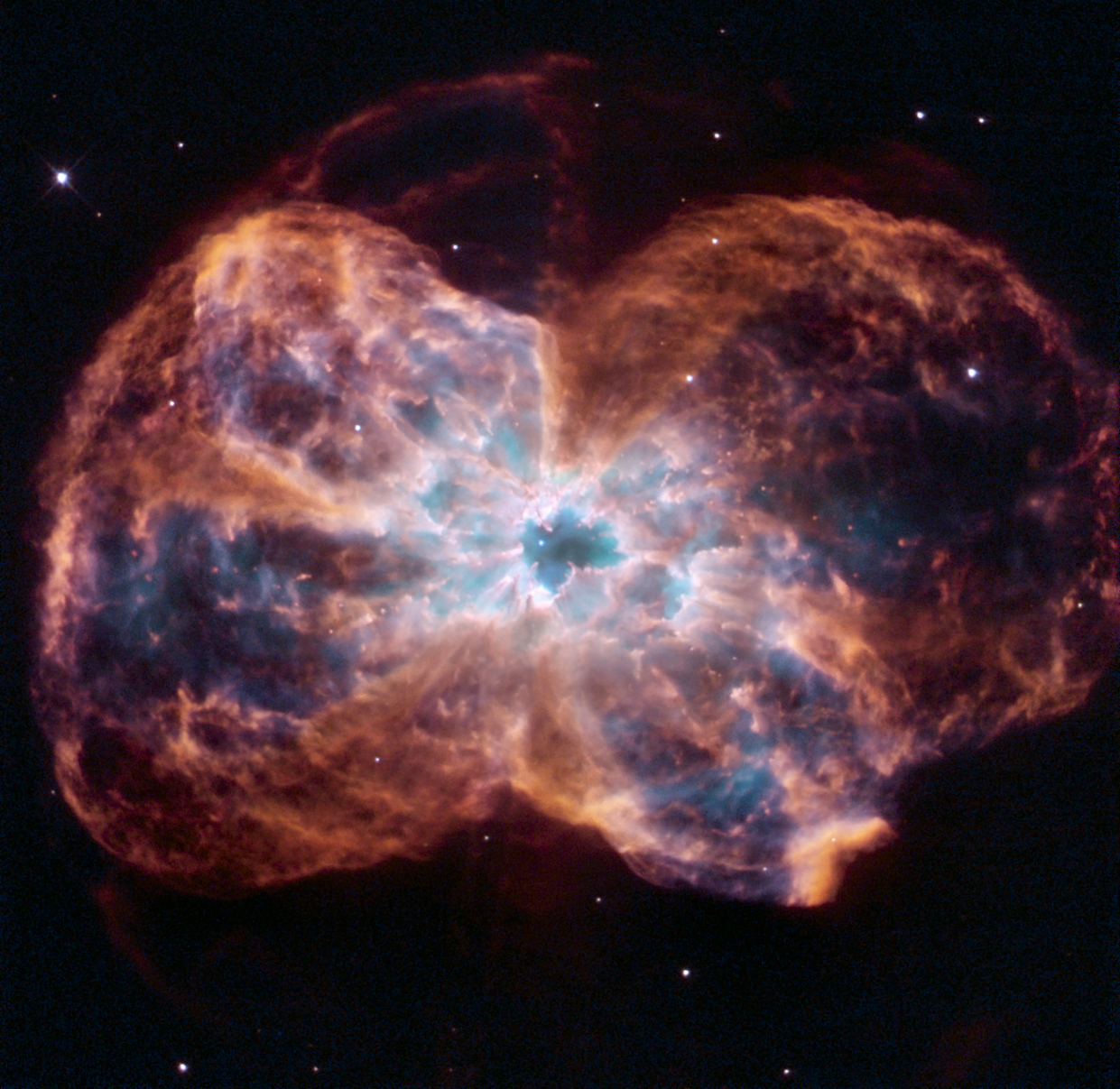
Planetary nebula NGC 2440 is a breathtaking relic of a star that was once similar to our Sun but has reached the final chapter of its stellar life. As the aging star exhausted its nuclear fuel, it shed its outer layers of gas in a series of violent pulsations, forming a colorful and intricately structured cocoon around the star's remaining core — an incredibly hot white dwarf. The central star of NGC 2440 is one of the hottest white dwarfs known, with a surface temperature exceeding 200,000 degrees Celsius, roughly 35 times hotter than our Sun's surface. This extreme heat causes the surrounding ejected gas to glow in vivid colors as different chemical elements are excited to fluorescence. The nebula's chaotic, multi-lobed structure suggests that the dying star experienced multiple episodes of mass ejection in different directions over thousands of years, creating the complex layered appearance visible in this image. NGC 2440 offers a poignant preview of our own Sun's distant future.
Scientific Significance
NGC 2440 is a particularly important planetary nebula for studying the late stages of stellar evolution because its central white dwarf is among the hottest known, providing an extreme endpoint for models of post-asymptotic giant branch stellar evolution. The nebula's complex multi-polar structure reveals that the mass-loss process during a star's death is far from simple — multiple ejection episodes, possibly influenced by an unseen binary companion or magnetic fields, have created overlapping lobes oriented in different directions. Chemical analysis of the nebula's gas reveals enriched abundances of carbon, nitrogen, and oxygen, elements synthesized in the star's interior and returned to the interstellar medium through this mass-loss process. This enrichment is fundamental to cosmic chemistry, as planetary nebulae are among the primary sources of carbon and nitrogen in the galaxy. Understanding NGC 2440's structure helps astronomers reconstruct the mass-loss history that transforms a red giant into a white dwarf.
Observation Details
Hubble captured this image using the Wide Field Camera 3 (WFC3) in multiple narrowband filters that isolate emission from specific elements including hydrogen, oxygen, helium, and nitrogen. Each element emits light at characteristic wavelengths, allowing astronomers to map the chemical composition and physical conditions throughout the nebula. The false-color rendering assigns different colors to different emission lines, revealing the layered chemical structure invisible in natural light. Hubble's resolution was essential for resolving the fine filamentary structures within the nebula's multiple lobes.
Location in the Universe
Constellation
Puppis
Distance from Earth
4,000 light-years
Fun Facts
- 1
The central white dwarf of NGC 2440 has a surface temperature of over 200,000°C — so hot that it radiates most of its energy as ultraviolet light invisible to the human eye.
- 2
Despite the name, planetary nebulae have nothing to do with planets — the term was coined by William Herschel in the 1780s because their round, fuzzy appearance through early telescopes resembled the disks of planets.
- 3
The gas shells of NGC 2440 are expanding outward at roughly 30 miles per second and will eventually dissipate into the interstellar medium within about 10,000 years, recycling enriched material back into space.
Image credit: NASA, ESA, Hubble Space Telescope