About This Image
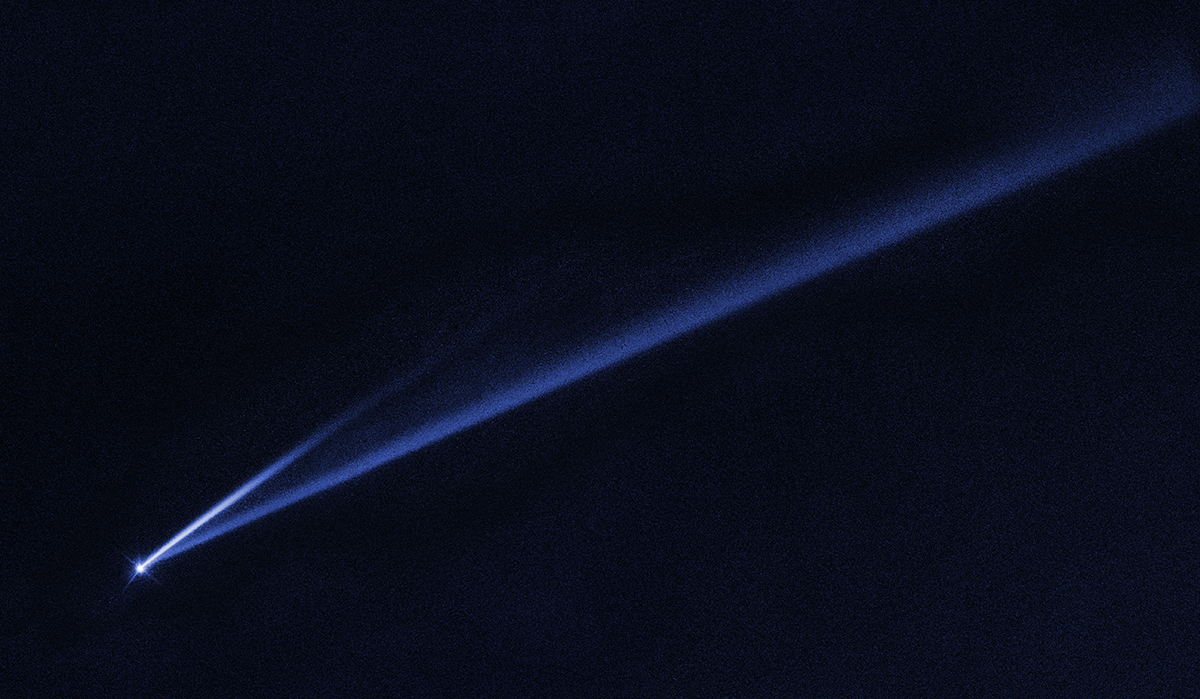
Hubble captured the remarkable gradual self-destruction of the asteroid (6478) Gault, a small rocky body in the main asteroid belt between Mars and Jupiter that is slowly tearing itself apart — not from a collision, but from the subtle, long-term effects of sunlight. Over millions of years, the gentle pressure of solar radiation has gradually increased the asteroid's rotation rate through a process known as the YORP effect, spinning it faster and faster until centrifugal forces at its surface exceed the weak gravitational pull holding it together. Dusty material ejected from the asteroid's surface has formed two spectacular comet-like tails stretching approximately 500,000 and 3,000 miles long respectively, creating a dramatic visual display from an otherwise unremarkable space rock. This observation provided astronomers with a rare opportunity to witness asteroid destruction in real time, shedding light on how the solar system's population of small bodies evolves and gradually breaks down over billions of years.
Scientific Significance
The observation of asteroid Gault's active disintegration provided the first clear, real-time evidence of the YORP effect destroying a main-belt asteroid, confirming theoretical predictions that had been debated for decades. The YORP effect is now recognized as one of the primary mechanisms shaping the size distribution of asteroids in the solar system, gradually spinning small bodies until they shed mass or fragment entirely. Hubble's observations allowed astronomers to measure the timing, velocity, and composition of the ejected dust, revealing that Gault's surface material is consistent with ordinary silicate rock rather than volatile-rich composition. This rules out outgassing as the cause of the activity, confirming the rotational disruption hypothesis. Understanding YORP-driven destruction is crucial for asteroid hazard assessment, as it influences the population statistics of near-Earth objects and helps predict which asteroids may pose future collision risks.
Observation Details
Hubble observed asteroid Gault using the Wide Field Camera 3 (WFC3) in visible-light broadband filters, tracking the asteroid as it moved against the background stars. The sharp resolution of Hubble was essential for resolving the narrow dust tails and separating them from the asteroid's unresolved nucleus. Multiple epochs of observation over several weeks allowed astronomers to measure the evolution of the tails and constrain the timing of the dust-ejection events. Color information from different filters provided constraints on the dust particle sizes, revealing a range from fine powder to sand-grain-sized particles.
Location in the Universe
Constellation
N/A (Solar System)
Distance from Earth
214 million miles (at time of observation)
Fun Facts
- 1
Asteroid Gault is only about 2.5 miles wide, yet the dust tails it has produced stretch for hundreds of thousands of miles — like a grain of sand leaving a trail visible from across a football stadium.
- 2
The YORP effect that is destroying Gault works incredibly slowly, taking millions of years to spin up an asteroid, but is responsible for breaking apart countless small bodies in the asteroid belt over the solar system's history.
- 3
Before Hubble caught it shedding material, Gault had been considered a perfectly ordinary main-belt asteroid for over 30 years since its discovery in 1988 — its dramatic transformation came as a complete surprise to astronomers.
Image credit: NASA, ESA, Hubble Space Telescope