About This Image
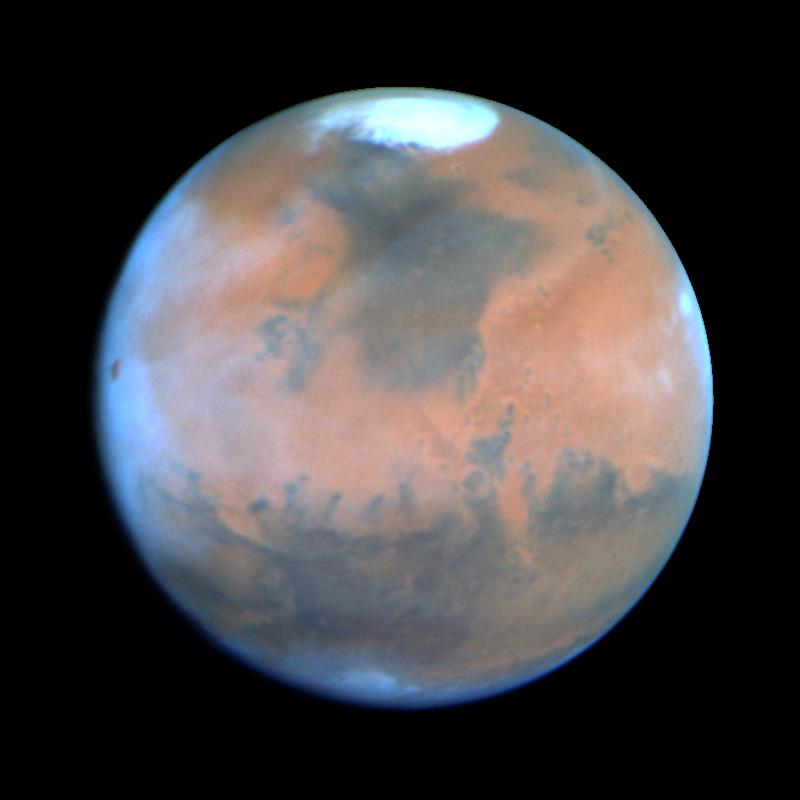
This crisp Hubble image captures springtime in the northern hemisphere of Mars, revealing the Red Planet in stunning detail from Earth orbit. The northern polar ice cap, which grows dramatically during the Martian winter as carbon dioxide freezes out of the thin atmosphere, has retreated to its residual core of solid water-ice measuring several hundred miles across — a seasonal transformation that takes place each Martian year. Wispy morning clouds are visible along the planet's western limb, where the thin Martian atmosphere interacts with temperature changes as the planet rotates into daylight. The image also reveals regional variations in surface albedo — light and dark patches that correspond to different terrain types, from the bright, dust-covered ancient highlands to the darker volcanic plains and rock exposures. Mars's thin atmosphere, with a surface pressure less than 1% of Earth's, is clearly transparent enough for Hubble to resolve surface features as small as 12 miles across from a distance of roughly 60 million miles, demonstrating the telescope's remarkable power as a planetary observatory.
Scientific Significance
Hubble's regular monitoring of Mars provides an invaluable long-baseline record of the planet's atmospheric and surface changes that complements the more detailed but shorter-duration observations from Mars orbiters and landers. This 1995 observation captured Mars during a period between dedicated Mars missions, filling a gap in continuous planetary monitoring. Hubble observations have documented the growth and decay of the polar ice caps over multiple Martian years, contributed to our understanding of the global dust cycle, and detected changes in surface albedo patterns caused by wind redistribution of surface dust. The ability to observe the entire visible hemisphere simultaneously — impossible from orbit around Mars — makes Hubble uniquely suited for detecting planet-wide dust storms during their earliest stages. These observations also provided ground truth calibration for historical telescopic observations of Mars, connecting centuries of Earth-based observations to the modern era of spacecraft exploration.
Observation Details
This image was captured using Hubble's Wide Field and Planetary Camera 2 (WFPC2) in multiple broadband visible-light filters selected to highlight different surface and atmospheric features. Blue filters reveal atmospheric hazes and clouds, green filters provide the best surface detail, and red filters emphasize contrast between bright dust-covered regions and darker rock exposures. The observations were timed to coincide with a favorable opposition geometry when Mars was relatively close to Earth, maximizing the achievable spatial resolution. Multiple short exposures were combined to build up signal while freezing the planet's rotation, which would otherwise blur surface features.
Location in the Universe
Constellation
N/A (Solar System)
Distance from Earth
35 to 250 million miles (varies)
Fun Facts
- 1
Mars's northern polar cap is made of two components: a permanent core of water ice about 600 miles across and a much larger seasonal layer of frozen carbon dioxide (dry ice) that sublimates each spring, shrinking the cap dramatically.
- 2
Hubble has been monitoring Mars for over three decades, creating a long-term record of seasonal changes, dust storms, and atmospheric phenomena that no Mars orbiter could match for sheer duration of coverage.
- 3
The dark markings on Mars visible in this image were once thought to be vegetation by 19th-century astronomers, who interpreted their seasonal changes as evidence of Martian plant life responding to the seasons.
Image credit: NASA, ESA, Hubble Space Telescope