About This Image
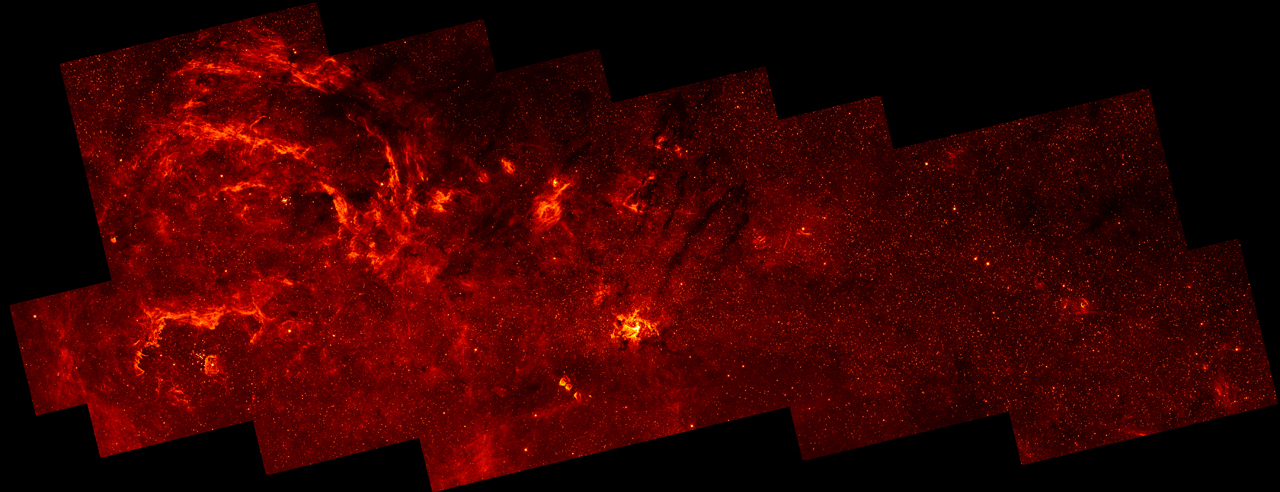
This infrared image peers into the tumultuous heart of our Milky Way galaxy, revealing a dense and chaotic population of massive stars and complex structures in the hot ionized gas that swirls around the galactic core. The center of the Milky Way, located roughly 26,000 light-years from Earth in the direction of the constellation Sagittarius, is normally hidden from optical telescopes by thick curtains of interstellar dust that absorb visible light. However, infrared radiation passes through this dust, allowing Hubble to unveil the crowded stellar environment surrounding Sagittarius A*, the supermassive black hole that anchors our galaxy. The image reveals arches and filaments of ionized gas shaped by powerful magnetic fields and stellar winds from the many massive, hot stars that populate this extreme environment. Star formation continues vigorously near the galactic center despite the hostile conditions — intense radiation, strong tidal forces, and powerful magnetic fields — that would inhibit star formation in most other galactic environments. The density of stars in this region is millions of times greater than in our solar neighborhood.
Scientific Significance
Hubble's infrared observations of the galactic center have been transformative for understanding the extreme stellar environment near a supermassive black hole. The detected population of massive stars within the central parsec includes the Arches Cluster and the Quintuplet Cluster — two of the most massive and dense young star clusters in the entire galaxy. The presence of young, massive stars so close to the supermassive black hole poses a significant theoretical challenge, as the extreme tidal forces should prevent molecular clouds from collapsing to form stars through conventional mechanisms. This 'paradox of youth' has stimulated the development of alternative star formation scenarios, including in-spiraling disk fragmentation and cluster migration models. The ionized gas structures, including the thermal arched filaments and the circumnuclear ring, trace the complex interplay between stellar winds, magnetic fields, and the gravitational influence of the central black hole. These observations provide essential context for interpreting galactic nuclei in external galaxies.
Observation Details
This image was captured using Hubble's Near Infrared Camera and Multi-Object Spectrometer (NICMOS) at wavelengths between 1.1 and 1.9 micrometers, where infrared light can penetrate the roughly 25 magnitudes of visual extinction caused by intervening dust. The NICMOS observations achieved angular resolution of approximately 0.2 arcseconds, corresponding to about 0.025 parsecs at the distance of the galactic center. Multiple pointings were mosaicked together to cover the central few parsecs of the galaxy. The near-infrared filters were selected to distinguish between hydrogen recombination line emission from ionized gas and continuum emission from stars, enabling separation of the stellar and gas components.
Location in the Universe
Constellation
Sagittarius
Distance from Earth
26,000 light-years
Fun Facts
- 1
The supermassive black hole Sagittarius A* at the very center of the Milky Way has a mass of about 4 million times that of the Sun, yet is so compact that it would fit within the orbit of Mercury.
- 2
Stars near the galactic center orbit the supermassive black hole at speeds exceeding 5,000 kilometers per second — fast enough to travel from New York to Los Angeles in less than one second.
- 3
The stellar density near the galactic center is so extreme that if our solar system were located there, the night sky would contain over a million stars visible to the naked eye, compared to the roughly 5,000 we can see from Earth.
Image credit: NASA, ESA, Hubble Space Telescope