About This Image
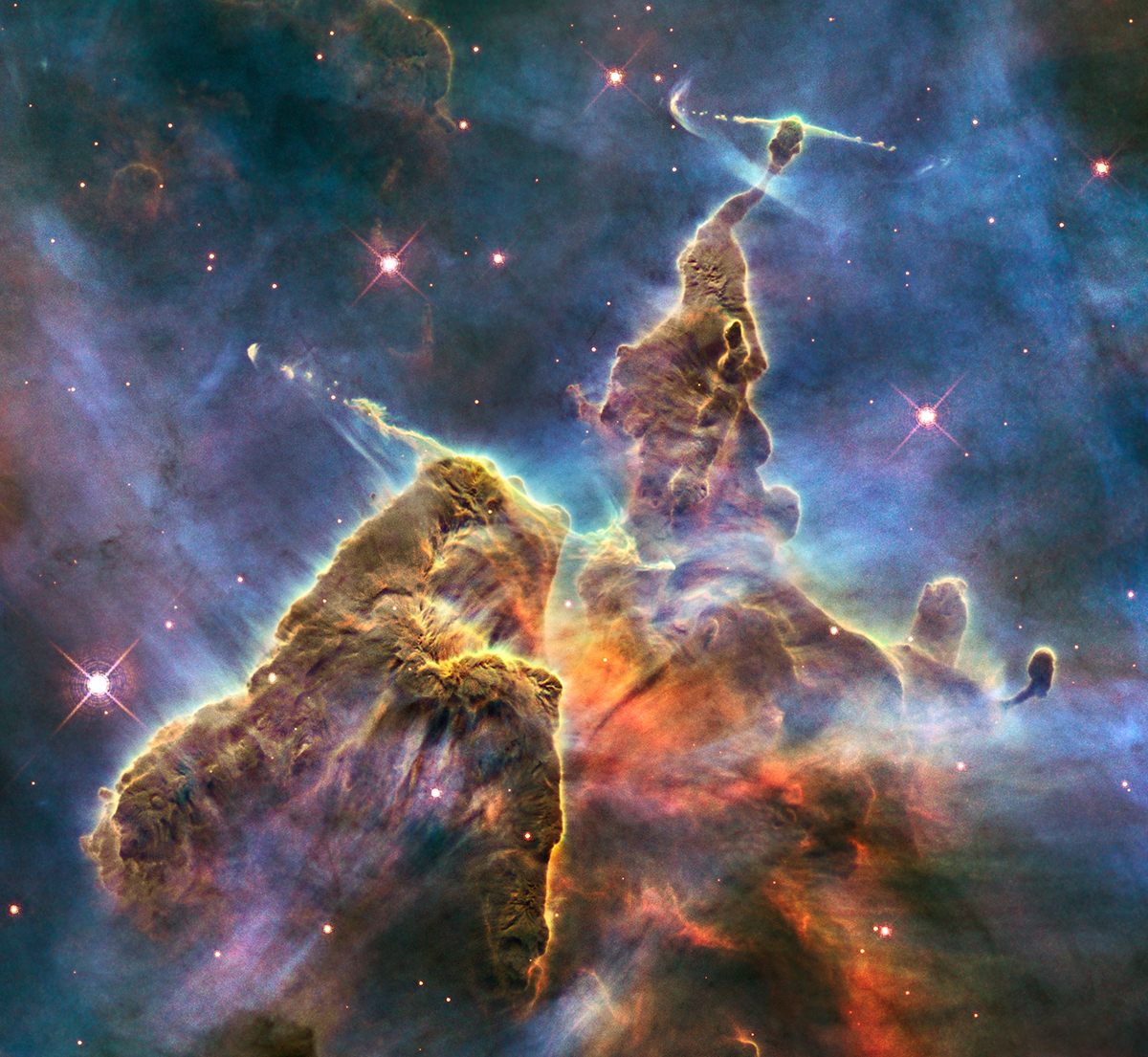
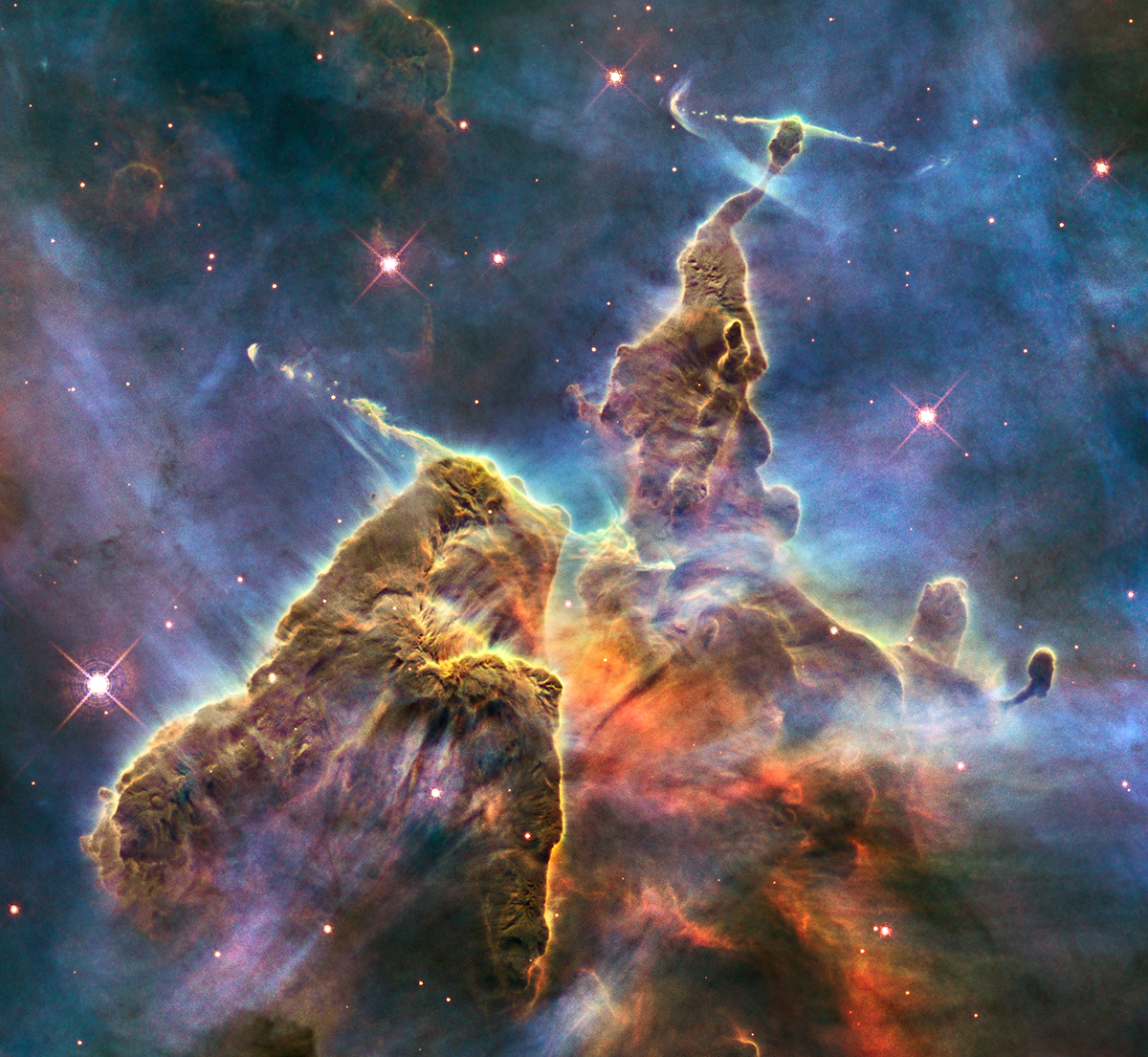
This iconic Hubble image captures 'Mystic Mountain,' a towering pillar of gas and dust rising three light-years tall within the Carina Nebula — one of the most dramatic and visually stunning structures ever photographed in space. Released to celebrate Hubble's 20th anniversary in 2010, this image reveals a cosmic landscape of breathtaking complexity and beauty. The pillar is being sculpted by the blistering ultraviolet radiation and stellar winds from some of the most massive and luminous stars in our galaxy, located outside the frame. At the summit and along the ridges of the pillar, streamers of gas are being boiled away into space, creating a frothy, turbulent boundary between the dense molecular material and the surrounding hot, ionized gas. Narrow jets of gas fired by newly forming stars within the pillar shoot outward like cosmic searchlights, punching through the dusty material and illuminating small patches of nebulosity known as Herbig-Haro objects. Mystic Mountain encapsulates the Carina Nebula's defining theme: the simultaneous destruction and creation of stellar material, where the very forces tearing the pillar apart are also compressing pockets of gas within it to ignite new stars.
Scientific Significance
Mystic Mountain is one of the most thoroughly studied pillar structures in any star-forming region, and its detailed morphology provides critical tests for models of radiation-driven implosion and triggered star formation. The pillar's three-light-year height and complex surface texture, including ridges, grooves, and finger-like protrusions, record the integrated effects of millions of years of radiative sculpting by the Carina Nebula's central OB association. The detection of multiple Herbig-Haro jets emanating from within the pillar conclusively demonstrates that active star formation is occurring inside the structure, even as it is being externally destroyed. Time-series observations show measurable proper motions in the jet knots over timescales of years, constraining the jet velocities and the ages of the driving protostars. The pillar's mass and density have been estimated from dust extinction and molecular line observations, indicating it contains enough material to form several dozen Sun-like stars if it can survive long enough to undergo gravitational fragmentation.
Observation Details
This iconic anniversary image was captured using Hubble's Wide Field Camera 3 (WFC3) in multiple narrowband filters: hydrogen-alpha (656 nm), sulfur II (672 nm), and oxygen III (501 nm) for the visible-light component, and F110W and F160W for the companion infrared image. The visible-light composite assigns blue to oxygen, green to hydrogen, and red to sulfur, following the Hubble Heritage palette that has become standard for HII region imaging. The infrared observations penetrate the dusty pillar to reveal the embedded protostars driving the jets, providing a complementary view that connects the external morphology to the internal stellar activity.
Location in the Universe
Constellation
Carina
Distance from Earth
7,500 light-years
Fun Facts
- 1
Mystic Mountain stands approximately three light-years tall — roughly the distance from our Sun to its nearest stellar neighbor, Alpha Centauri — making it one of the largest individual pillar structures ever observed in a star-forming nebula.
- 2
This image was created using 50 separate Hubble exposures taken through multiple filters, requiring painstaking assembly to produce the final composite that has become one of the most reproduced astronomical images in history.
- 3
The Herbig-Haro jets visible shooting from Mystic Mountain's peak travel at over 700,000 miles per hour and extend several light-years into space, yet the newborn stars producing them are completely hidden within the pillar's dusty interior.
Image credit: NASA, ESA, Hubble Space Telescope