About This Image
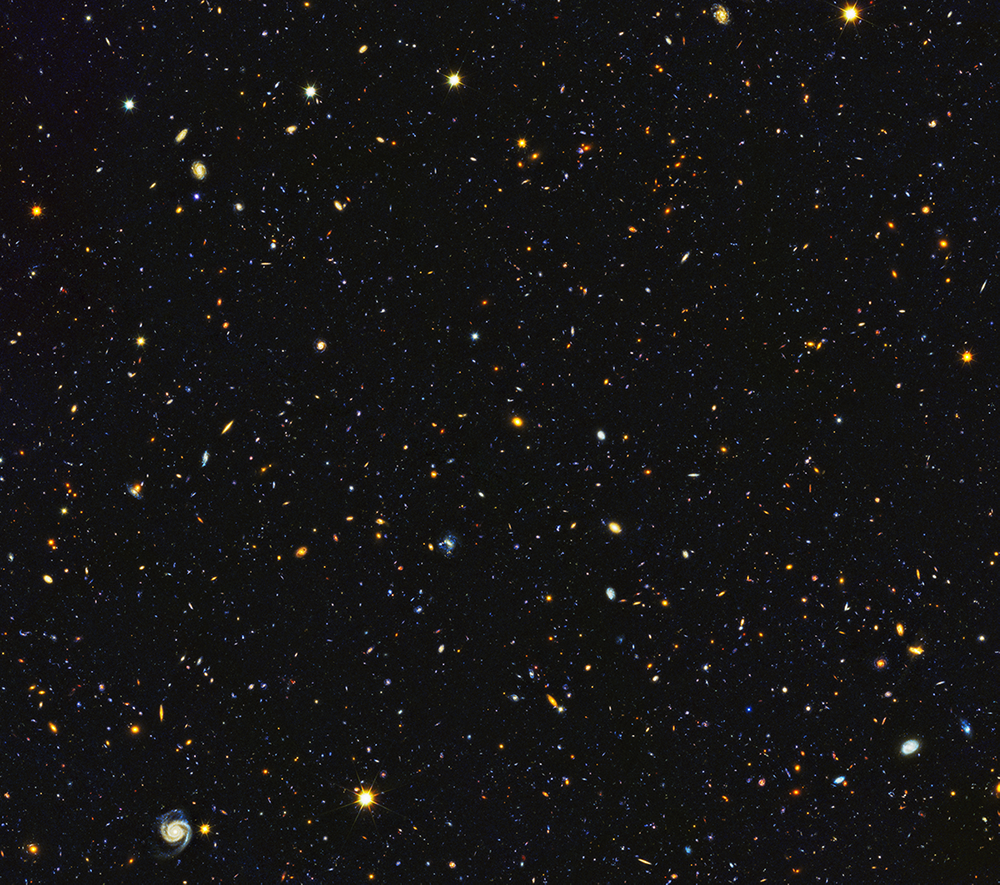
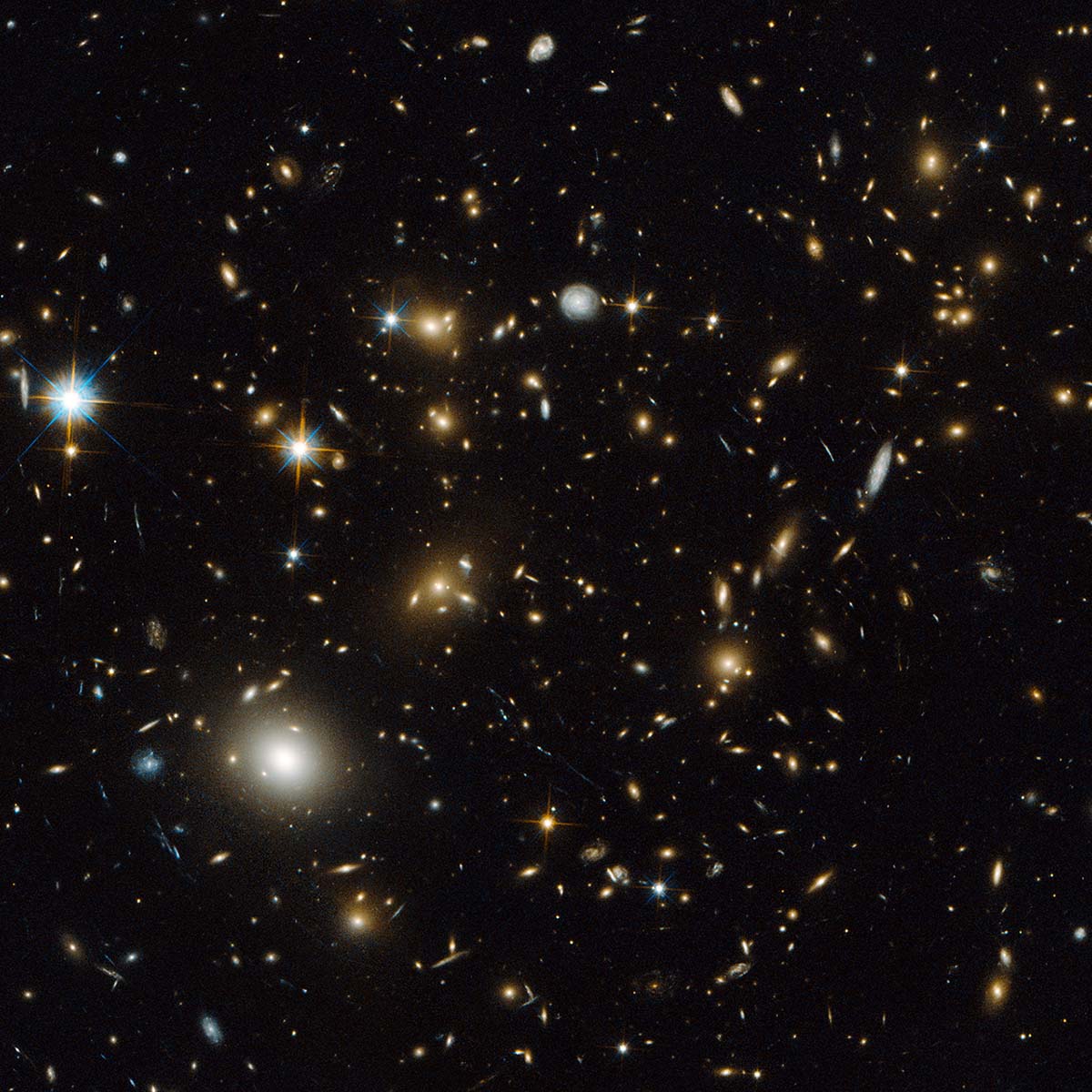
Nearly every object in this extraordinary image is a distant galaxy belonging to the massive cluster MACS J0717.5+3745, one of the most complex and dynamic galaxy clusters ever observed. This colossal structure is actually the result of four separate galaxy clusters colliding in a cosmic pileup of unprecedented scale, creating a turbulent merger that stretches across millions of light-years. Some of the faint arcs and streaks visible in the image are even more distant galaxies located far behind the cluster, whose light has been bent, stretched, and amplified by the powerful gravitational field of the cluster's enormous mass — a phenomenon known as gravitational lensing. The cluster's total mass, dominated by invisible dark matter, is so great that it warps the fabric of spacetime itself, turning this cosmic collision into a natural telescope that magnifies the faintest and most distant objects in the universe. This ongoing merger generates shock waves in the superheated intergalactic gas, producing X-ray emissions detectable by space observatories.
Scientific Significance
MACS J0717.5+3745 is one of the most scientifically valuable galaxy clusters known, serving as a natural laboratory for studying dark matter, galaxy evolution, and cosmology. As the most massive cluster in the MACS (Massive Cluster Survey) catalog, its extreme gravitational lensing power has been exploited by the Hubble Frontier Fields program to peer deeper into the early universe than otherwise possible. The quadruple merger occurring within this cluster provides unique constraints on the properties of dark matter: by mapping how mass is distributed relative to the visible galaxies and hot gas, astronomers can test whether dark matter is truly collisionless as predicted. X-ray observations reveal the complex dynamics of the intracluster medium during the merger, including shock fronts and cold fronts that trace the collision geometry. The cluster's filamentary connection to the cosmic web has also been directly detected, providing observational evidence for the large-scale structure of the universe.
Observation Details
Hubble observed MACS J0717.5+3745 using the Advanced Camera for Surveys (ACS) and Wide Field Camera 3 (WFC3) as part of the Hubble Frontier Fields program, which dedicated over 140 orbits to imaging this cluster in unprecedented depth. Observations were taken in multiple broadband filters spanning visible to near-infrared wavelengths, enabling photometric redshift estimates for thousands of lensed background galaxies. The extreme depth of these observations, reaching magnitudes fainter than 29, revealed some of the most distant and intrinsically faint galaxies ever detected.
Location in the Universe
Constellation
Auriga
Distance from Earth
5.4 billion light-years
Fun Facts
- 1
MACS J0717.5+3745 is the site of the most powerful collision ever detected among galaxy clusters — four clusters are merging simultaneously, an extremely rare cosmic event.
- 2
The cluster acts as a gravitational lens so powerful that it has been used to detect galaxies from when the universe was less than one billion years old, among the most distant objects ever observed.
- 3
The superheated gas between the colliding clusters reaches temperatures exceeding 100 million degrees, making it one of the hottest known regions in the universe outside of stellar interiors.
Image credit: NASA, ESA, Hubble Space Telescope