About This Image
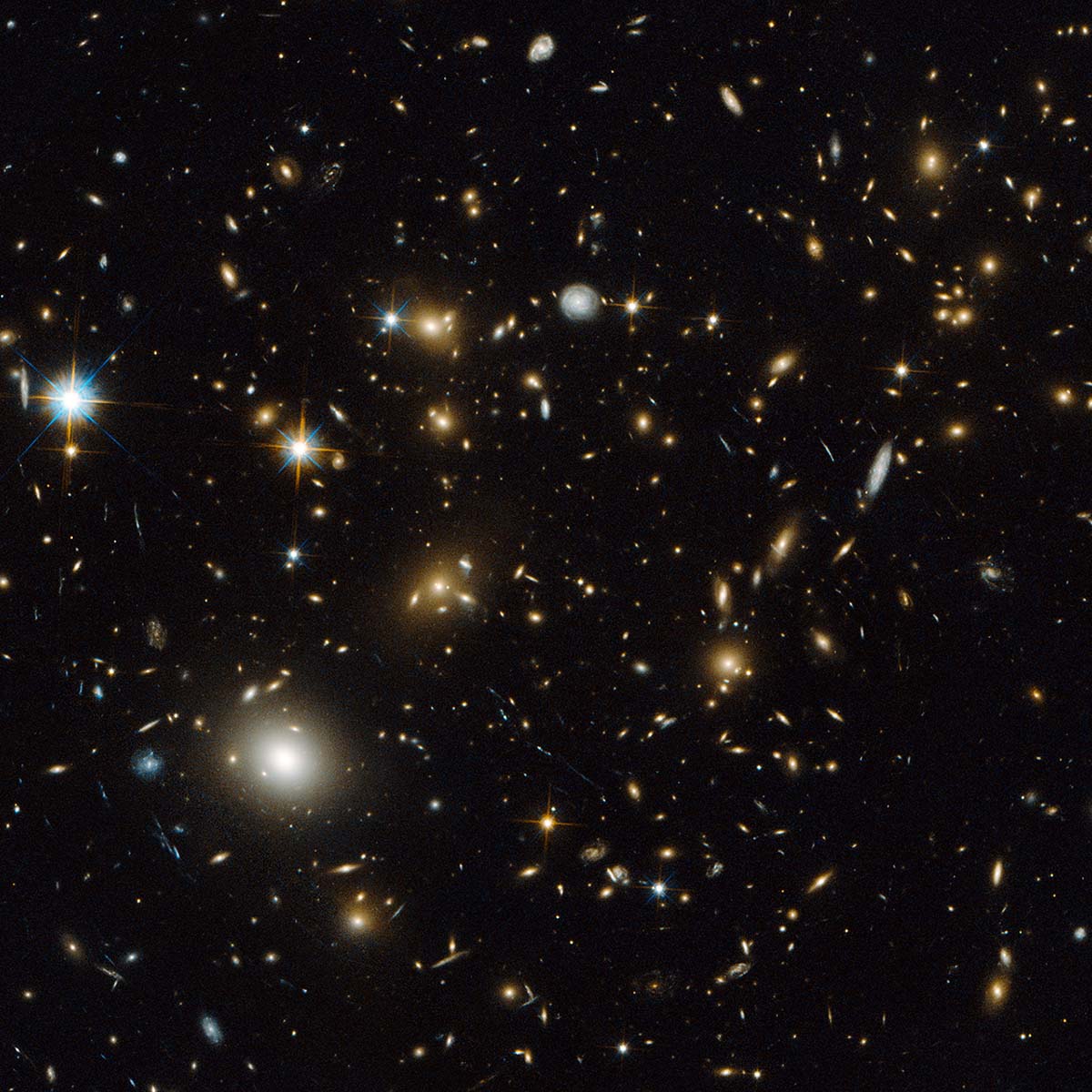
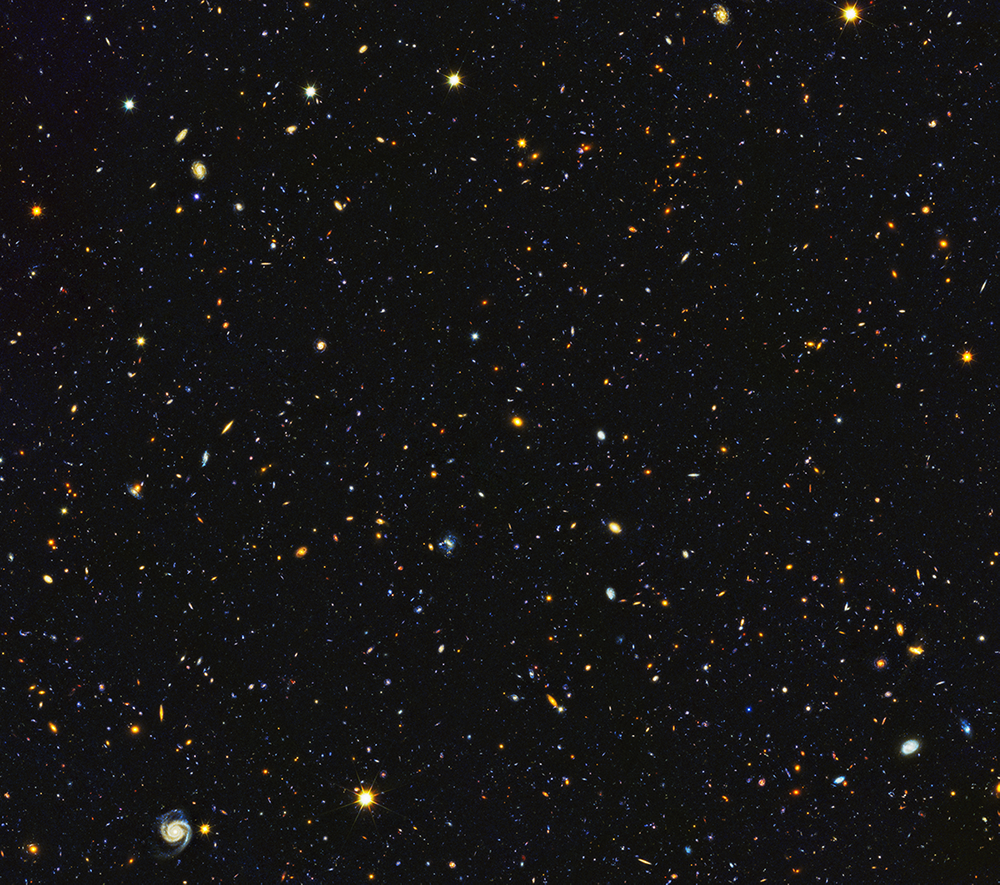
This breathtaking image captures approximately 15,000 galaxies stretching back through 11 billion years of cosmic history, from mature galaxies in the nearby universe to faint, irregular protogalaxies that existed when the cosmos was less than 3 billion years old. Hubble examined this particular region of sky, located near the Big Dipper in the constellation Ursa Major and designated the GOODS-North field, as part of the Great Observatories Origins Deep Survey (GOODS) — one of the most ambitious galaxy survey programs ever conducted. Every smudge and speck of light in this image is an entire galaxy containing billions of stars, and the variety of shapes, sizes, and colors on display chronicles the dramatic evolution of galaxies over most of cosmic time. Large, nearby spirals and ellipticals share the frame with distant, tiny, irregularly shaped galaxies whose chaotic appearances reflect the tumultuous conditions of the early universe, when galaxy mergers were far more frequent and star formation rates were at their peak. This single image contains more galaxies than there are people in many small countries.
Scientific Significance
The GOODS-North field is one of the most scientifically productive patches of sky ever observed, yielding fundamental insights into galaxy formation and evolution across cosmic time. By combining ultraviolet data from Hubble with infrared observations from Spitzer and X-ray data from Chandra, the GOODS program created a multi-wavelength census of galaxy properties — including star formation rates, stellar masses, dust content, and nuclear activity — spanning the past 11 billion years. Analysis of the galaxy population reveals that the cosmic star formation rate peaked roughly 10 billion years ago and has been declining ever since, a finding with profound implications for understanding why the universe produces progressively fewer new stars over time. The GOODS survey also identified large numbers of actively accreting black holes (active galactic nuclei) across cosmic time, revealing the co-evolution of black holes and their host galaxies. The ultraviolet component of this particular image was specifically designed to study star formation in galaxies during the epoch 5-10 billion years ago.
Observation Details
This image was assembled from data obtained using Hubble's Wide Field Camera 3 (WFC3) in ultraviolet and visible wavelengths, combined with archival Advanced Camera for Surveys (ACS) data in visible and near-infrared bands. The ultraviolet observations, spanning wavelengths from 225 to 336 nanometers, required approximately 250 orbits of Hubble time over a two-year period. These UV observations filled a critical gap in the electromagnetic spectrum coverage of the GOODS field, enabling direct detection of unobscured star formation in galaxies at intermediate redshifts. The final mosaic covers an area of roughly 12 by 14 arcminutes — about the apparent size of a pencil eraser held at arm's length.
Location in the Universe
Constellation
Ursa Major
Distance from Earth
Up to 11 billion light-years
Fun Facts
- 1
If each galaxy in this image contained an average of 100 billion stars, this single Hubble pointing captures roughly 1.5 quadrillion (1,500,000,000,000,000) stars — more stars than grains of sand on all of Earth's beaches.
- 2
The GOODS survey combined data from NASA's Great Observatories — Hubble, Chandra, and Spitzer — creating one of the most comprehensive multi-wavelength views of the distant universe ever assembled.
- 3
Some of the faintest galaxies in this image are over four billion times too faint to see with the naked eye, illustrating the extraordinary light-gathering power of Hubble's 2.4-meter mirror in space.
Image credit: NASA, ESA, Hubble Space Telescope