About This Image
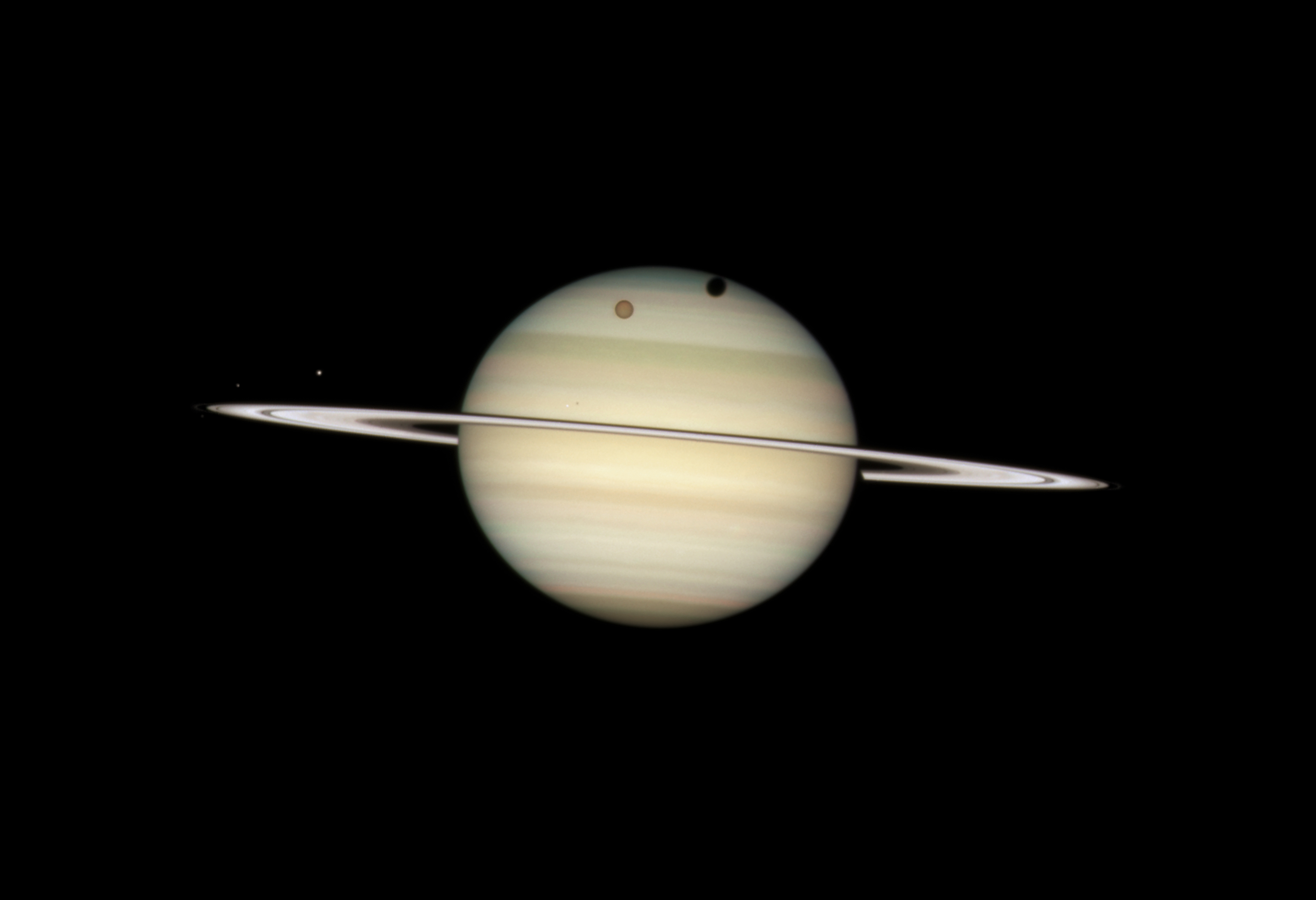
In this remarkable image, four moons of Saturn are captured passing in front of the giant planet in a rare celestial alignment that occurs only when Saturn's rings are oriented edge-on as seen from Earth — an event that happens roughly every 15 years. The large, orange-tinted moon Titan, Saturn's biggest satellite and the second-largest moon in the solar system, dominates the scene while casting a prominent dark shadow onto Saturn's northern hemisphere. Three smaller icy moons — Mimas, Dione, and Enceladus — appear as tiny white dots against Saturn's banded atmosphere, their diminutive sizes emphasizing the enormous scale of the gas giant planet. The ring system, normally Saturn's most prominent visual feature, appears as a thin, dark line bisecting the planet because it is seen nearly edge-on from Earth's vantage point. These edge-on ring plane crossings provide a unique opportunity to discover new moons, study the rings' vertical structure, and observe mutual events between Saturn's many satellites that are otherwise impossible to see when the rings are tilted.
Scientific Significance
This observation during Saturn's 2009 ring plane crossing provided valuable scientific data on multiple fronts. The edge-on viewing geometry allowed precise measurements of the rings' vertical thickness, which at approximately 10 meters is astonishingly thin relative to the rings' 280,000-kilometer diameter — proportionally thinner than a sheet of paper. The transit of multiple moons across Saturn's disk enabled precise astrometric measurements of the moons' orbital positions, refining orbital models that are essential for planning spacecraft trajectories. Observations of Titan during transits provide data on how the moon's thick atmosphere appears when backlit by Saturn, constraining models of atmospheric haze distribution. The ring plane crossing also facilitated searches for previously unknown small moons embedded within or near the ring system, as these objects are more easily detected against the reduced glare of the edge-on rings.
Observation Details
Hubble captured this image using the Wide Field Camera 3 (WFC3) in visible-light broadband filters during a carefully timed observation window when all four moons were simultaneously projected against Saturn's disk. The timing of the observation had to be calculated months in advance using precise ephemeris data for each moon. Multiple short exposures were combined to capture both the relatively bright disk of Saturn and the much fainter moons without saturating the detector. The WFC3's high sensitivity and sharp resolution were essential for resolving the tiny disks of Mimas, Dione, and Enceladus against Saturn's bright, banded atmosphere.
Location in the Universe
Constellation
N/A (Solar System)
Distance from Earth
746 million to 1 billion miles (varies)
Fun Facts
- 1
Titan, the large orange moon in this image, is the only moon in the solar system with a thick atmosphere — its surface pressure is 1.5 times that of Earth, and its atmosphere is primarily nitrogen, like ours.
- 2
Enceladus, one of the tiny white dots in this image, was later discovered by the Cassini spacecraft to have geysers of water vapor erupting from its south pole, making it one of the most promising places to search for extraterrestrial life.
- 3
Saturn's ring plane crossing, which made this multi-moon transit visible, occurs only twice during each 29.5-year orbital period — making such images possible only during narrow windows separated by about 15 years.
Image credit: NASA, ESA, Hubble Space Telescope