About This Image
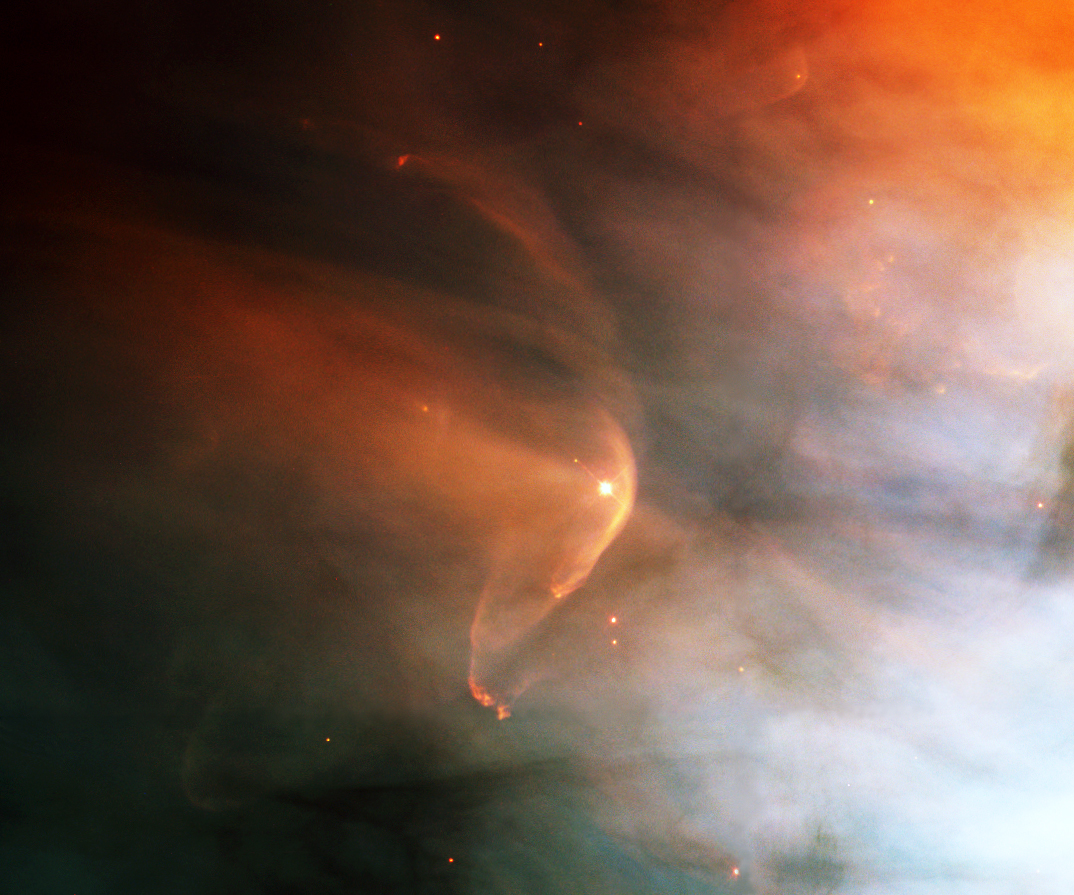
Named for the crescent-shaped wave made by a ship as it moves through water, a bow shock can be created in space when two streams of gas collide at supersonic speeds. This stunning image captures the bow shock around the young star LL Orionis, where the star's vigorous stellar wind — a stream of charged particles moving at extraordinary speed — slams into the slow-moving gas flowing away from the Orion Nebula's hot central star cluster. The collision creates a graceful, curved shock front that glows as the compressed gas is heated and excited. LL Orionis is a young, energetic star still in the early stages of its life, producing a stellar wind far more powerful than our Sun's. The surrounding Orion Nebula provides a rich canvas of flowing gas currents against which this dramatic cosmic collision plays out, offering astronomers a vivid illustration of how stellar winds interact with their environment and shape the interstellar medium.
Scientific Significance
The bow shock around LL Orionis provides an exceptionally clear example of the interaction between stellar winds and the ambient interstellar medium, a fundamental process that shapes the structure and evolution of star-forming regions. Young T Tauri stars like LL Orionis drive powerful outflows that inject energy and momentum into their surroundings, creating feedback effects that can either trigger or suppress nearby star formation. The geometry and brightness of the bow shock allow astronomers to measure the relative velocities of the colliding gas streams and estimate the mass-loss rate of the young star. These measurements are critical for understanding how much energy young stars return to their natal molecular clouds during the first few million years of their lives. The Orion Nebula, as the nearest massive star-forming region, offers unparalleled opportunities to study such interactions at high spatial resolution.
Observation Details
This image was obtained using Hubble's Wide Field and Planetary Camera 2 (WFPC2) as part of a mosaic survey of the Orion Nebula. The observations employed multiple broadband and narrowband filters to capture both the continuum emission from stars and the line emission from ionized gas. The hydrogen-alpha filter was particularly effective at highlighting the bow shock structure, as the compressed gas in the shock front emits strongly at this wavelength. Hubble's resolution was crucial for distinguishing the thin shock front from the complex background emission of the Orion Nebula.
Location in the Universe
Constellation
Orion
Distance from Earth
1,500 light-years
Fun Facts
- 1
The bow shock around LL Orionis is similar in principle to the shock wave created by a supersonic jet aircraft — except this cosmic version spans about half a light-year across.
- 2
LL Orionis is a T Tauri star, a type of young star less than 10 million years old that has not yet begun stable hydrogen fusion, making it a stellar infant by cosmic standards.
- 3
Our own Sun creates a bow shock as it moves through the interstellar medium, though it is far less dramatic than LL Orionis's because the Sun's stellar wind is much weaker.
Image credit: NASA, ESA, Hubble Space Telescope