About This Image
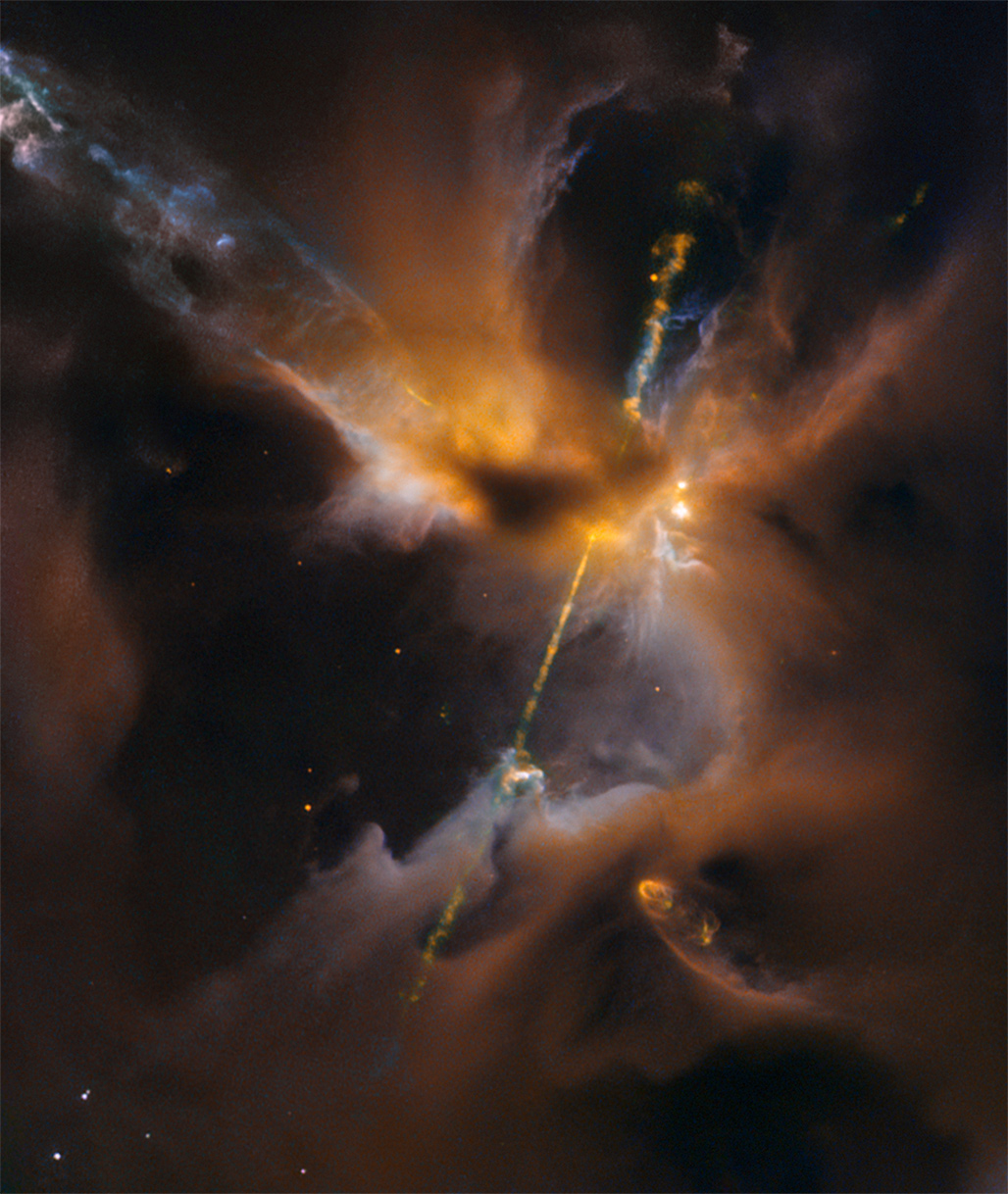
A partially obscured, newborn star near the center of this image is shooting twin jets of superheated gas into the surrounding molecular cloud, creating the spectacular object known as Herbig-Haro 24. These bipolar jets, traveling at hundreds of kilometers per second, slam into the ambient gas and dust with tremendous force, creating brilliant shock fronts that light up as patches of nebulosity on either side of the hidden protostar. Herbig-Haro objects like HH 24 are among the most visually striking signposts of ongoing star formation, marking the locations where young stars are still actively accreting material from their surrounding disks. The jets are launched from the innermost regions of the accretion disk surrounding the protostar, where magnetic fields accelerate and collimate the outflowing gas into narrow, focused beams. As the jets propagate outward, they create a chain of luminous knots where variations in the jet velocity produce internal shocks. The dark molecular cloud from which the young star is emerging appears to glow faintly at its edges where the jet radiation excites the surrounding gas.
Scientific Significance
Herbig-Haro 24 is a particularly well-defined example of a protostellar jet system that provides critical observational constraints on how young stars shed angular momentum during the accretion process. Without jets to carry away excess angular momentum, the conservation of angular momentum would prevent infalling gas from reaching the protostellar surface, halting the star's growth. The bipolar symmetry of HH 24's jets demonstrates that the launching mechanism is intimately connected to the accretion disk geometry and the star's magnetic field structure. The chain of bright knots along each jet records the history of variable accretion and ejection episodes, as periodic increases in the accretion rate produce faster jet pulses that subsequently catch up with and shock against slower material ejected earlier. Time-series Hubble observations of HH 24 and similar objects have directly measured the proper motions of individual knots, providing kinematic data that constrains jet launching models.
Observation Details
Hubble captured this image using the Wide Field Camera 3 (WFC3) in near-infrared filters that penetrate the dense molecular cloud obscuring the central protostar. The infrared observations reveal the jet structures that would be invisible in optical light due to the heavy dust extinction in the Orion molecular cloud complex. Specific filters were chosen to capture emission from shock-excited molecular hydrogen (H₂) at 2.12 micrometers and iron II at 1.64 micrometers, both of which are strong indicators of shock-heated gas in protostellar jets. The resulting false-color image highlights the jet morphology against the background of scattered light from the molecular cloud.
Location in the Universe
Constellation
Orion
Distance from Earth
1,350 light-years
Fun Facts
- 1
HH 24 bears a remarkable resemblance to a lightsaber from Star Wars — NASA even highlighted this similarity in a special image release to celebrate the franchise's anniversary.
- 2
The jets from the central protostar travel at roughly 100-300 kilometers per second — fast enough to travel from Earth to the Moon in less than half an hour.
- 3
Herbig-Haro objects are transient phenomena that typically last only a few thousand years before fading, making them cosmic mayflies — brief but brilliant markers of stellar birth.
Image credit: NASA, ESA, Hubble Space Telescope