About This Image
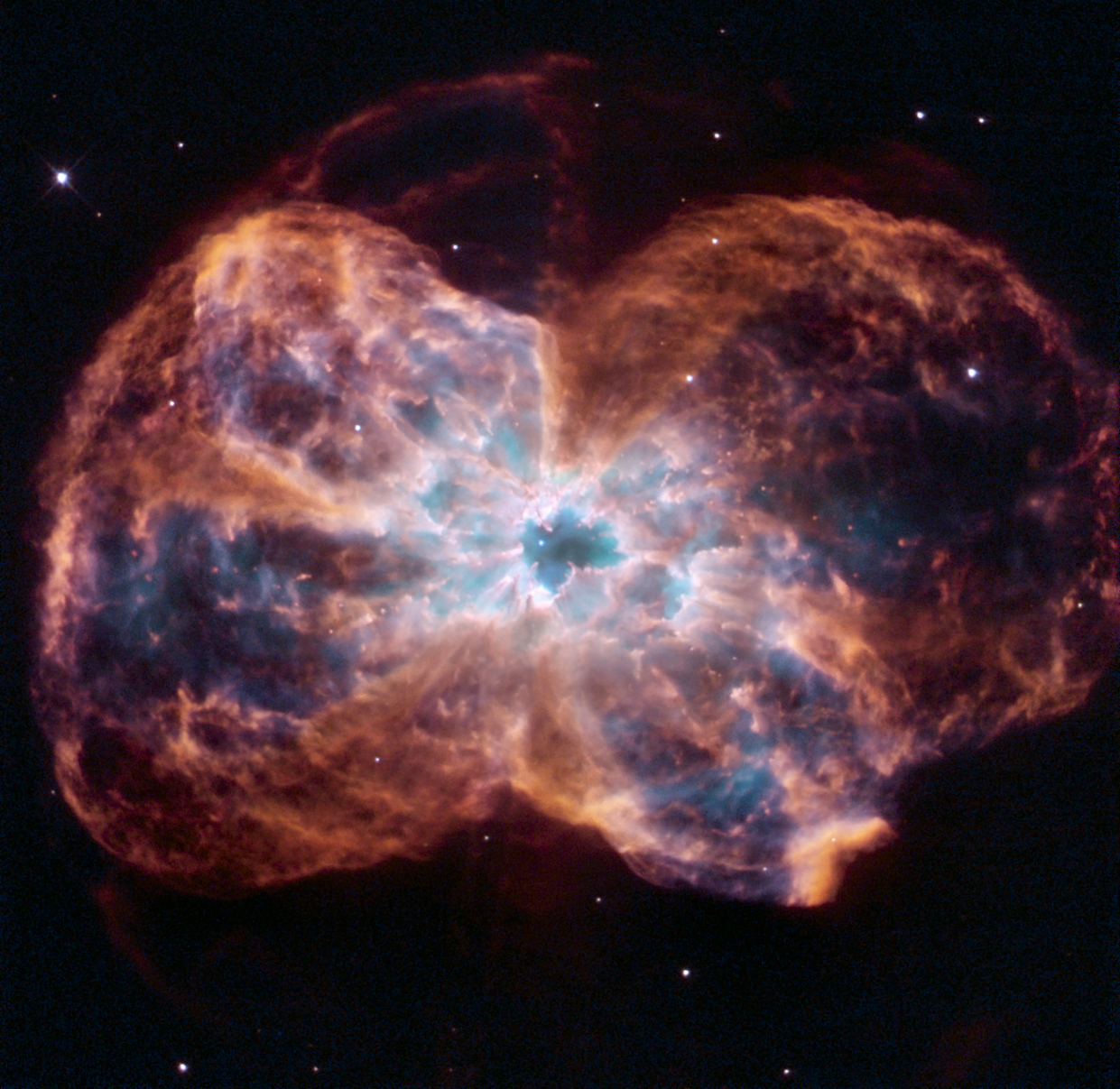
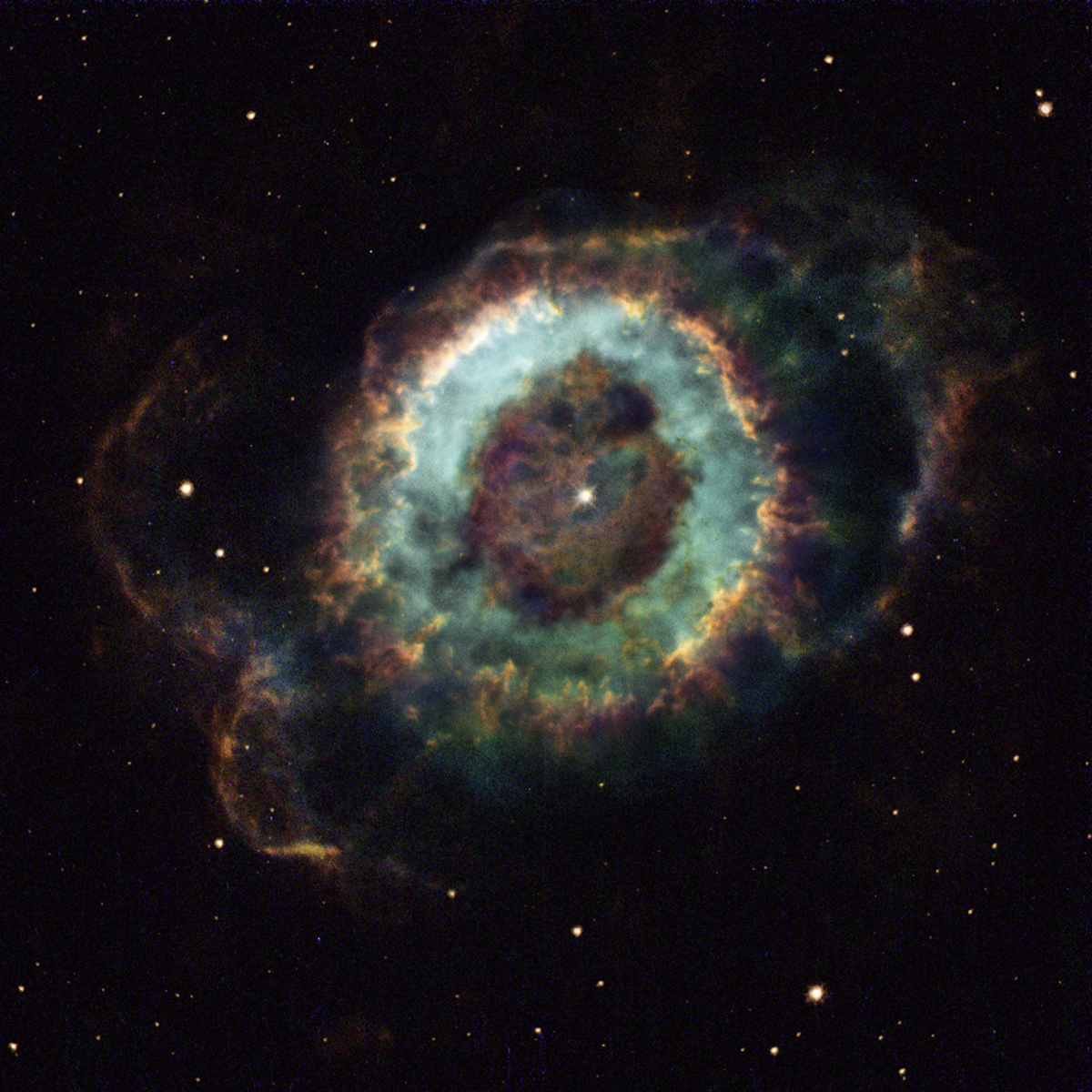
The Little Ghost Nebula (NGC 6369) appears as a small, ethereal cloud surrounding a dying star, its delicate, ghostly glow giving it its evocative common name. This planetary nebula was formed when a Sun-like star reached the end of its life and expelled its outer layers of gas into space, creating an expanding shell of luminous material around the hot, compact stellar remnant at its center. Found in the constellation Ophiuchus at a distance estimated between 2,000 and 5,000 light-years, the Little Ghost is notable for its nearly circular shape and its complex internal structure, which reveals multiple concentric shells of material ejected during different episodes of mass loss. The blue-green color of the inner region results from doubly ionized oxygen atoms glowing under the intense ultraviolet radiation of the central white dwarf, while the reddish outer halo is produced by the lower-energy glow of hydrogen and nitrogen. The nebula's small angular size made it a challenging but rewarding target for Hubble, whose high resolution reveals intricate details invisible to ground-based telescopes, including ring-like features and radial filaments that speak to the complex dynamics of the star's death throes.
Scientific Significance
NGC 6369 provides important data on the late stages of stellar evolution for intermediate-mass stars — those between about 1 and 8 solar masses that end their lives as white dwarfs surrounded by planetary nebulae. The multiple concentric shells visible in Hubble's image record distinct episodes of mass ejection during the star's asymptotic giant branch (AGB) phase, when thermal pulses in the star's helium-burning shell periodically trigger enhanced mass loss. The spacing and density of these shells constrain the interpulse period and mass-loss rate during the AGB phase, fundamental parameters in stellar evolution models. The nearly circular symmetry of NGC 6369 suggests that the mass loss was relatively isotropic, in contrast to many planetary nebulae that display bipolar or multi-polar morphologies indicative of binary star interactions or strong magnetic fields. This makes it a valuable comparison case for understanding what determines the diverse shapes of planetary nebulae.
Observation Details
Hubble observed the Little Ghost Nebula using the Wide Field and Planetary Camera 2 (WFPC2) in narrowband filters targeting oxygen III (501 nm), hydrogen-alpha (656 nm), and nitrogen II (658 nm) emission lines. These three filters isolate emission from gas at different temperatures and ionization states, enabling astronomers to map the physical conditions throughout the nebula. The oxygen III emission traces the hottest, most highly ionized gas closest to the central star, while hydrogen-alpha and nitrogen II trace cooler gas further from the ionizing source. The resulting color composite reveals the layered ionization structure characteristic of photoionized planetary nebulae.
Location in the Universe
Constellation
Ophiuchus
Distance from Earth
2,000 to 5,000 light-years
Fun Facts
- 1
The Little Ghost Nebula earned its spooky name because when viewed through a small telescope, it appears as a faint, round, ghostly apparition that seems to float in the darkness of space.
- 2
The central star of NGC 6369 has a surface temperature of roughly 89,000°C — about 15 times hotter than the Sun's surface — but is only about the size of Earth, having compressed its mass into an incredibly dense white dwarf.
- 3
Planetary nebulae like the Little Ghost are ephemeral by cosmic standards, lasting only about 20,000 to 30,000 years before dispersing into the interstellar medium — a mere instant in a star's multi-billion-year lifetime.
Image credit: NASA, ESA, Hubble Space Telescope