About This Image
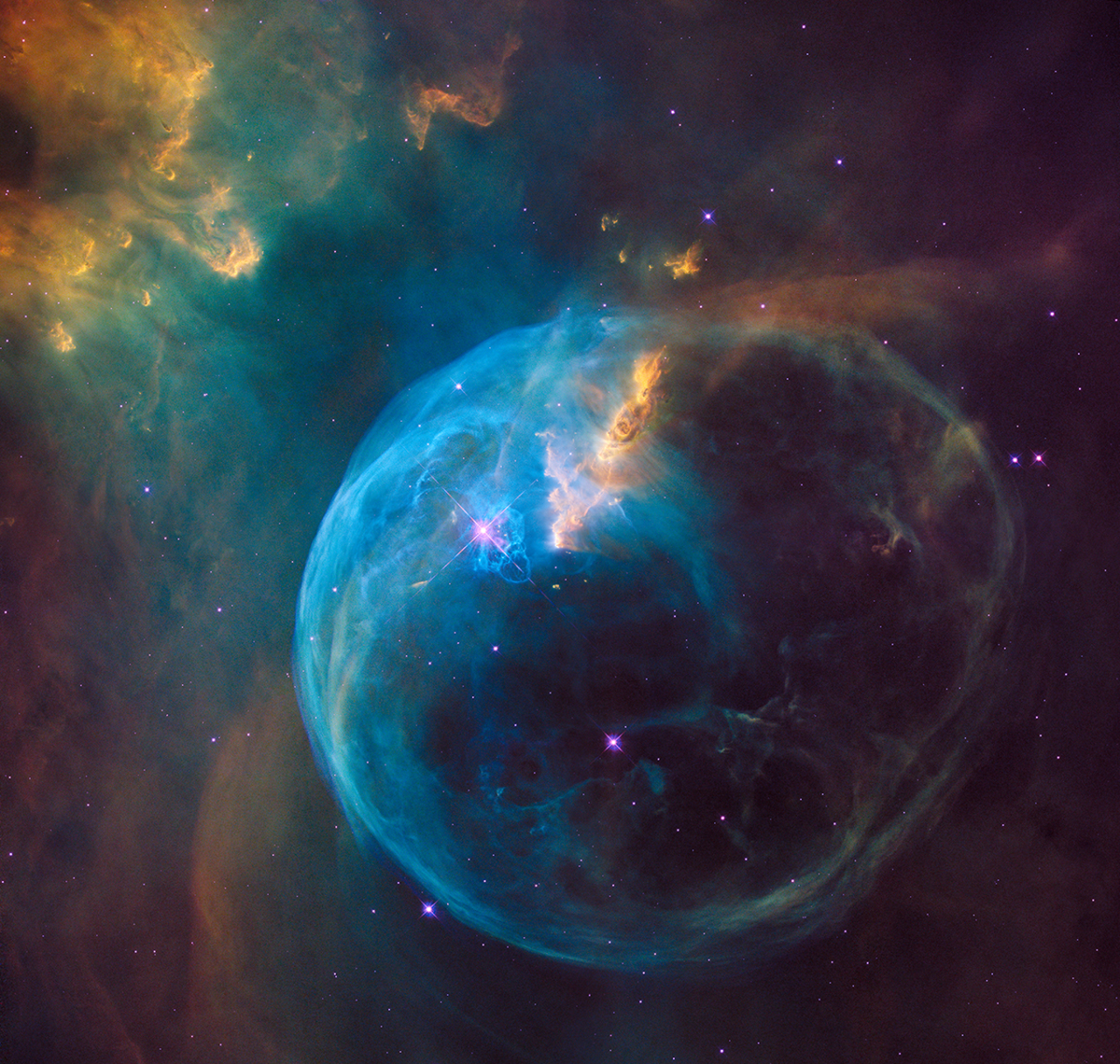
An enormous, nearly perfect cosmic bubble is being blown into space by the fierce stellar winds of a super-hot, massive star designated SAO 20575 (also known as BD+60°2522). The Bubble Nebula, officially cataloged as NGC 7635, is an awe-inspiring example of a wind-blown bubble — a structure created when the fast-moving stellar wind from a massive star sweeps up the slower, denser surrounding interstellar gas, compressing it into a thin, glowing shell. The bubble is roughly seven light-years in diameter, large enough that light itself takes seven years to cross from one side to the other. The driving star, visible inside the bubble but noticeably offset from its center, is roughly 10 to 20 times more massive than the Sun and millions of times more luminous. The asymmetric position of the star within its own bubble reveals that the surrounding interstellar medium is not uniform — the bubble expands more easily in directions where the gas is less dense and is compressed in directions where it encounters denser molecular cloud material. This interaction between the expanding bubble and the neighboring molecular cloud creates the dramatic bright rim visible at the upper edge of the structure.
Scientific Significance
The Bubble Nebula is one of the most visually perfect examples of a stellar wind bubble, a structure predicted by theoretical models of how massive stars interact with their surrounding interstellar medium. The standard model of wind-blown bubbles predicts a structure consisting of freely streaming stellar wind, a hot shocked wind region, a thin dense shell of swept-up material, and the undisturbed ambient medium. Hubble's observations allow detailed comparison of NGC 7635's actual structure with these theoretical predictions, revealing both agreements and discrepancies that refine our understanding of stellar wind physics. The offset position of the central star from the geometric center of the bubble demonstrates how density gradients in the interstellar medium produce asymmetric bubble growth, a common feature in real stellar wind bubbles that is often simplified away in theoretical models. The interaction between the bubble and the adjacent dense molecular cloud also creates a photodissociation region whose properties can be measured and compared with models.
Observation Details
This image was captured using Hubble's Wide Field Camera 3 (WFC3) in visible light for the telescope's 26th anniversary. The full bubble required a mosaic of four tiles, each captured in narrowband filters isolating hydrogen-alpha (656 nm), oxygen III (501 nm), and nitrogen II (658 nm) emission lines. This Hubble Heritage color mapping assigns blue to oxygen III, green to hydrogen-alpha, and red to nitrogen II, revealing the chemical stratification within the bubble wall and surrounding nebulosity. The narrowband imaging cleanly separates the emission nebula from the field stars, providing an uncontaminated view of the gas structure.
Location in the Universe
Constellation
Cassiopeia
Distance from Earth
7,100 light-years
Fun Facts
- 1
The Bubble Nebula was the subject of Hubble's 26th anniversary image in 2016 — it was the first time the entire bubble had been captured in a single Hubble image, requiring all four tiles of the WFC3 detector.
- 2
The central star is so luminous that it emits as much energy in one second as the Sun produces in approximately one year, and its stellar wind blows outward at over 4 million miles per hour.
- 3
The Bubble Nebula is located near the giant molecular cloud complex associated with the Cassiopeia OB2 stellar association, one of the most active star-forming regions in our quadrant of the Milky Way.
Image credit: NASA, ESA, Hubble Space Telescope