About This Image
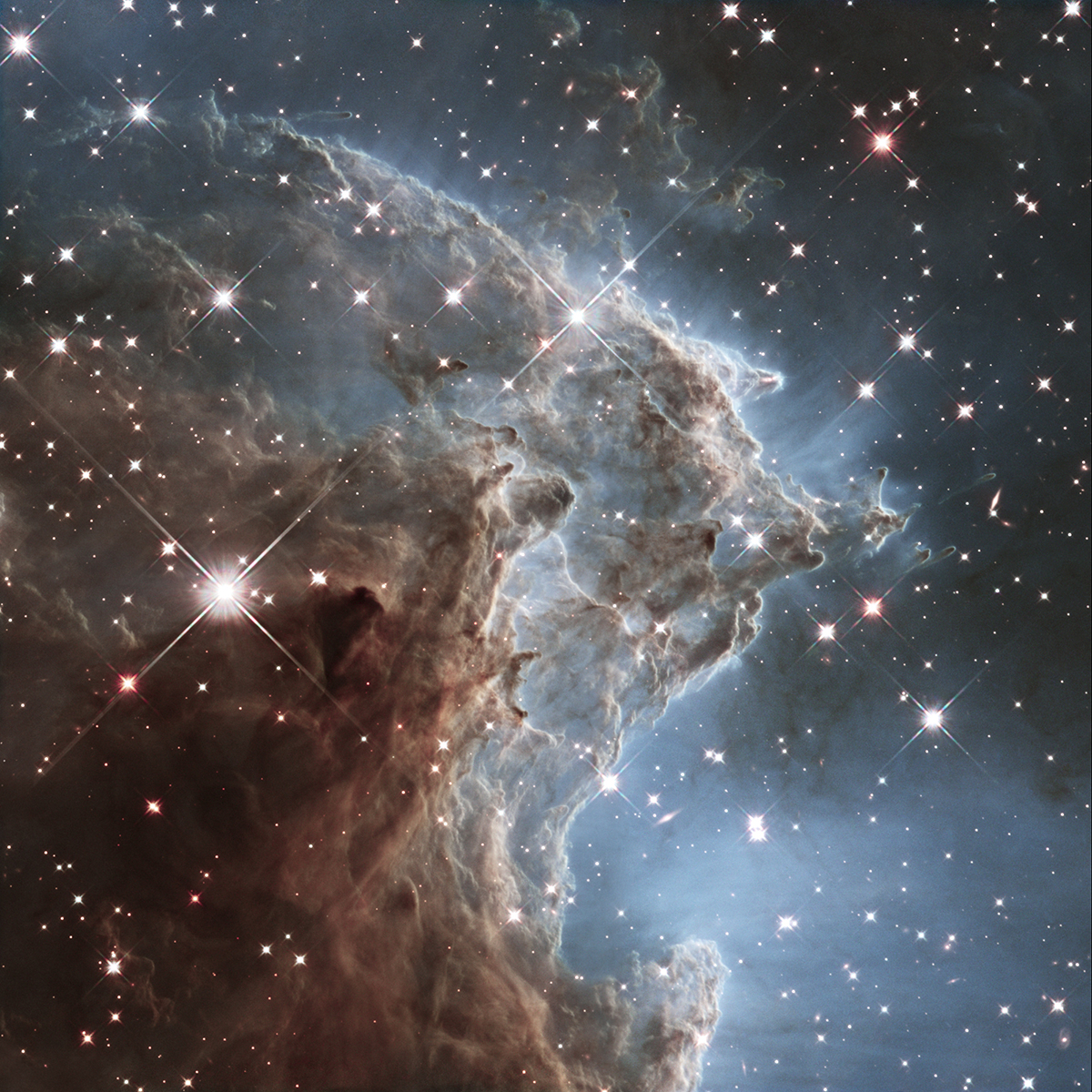
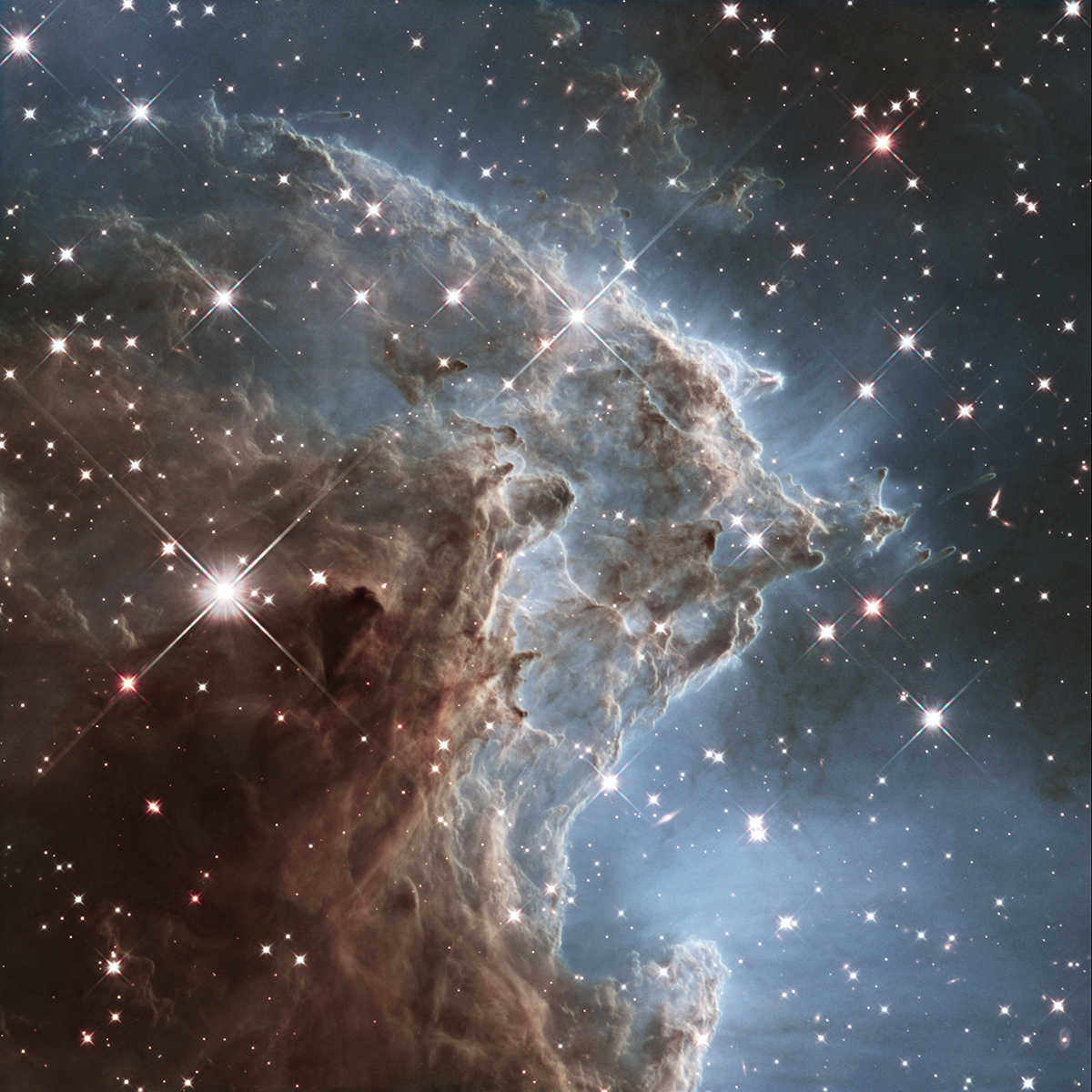
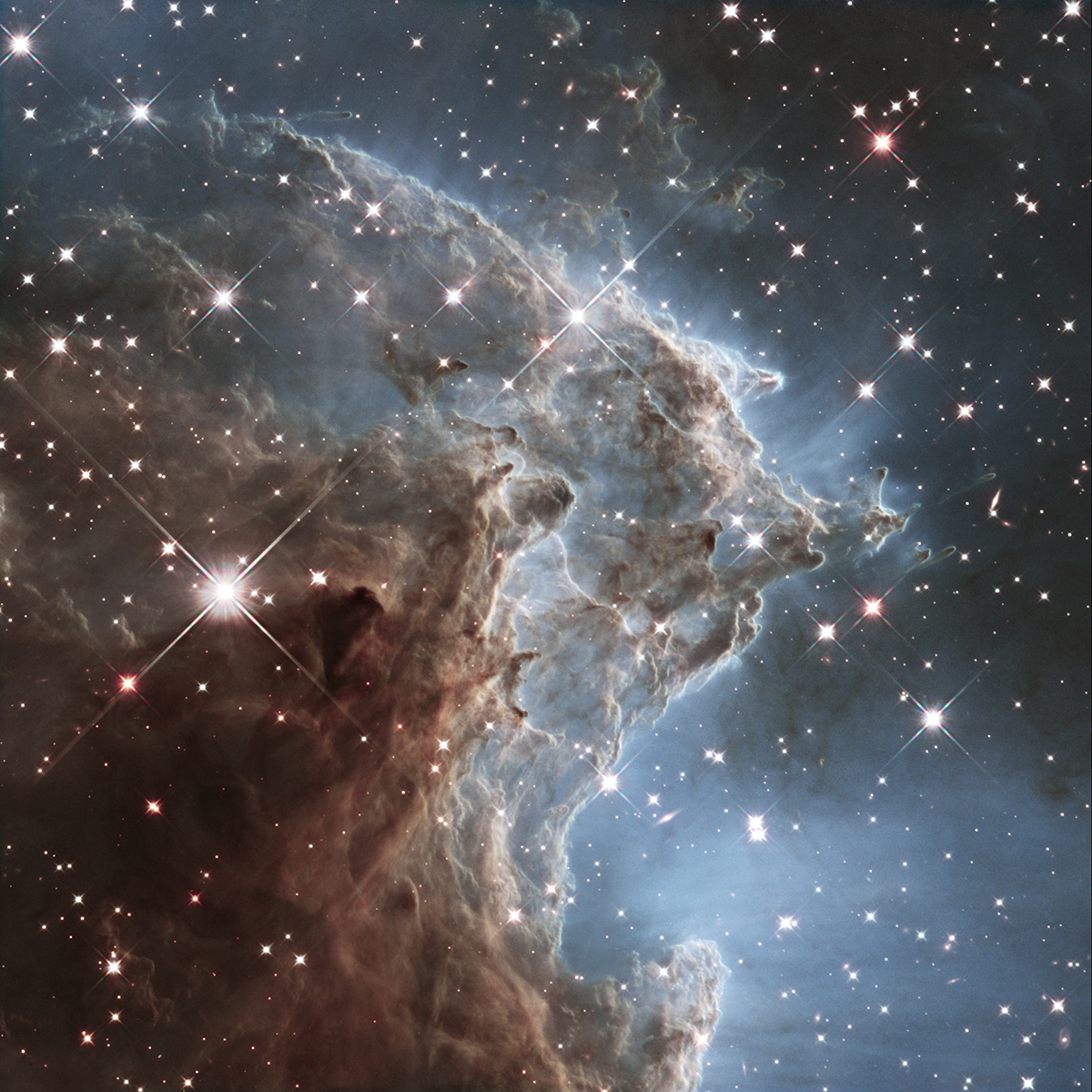
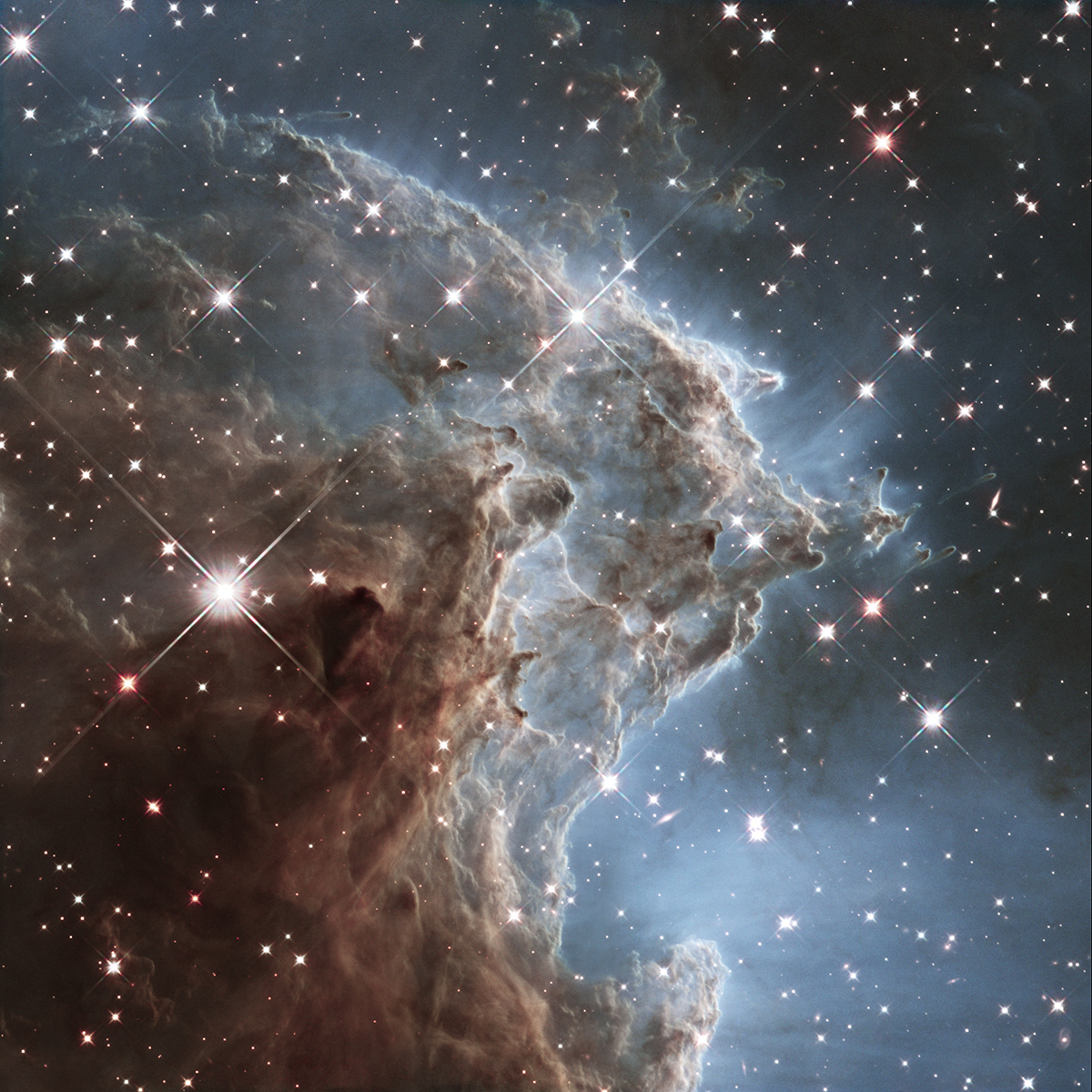
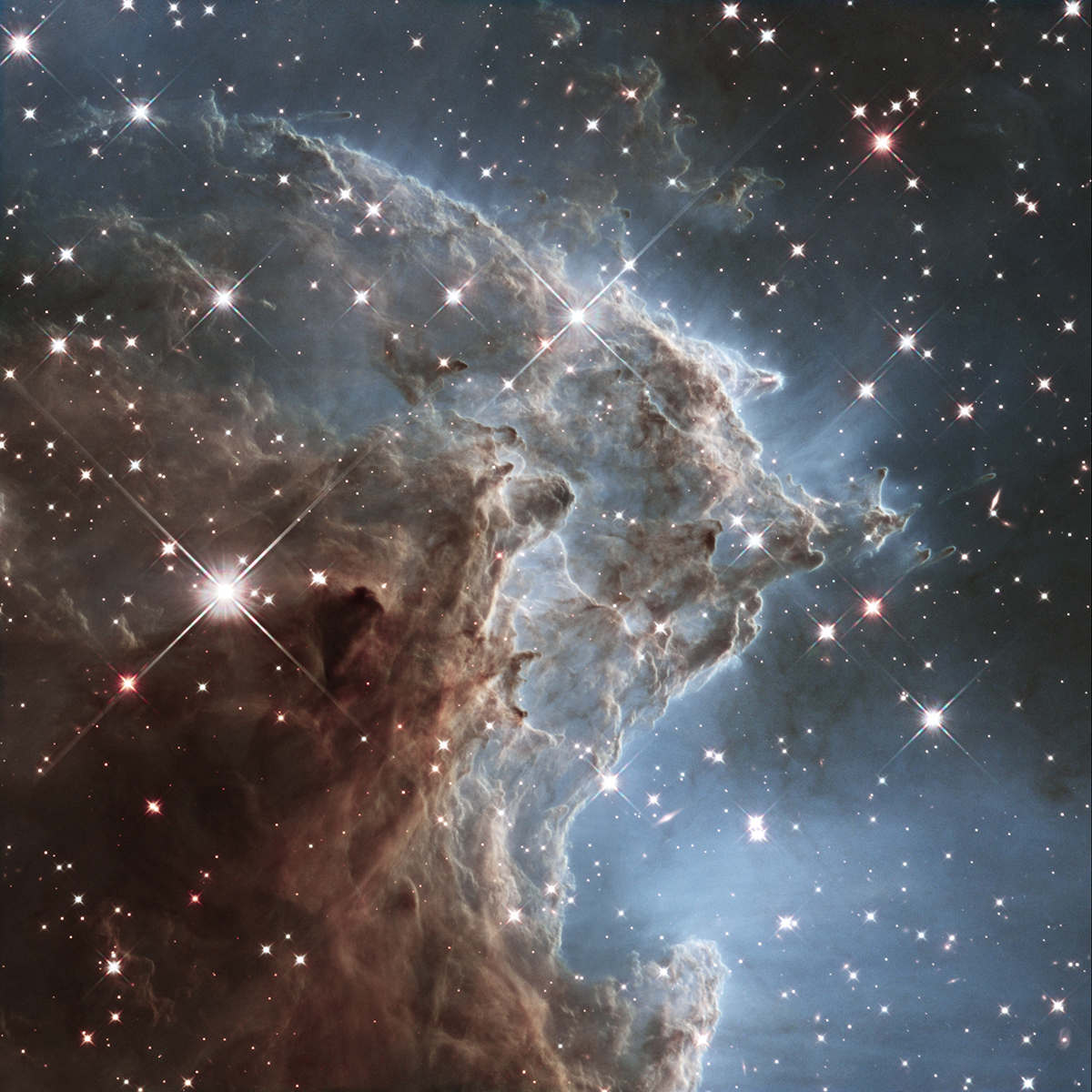
This fifth and final Hubble perspective of the Monkey Head Nebula (NGC 2174) captures an area at the periphery of the active star-forming region, where the transition between the ionized nebula interior and the surrounding undisturbed molecular cloud is clearly visible. Here, the radiation-carved structures become less dramatic as the influence of the central massive stars wanes with distance, and the morphology shifts from the bold, sharply defined pillars seen closer to the ionizing sources to softer, more rounded features that blend gradually into the ambient cloud. This boundary region is scientifically important because it represents the advancing frontier of the HII region — the ever-expanding bubble of ionized gas that grows as stellar radiation progressively eats into the surrounding molecular material. The structures at this frontier are younger in their exposure to radiation than the deeply carved pillars closer to the central stars, providing a natural time sequence of pillar evolution within a single image. Faint wisps of emission extending beyond the main nebula boundary trace the most recent expansion of the ionization front into pristine molecular gas.
Scientific Significance
The boundary region of the Monkey Head Nebula captured in this image provides unique insights into the early stages of HII region expansion into molecular clouds. At this frontier, the conditions are intermediate between the heavily processed interior of the HII region and the undisturbed molecular gas, allowing astronomers to study the initial response of molecular material to stellar radiation exposure. Observations show that the first structures to form at the advancing ionization front are broad, rounded prominences rather than the narrow, elongated pillars found deeper inside the nebula, suggesting that pillar formation requires sustained radiation exposure over extended periods. This evolutionary sequence — from broad, newly exposed features to narrow, deeply carved pillars — helps constrain the timescales for pillar development in star-forming regions, with implications for understanding how long embedded protostars have to complete their formation before their natal material is removed.
Observation Details
This image was captured using Hubble's Wide Field Camera 3 (WFC3) in infrared wavelengths, completing the multi-pointing mosaic of the Monkey Head Nebula begun with the earlier observations. The same filter set (F105W, F110W, F128N, F160W) was used for consistency across the mosaic, enabling uniform photometric analysis of the embedded stellar population. The infrared observations were supplemented by archival visible-light data from ground-based telescopes, which provided wider-field context for the Hubble pointings. Astrometric calibration ensured accurate alignment between the individual mosaic tiles.
Location in the Universe
Constellation
Orion
Distance from Earth
6,400 light-years
Fun Facts
- 1
The HII region boundary visible in this image is advancing into the molecular cloud at roughly 1-2 kilometers per second — slow by everyday standards, but fast enough to reshape the nebula's structure over thousands of years.
- 2
The Monkey Head Nebula is part of a much larger molecular cloud complex called the Gemini OB1 association, which has been forming stars for at least 10 million years across a region spanning hundreds of light-years.
- 3
Five different Hubble pointings were needed to capture the full diversity of structures within the Monkey Head Nebula, demonstrating the incredible complexity hidden within even a single star-forming region.
Image credit: NASA, ESA, Hubble Space Telescope