About This Image
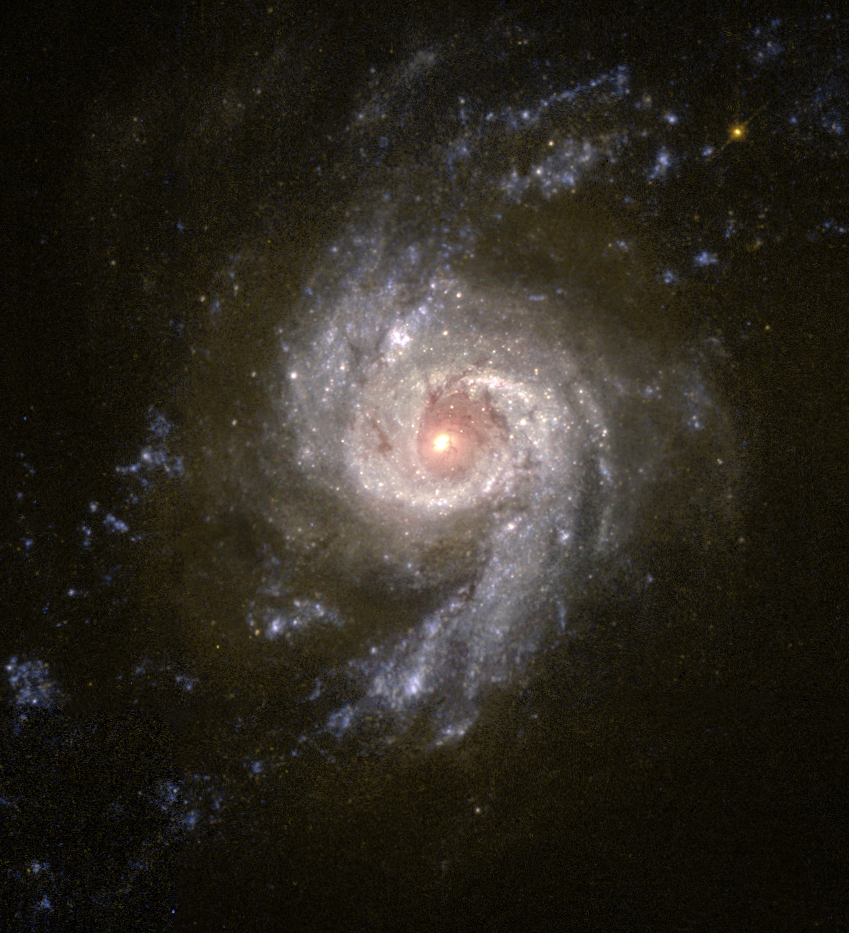
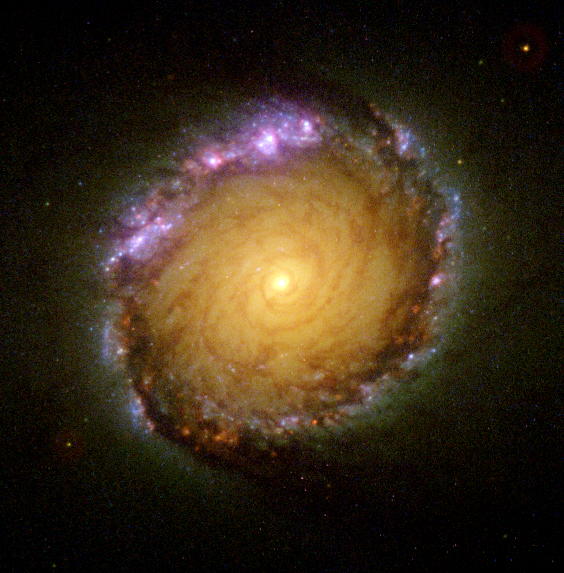
The core of the barred spiral galaxy NGC 1512 is unique for its stunning 2,400-light-year-wide circle of infant star clusters, called a "circumnuclear" starburst ring. This remarkable ring of vigorous star formation encircles the galaxy's nucleus like a glowing crown, creating one of the most beautiful examples of nuclear star formation in the nearby universe. Starbursts are episodes of intense star formation where gas is compressed by gravitational forces, and in NGC 1512's case, the galaxy's strong central bar funnels gas inward toward the nucleus, accumulating it into a dense ring where conditions become ripe for explosive bursts of new star birth. The brilliant blue clusters in the ring contain hot, massive stars only a few million years old — cosmic infants by galactic standards.
Scientific Significance
NGC 1512 is a premier example of how galactic bars drive the internal evolution of spiral galaxies. The bar structure acts as a gravitational conveyor belt, channeling interstellar gas from the outer disk inward toward the nucleus. As this gas accumulates at the inner end of the bar, it forms a dense ring where gravitational instabilities trigger intense bursts of star formation. Understanding this bar-driven gas transport mechanism is crucial because it explains how galaxies redistribute their raw materials over time and how the growth of central bulges and supermassive black holes is connected to large-scale galactic structure. NGC 1512's starburst ring contains clusters with ages ranging from just a few million to several hundred million years, indicating that star formation has been occurring in episodic bursts rather than continuously. The interaction with companion galaxy NGC 1510 adds another dimension to the story, demonstrating how external gravitational perturbations can enhance bar-driven gas flows and amplify nuclear starbursts.
Observation Details
This image was captured using Hubble's Wide Field and Planetary Camera 2 (WFPC2) in ultraviolet, visible, and near-infrared filters. The ultraviolet observations were particularly critical for identifying the youngest and hottest star clusters in the circumnuclear ring, as massive young stars emit most of their energy at ultraviolet wavelengths. The multi-wavelength approach allowed astronomers to estimate the ages, masses, and metallicities of individual star clusters within the ring by comparing their colors to stellar evolution models. Ground-based spectroscopy complemented the Hubble imaging by measuring the velocities of gas flowing along the bar toward the nuclear ring.
Location in the Universe
Constellation
Horologium
Distance from Earth
30 million light-years
Fun Facts
- 1
NGC 1512's circumnuclear starburst ring is one of the most perfectly circular stellar ring structures known, with a diameter of about 2,400 light-years — roughly the distance from our Sun to the nearest spiral arm of the Milky Way.
- 2
The galaxy actually has a second, much larger outer ring of star formation with a diameter of about 130,000 light-years, giving NGC 1512 a rare double-ring structure that makes it one of the most architecturally complex galaxies in the local universe.
- 3
NGC 1512 is gravitationally interacting with its small companion galaxy NGC 1510, and this interaction is thought to help drive gas inward along the bar, fueling the spectacular nuclear starburst ring.
Image credit: NASA, ESA, Hubble Space Telescope