About This Image
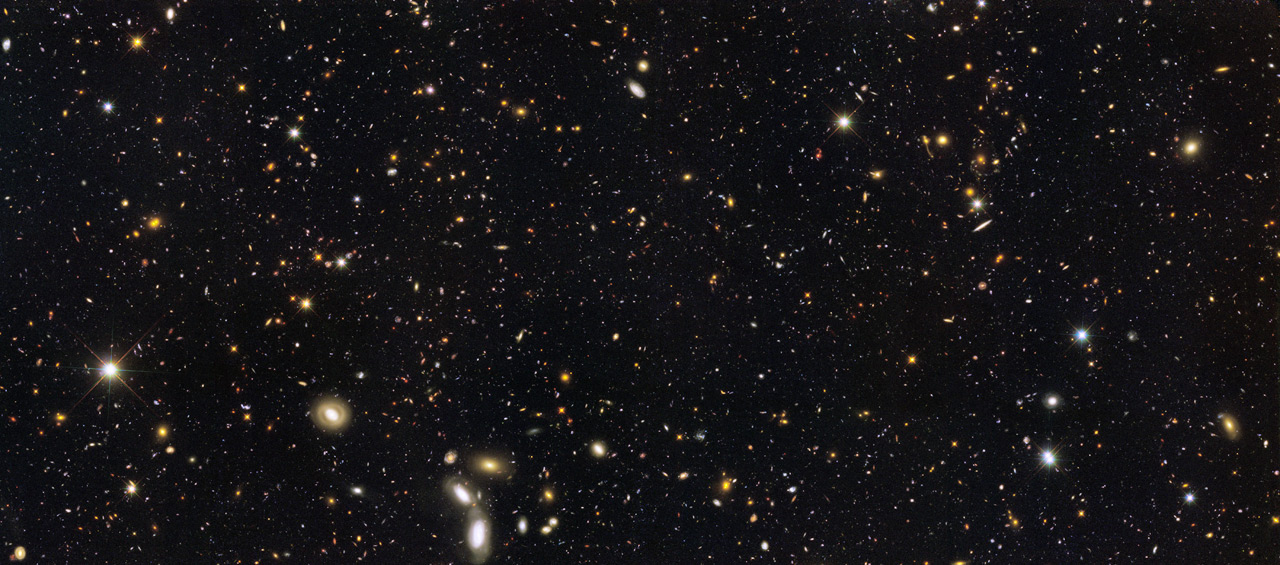
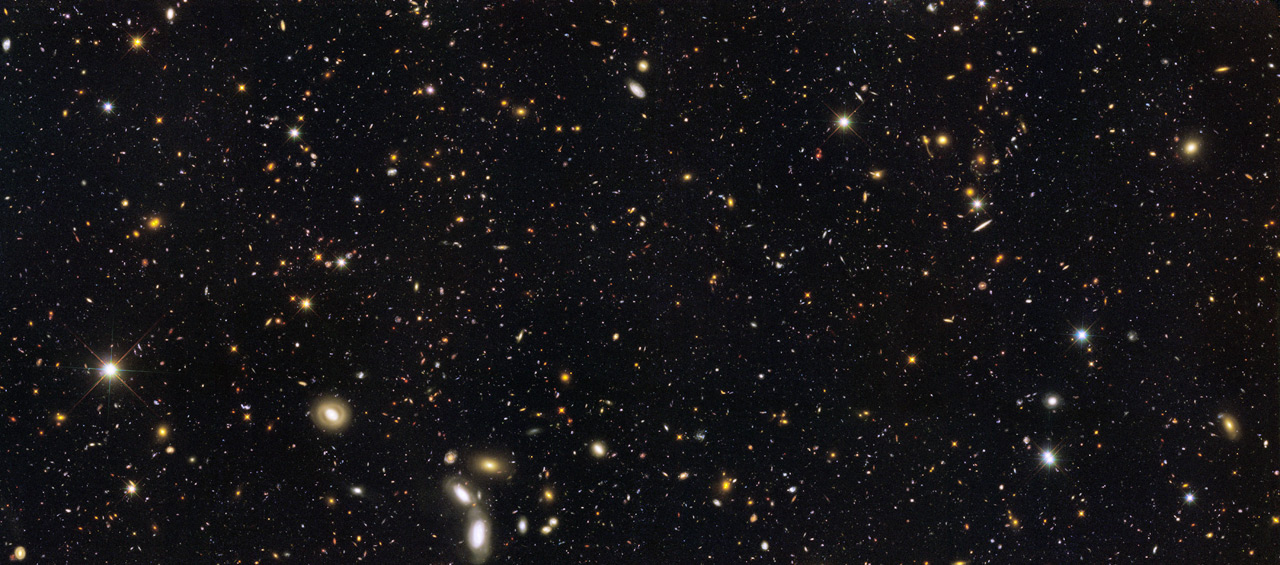
More than 12 billion years of cosmic history are shown in this panoramic view of thousands of galaxies in various stages of assembly. The view covers a portion of the southern field of a galaxy census called the Great Observatories Origins Deep Survey (GOODS).
Scientific Significance
The GOODS South Field is one of the foundational datasets for modern extragalactic astronomy. It links galaxy morphology, stellar mass, star-formation rate, and environment over a broad redshift range, enabling statistical tests of how galaxies assembled from the early universe to the present. Because GOODS was designed as a multiwavelength legacy survey, it allows consistent cross-comparison between ultraviolet, optical, infrared, and X-ray properties. The field underpins benchmark measurements such as the evolution of the cosmic star-formation rate density and growth of massive galaxies through mergers and internal processes.
Observation Details
Hubble observations of GOODS South used deep, repeated imaging in multiple filters to maximize depth while preserving accurate colors for photometric redshifts. Survey strategy balanced sky coverage and sensitivity, producing a large sample of faint galaxies with resolved structure. Data processing included mosaicking, geometric distortion correction, and matched-aperture photometry across bands. Public data releases provided calibrated images and source catalogs used by thousands of studies. The field also benefits from coordinated spectroscopy and infrared follow-up that refine redshifts and stellar-population modeling.
Location in the Universe
Constellation
Fornax
Distance from Earth
Up to 13 billion light-years
Fun Facts
- 1
GOODS combines data from multiple great observatories, including Hubble, Spitzer, and Chandra, to study galaxy evolution across wavelengths.
- 2
Each deep pointing contains galaxies from many epochs, so a single image effectively samples billions of years of history.
- 3
The same field has been revisited for years, enabling improved catalogs and redshift estimates as analysis methods advanced.
Image credit: NASA, ESA, Hubble Space Telescope