About This Image
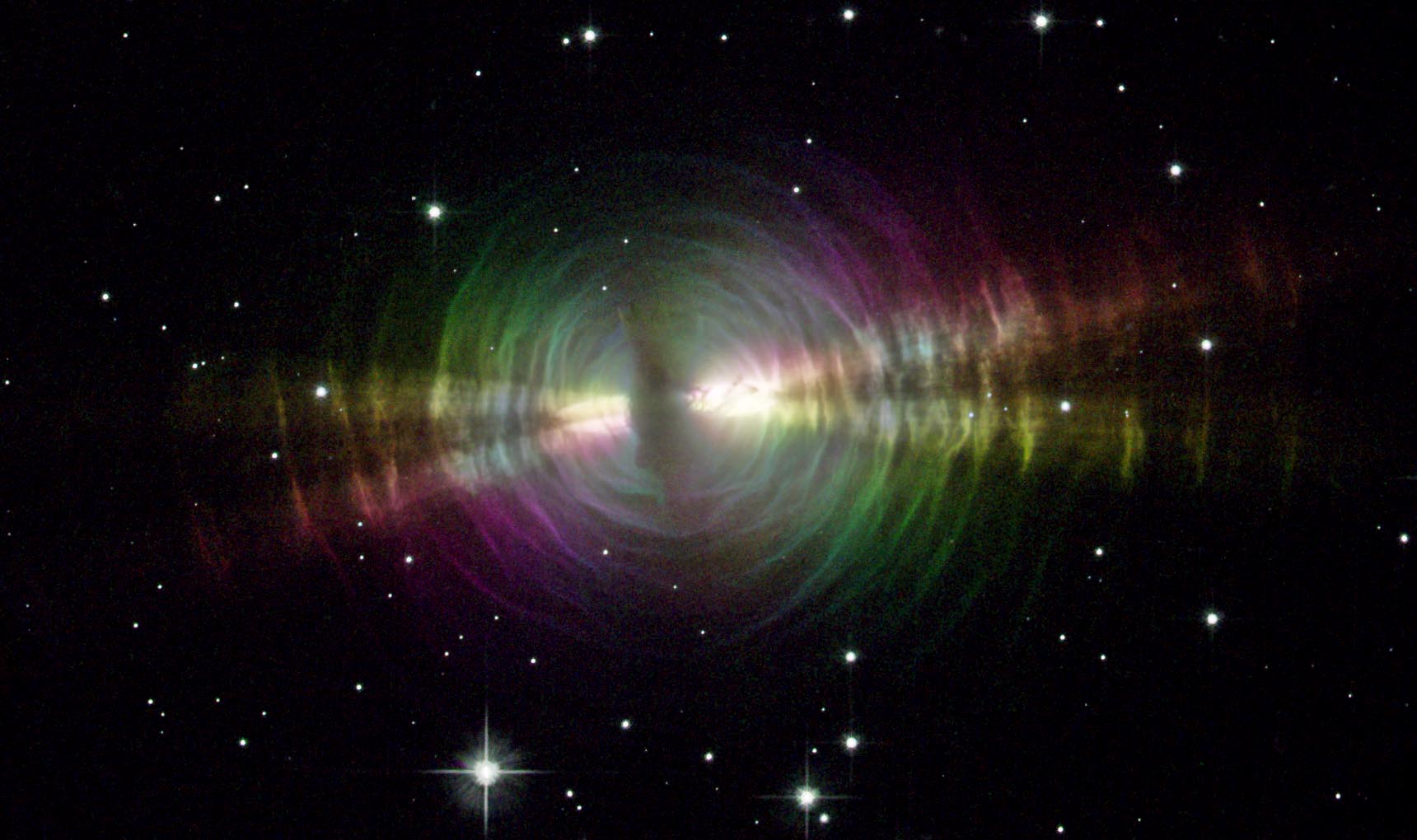
In the Egg Nebula, shells of dust form concentric rings around an aging star, resembling the layers of an onion. A thick dust belt, running almost vertically through the center, blocks light from the central star while twin beams of light radiate from the star.
Scientific Significance
The Egg Nebula is one of the clearest nearby examples of how spherical stellar winds evolve into strongly bipolar outflows before planetary-nebula formation. Its ring-like shells and polar lobes constrain models of episodic mass loss, dust production, and the role of binary interaction or magnetic shaping in late stellar evolution. Because this stage is brief, well-resolved objects like the Egg Nebula are rare and scientifically important. They help connect red giant mass-loss physics to the eventual enrichment of the interstellar medium with carbon-rich dust and molecules.
Observation Details
Hubble imaged the Egg Nebula in optical bands with high dynamic range to capture both bright central scattering lobes and faint outer arcs. The data reveal layered shells, a prominent obscuring dust lane, and collimated beams extending from the hidden central star. Polarimetric and multi-band analyses distinguish scattered light from line emission and map dust geometry. Temporal comparisons across epochs can detect small morphological changes in outflow features. Hubble's angular resolution is essential for resolving the narrow cavities and fine shell spacing that diagnose shaping mechanisms.
Location in the Universe
Constellation
Cygnus
Distance from Earth
About 3,000 light-years
Fun Facts
- 1
The Egg Nebula represents a short-lived transition stage between an asymptotic giant branch star and a full planetary nebula.
- 2
Its concentric arcs record episodic mass loss from the central star over thousands of years.
- 3
A dense equatorial dust lane blocks direct starlight, so we mainly see bipolar beams scattered through polar cavities.
Image credit: NASA, ESA, Hubble Space Telescope