About This Image
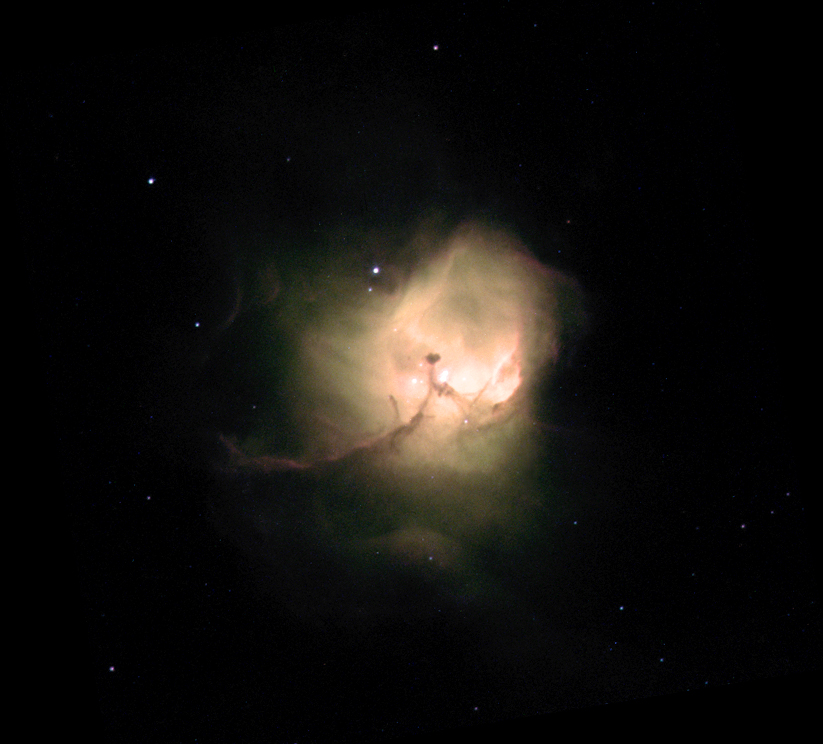
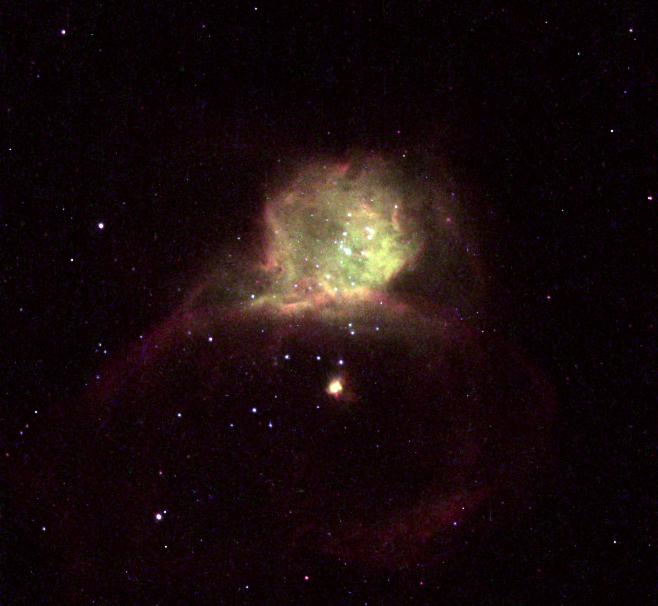
Hubble-X is a glowing gas cloud, one of the most active star-forming regions within galaxy NGC 6822. The cloud is about 110 light-years across and contains many thousands of newly formed stars in a central cluster.
Scientific Significance
Hubble X helps connect nearby resolved star formation to global starburst behavior seen in distant galaxies. In NGC 6822, individual massive stars, compact clusters, and ionized shells can be measured directly, allowing precise tests of how radiation and stellar winds regulate subsequent star formation. Because NGC 6822 is a low-mass, low-metallicity system, it also serves as a bridge to conditions common in earlier cosmic epochs. Measurements from Hubble X improve calibrations of star-formation indicators and feedback prescriptions used in galaxy evolution simulations.
Observation Details
Hubble imaging of Hubble X used optical filters sensitive to ionized-gas emission and stellar continuum. The combined dataset resolves luminous young stars in the core and filamentary gas around the region. Photometry across multiple bands enables age estimates for the stellar population and separation of nebular versus stellar light. By comparing the morphology of bright ionized rims with cluster positions, astronomers infer where feedback is compressing nearby gas or clearing cavities. These high-resolution observations are difficult to reproduce from the ground because of atmospheric seeing limits.
Location in the Universe
Constellation
Sagittarius
Distance from Earth
About 1.6 million light-years
Fun Facts
- 1
Hubble X is one of the brightest star-forming complexes in the dwarf galaxy NGC 6822, also called Barnard's Galaxy.
- 2
Its central cluster contains many hot, short-lived stars that flood the cloud with ultraviolet light.
- 3
The region spans roughly 110 light-years, large enough to host multiple generations of young stars.
Image credit: NASA, ESA, Hubble Space Telescope