About This Image
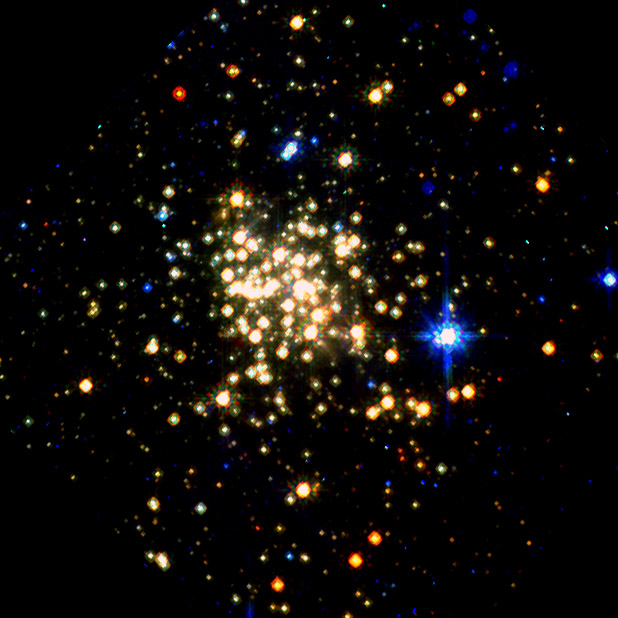
The Arches cluster is the densest known star cluster in our galaxy and resides 25,000 light-years away. In this rough-and-tumble region, huge clouds of gas collide to form behemoth stars.
Scientific Significance
The Arches Cluster is a key testbed for understanding star formation under extreme Galactic Center conditions. Its high stellar density and top-heavy massive-star content constrain the upper end of the stellar initial mass function and the timescales for rapid cluster evolution. Observations also probe how strong tidal fields strip outer members and alter cluster structure over a few million years. Because massive stars dominate feedback through ionizing radiation, winds, and supernovae, Arches provides direct insight into how compact clusters inject energy and momentum into surrounding interstellar gas.
Observation Details
Hubble observed the Arches Cluster using high-resolution imaging in optical and near-infrared bands, with infrared data especially important for penetrating heavy dust extinction toward the Galactic Center. Photometric catalogs from these observations separate cluster members from foreground stars and allow color-magnitude analysis of stellar ages and masses. Repeated observations support proper-motion studies that improve membership assignment in this crowded field. The final data products reveal a dense central core and radial gradients in stellar mass distribution consistent with rapid dynamical evolution.
Location in the Universe
Constellation
Sagittarius
Distance from Earth
25,000 light-years
Fun Facts
- 1
The Arches Cluster lies near the Galactic Center, where tidal forces, radiation fields, and gas pressures are extreme.
- 2
It contains many stars above 50 solar masses, making it one of the richest nearby populations of very massive stars.
- 3
Despite its youth, the cluster is already dynamically evolving as stellar winds and gravity reshape its core.
Image credit: NASA, ESA, Hubble Space Telescope