About This Image
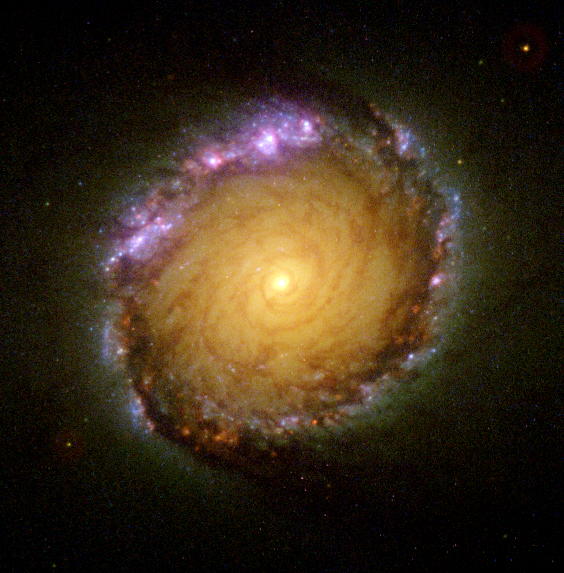
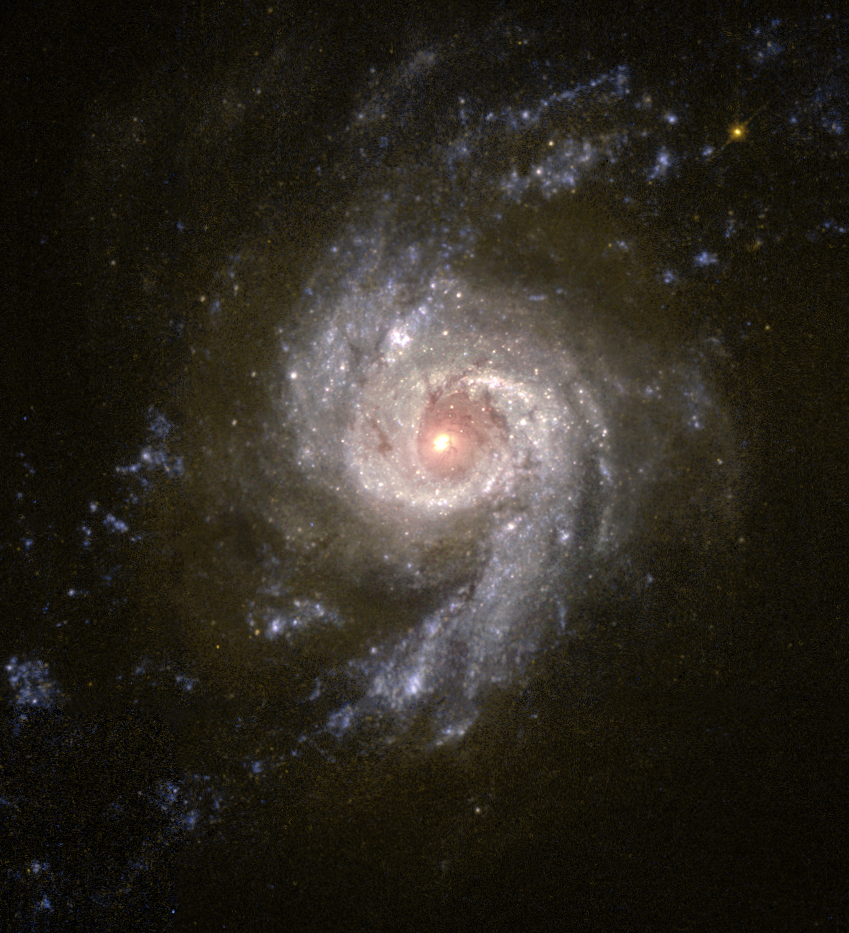
There are several hundred star clusters in the starburst galaxy NGC 3310. They appear in this image as the bright, blue clumps that trace the galaxy's spiral arms.
Scientific Significance
NGC 3310 is a key laboratory for studying merger-induced starbursts because its relative proximity allows Hubble to resolve individual star clusters across the galaxy's disk. By analyzing the colors, luminosities, and spatial distribution of these clusters, astronomers can reconstruct the star formation history of the galaxy and determine how the starburst has propagated across the disk over time. Age-dating of the cluster population has revealed a complex history with multiple bursts of star formation triggered at different times as the merger progressed, challenging simple models that treat starbursts as single, instantaneous events. The galaxy's spiral structure has survived the merger largely intact, demonstrating that minor mergers can dramatically enhance star formation rates without destroying the disk morphology — a finding that has implications for understanding how the Milky Way might respond to future interactions with its own satellite galaxies. NGC 3310 also serves as a nearby analog to high-redshift starburst galaxies, allowing detailed studies of physical processes that can only be observed in aggregate at greater distances.
Observation Details
This image was captured using Hubble's Wide Field and Planetary Camera 2 (WFPC2) in multiple broadband filters including ultraviolet, blue, visible, and near-infrared wavelengths. The ultraviolet observations were particularly valuable for identifying the youngest, hottest star clusters, whose UV emission dominates over the older stellar population. The multi-wavelength photometry of individual clusters enabled age-dating through comparison with stellar population synthesis models, revealing the temporal sequence of star formation episodes. The WFPC2's resolution allowed astronomers to measure cluster sizes and distinguish compact star clusters from more diffuse associations.
Location in the Universe
Constellation
Ursa Major
Distance from Earth
46 million light-years
Fun Facts
- 1
NGC 3310's starburst was triggered by the absorption of a smaller dwarf galaxy approximately 100 million years ago — the merger remnants are still visible as a faint stream of stars extending from the galaxy's disk.
- 2
The youngest star clusters in NGC 3310 are only a few million years old, while others date back several hundred million years, showing that the starburst has been occurring in successive waves rather than a single explosive burst.
- 3
NGC 3310 is forming stars at a rate roughly 10 times higher than a normal spiral galaxy of its size, converting its gas supply into stars so rapidly that the starburst phase will likely exhaust itself within a few hundred million years.
Image credit: NASA, ESA, Hubble Space Telescope