About This Image
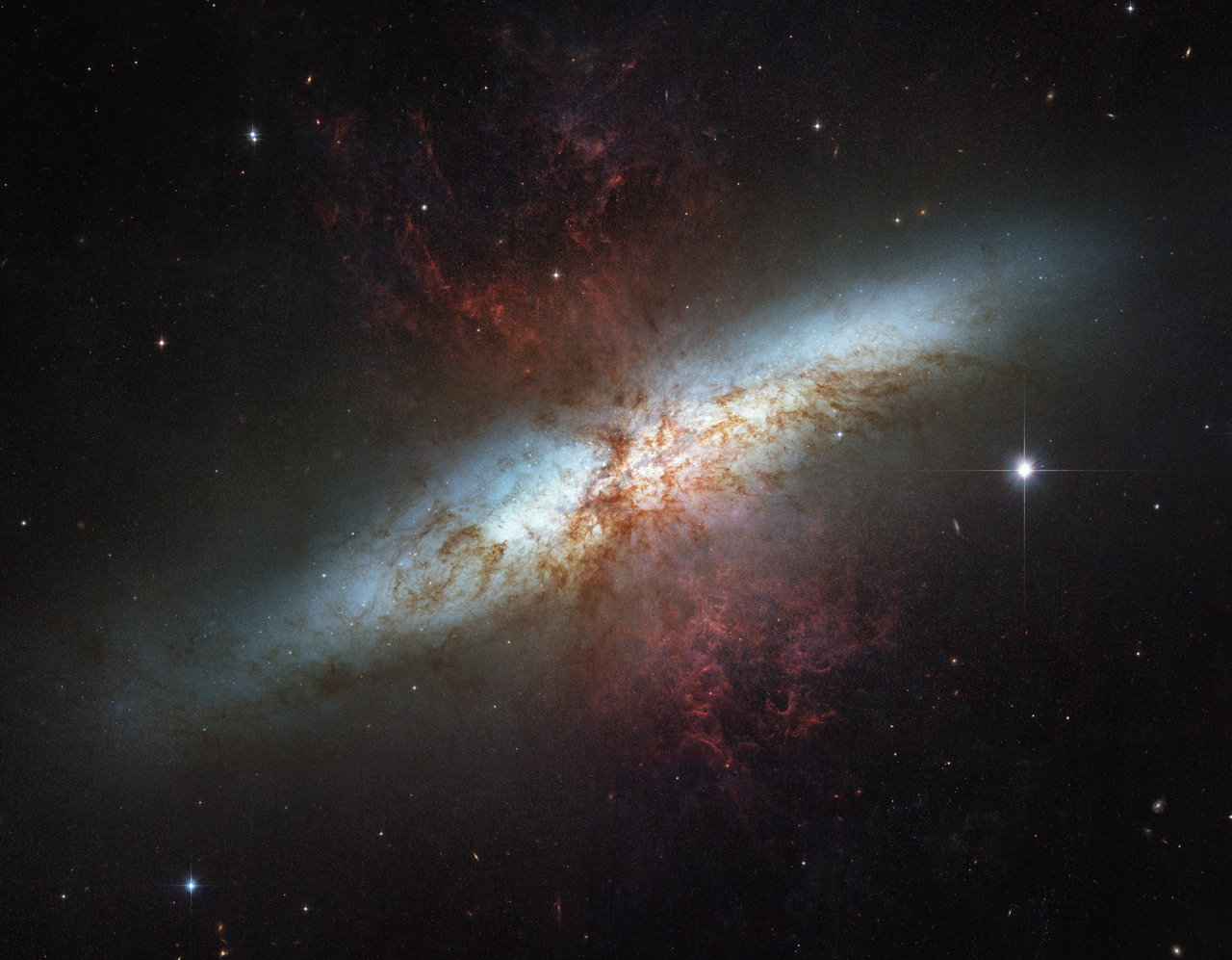
Galaxy M82 is remarkable for its bright blue disk, webs of shredded clouds, and fiery-looking plumes of glowing hydrogen blasting out of its central region in a dramatic display of cosmic pyrotechnics. Known as the Cigar Galaxy for its elongated shape when viewed through small telescopes, M82 is the nearest starburst galaxy to Earth — a galaxy undergoing an extraordinarily intense episode of star formation that produces new stars 10 times faster than they are born inside our Milky Way galaxy. The most spectacular feature is the superwind — enormous bipolar plumes of hot gas driven outward from the galaxy's core by the combined energy of millions of young stars and frequent supernova explosions. These glowing red filaments of hydrogen extend thousands of light-years above and below the galaxy's disk, carrying enriched gas into intergalactic space and dramatically altering the galaxy's evolutionary trajectory.
Scientific Significance
M82 is the prototypical starburst galaxy and serves as the primary laboratory for understanding the extreme end of the star formation spectrum. Its proximity allows Hubble to resolve individual star clusters, supernova remnants, and the fine filamentary structure of the galactic superwind with a level of detail impossible in more distant starbursts. The superwind is one of the most studied outflow phenomena in extragalactic astronomy because it represents the primary mechanism by which starburst galaxies inject energy, momentum, and chemically enriched material into the intergalactic medium. This feedback process is believed to play a crucial role in regulating galaxy growth across cosmic time, preventing galaxies from converting all their gas into stars and explaining why galaxies are less massive than theoretical predictions based on cooling gas alone. Hubble's observations have revealed that the superwind contains complex multiphase gas — from the hottest X-ray-emitting plasma to cool molecular clouds entrained in the outflow — challenging models that treat galactic winds as simple, uniform outflows. The M82 starburst also provides a nearby analog to the intense star-forming galaxies that dominated the universe at redshifts of 1-3, when cosmic star formation reached its peak, enabling detailed studies of processes that shaped the majority of today's stellar mass.
Observation Details
This mosaic image was assembled from observations taken with Hubble's Advanced Camera for Surveys (ACS) in multiple broadband and narrowband filters. The broadband visible and near-infrared filters captured the galaxy's stellar disk and the complex dust structures threaded through it, while narrowband hydrogen-alpha and ionized nitrogen filters isolated the glowing filaments of the superwind that extend perpendicular to the disk. The four-color composite image reveals the blue disk of young stars, the red and orange hydrogen emission from the superwind filaments, and the dark dust lanes that absorb light throughout the galaxy's core. The ACS observations resolved the superwind into thousands of individual filaments, many narrower than 10 light-years across, revealing the complex internal structure of the outflow.
Location in the Universe
Constellation
Ursa Major
Distance from Earth
12 million light-years
Fun Facts
- 1
M82's starburst was triggered by a close gravitational encounter with its much larger neighbor M81 approximately 300 million years ago — the tidal forces from M81 compressed gas in M82's center, igniting the most intense star-forming episode in the local universe.
- 2
The galactic superwind blowing out of M82's center carries gas, dust, and heavy elements into intergalactic space at speeds exceeding 1 million miles per hour — this expelled material enriches the surrounding intergalactic medium and may seed future galaxy formation.
- 3
In January 2014, a Type Ia supernova (SN 2014J) exploded in M82, becoming the closest Type Ia supernova to Earth in over 40 years and providing astronomers with an unprecedented opportunity to study this type of stellar explosion in exquisite detail.
Image credit: NASA, ESA, Hubble Space Telescope