About This Image
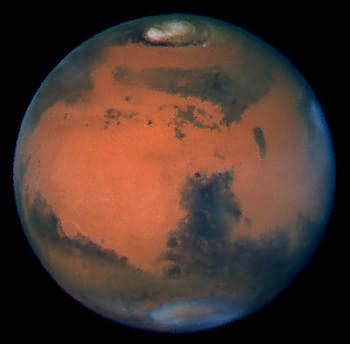
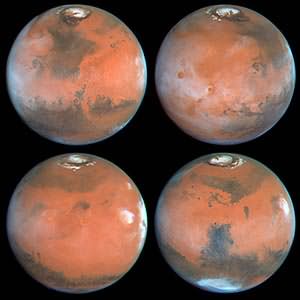
Four sides of Mars are captured in these Hubble images taken over the course of a single Martian day, revealing the diverse geology and atmospheric phenomena of the Red Planet as it rotates beneath the telescope's unwavering gaze. Mars has rotated about ninety degrees between each view, providing a complete 360-degree tour of the planet's surface features. The sequence reveals a world of dramatic contrasts: bright polar ice caps, dark volcanic plains, orange-red deserts of iron-oxide dust, wispy white water-ice clouds, and the subtle haze of atmospheric dust that gives Mars its characteristic ruddy color. Each panel showcases different major geological provinces — from the towering shield volcanoes of Tharsis to the ancient, heavily cratered southern highlands — painting a comprehensive portrait of a world that has captivated human imagination for centuries and remains the most explored planet beyond Earth.
Scientific Significance
Multi-panel rotational sequences like this provide astronomers with complete global maps of Mars's atmospheric state at a single moment in time — information that is impossible to obtain from the surface or even from a single orbiting spacecraft, which can only see one hemisphere at a time. By capturing all four quadrants of Mars within hours, Hubble creates a snapshot of the planet's entire atmospheric circulation system, including cloud formation patterns, dust distribution, and polar cap extent. These global maps serve as benchmarks for Martian atmospheric models and complement the detailed but geographically limited observations from Mars orbiters and rovers. The 1997 observations were particularly valuable because they coincided with the Mars Pathfinder mission, enabling direct comparison between Hubble's global atmospheric measurements and the surface-level meteorological data recorded by the Pathfinder lander. This synergy between space telescope and surface mission demonstrated the complementary value of simultaneous observations at multiple scales — a model that has been followed by subsequent Mars missions. Long-term monitoring of Mars by Hubble across multiple oppositions has also documented year-to-year variability in the planet's atmospheric opacity, cloud coverage, and polar cap recession, contributing to our understanding of Mars's complex and dynamic climate system.
Observation Details
These four images were captured using Hubble's Wide Field and Planetary Camera 2 (WFPC2) in broadband visible-light filters (blue, green, and red) to produce natural-color composites of each Martian hemisphere. The observations were scheduled at approximately 6-hour intervals to capture Mars at 90-degree rotational increments, providing complete longitudinal coverage. At the time of observation, Mars's angular diameter was large enough for Hubble to resolve surface features as small as approximately 19 kilometers (12 miles) across. Each panel was assembled from separate blue, green, and red filter exposures taken within minutes of each other to minimize the effects of atmospheric rotation between colors. The images were processed to remove limb-darkening effects and enhance the visibility of subtle atmospheric and surface features.
Location in the Universe
Constellation
N/A (Solar System)
Distance from Earth
60 million miles (at time of observation)
Fun Facts
- 1
A Martian day (called a 'sol') is only about 37 minutes longer than an Earth day — 24 hours and 37 minutes — which means Hubble could capture all four 90-degree views of Mars within a single Earth day with time to spare.
- 2
The four views reveal some of Mars's most famous geological features, including the dark volcanic region Syrtis Major, the bright basin Hellas (one of the largest impact craters in the solar system at 1,400 miles wide), and hints of the Tharsis volcanic plateau that hosts Olympus Mons — the tallest known mountain in the solar system.
- 3
These images were taken during the 1997 Mars opposition, the same year that NASA's Mars Pathfinder and Sojourner rover were exploring the Martian surface — providing a global atmospheric context for the ground-level observations from the surface mission.
Image credit: NASA, ESA, Hubble Space Telescope