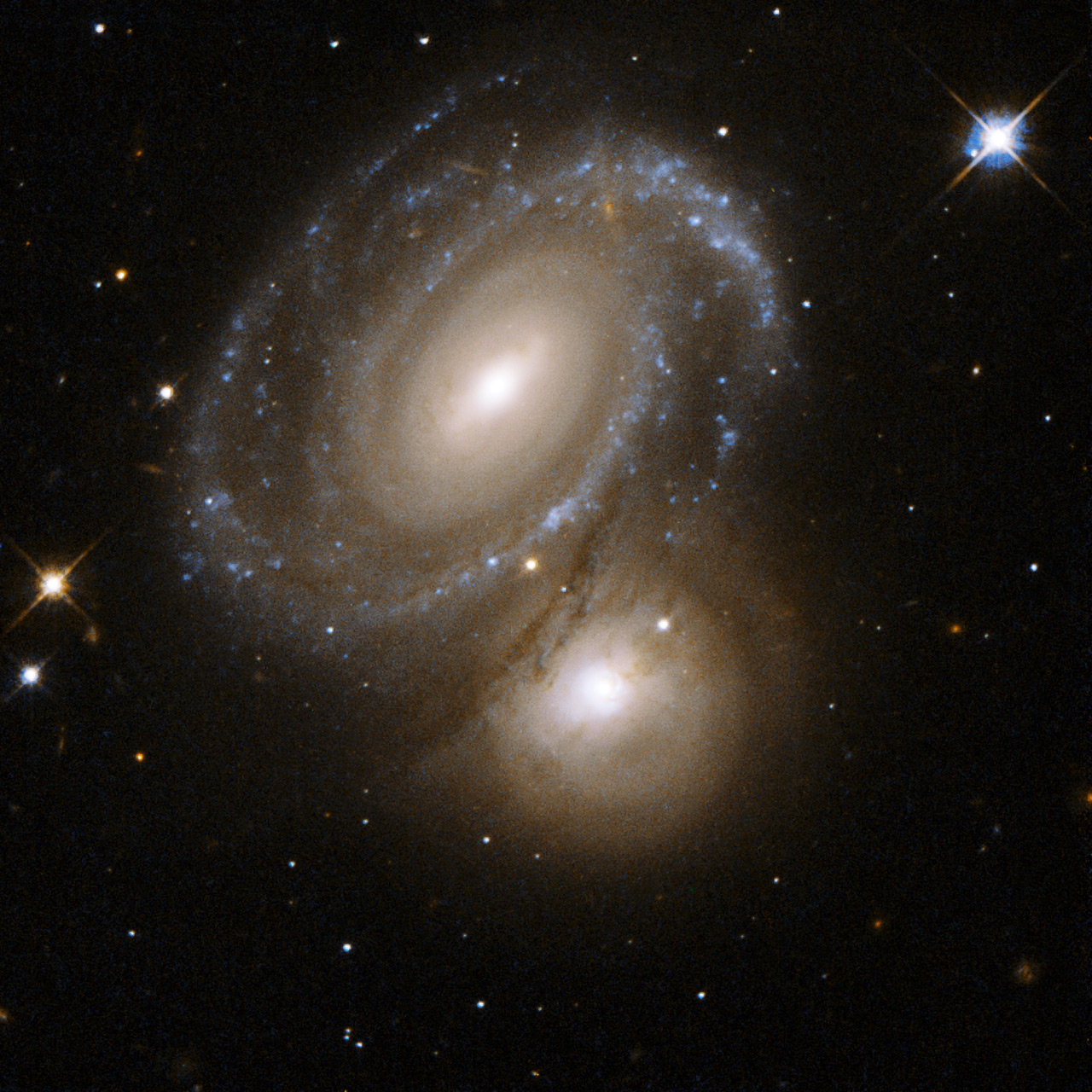
About This Image
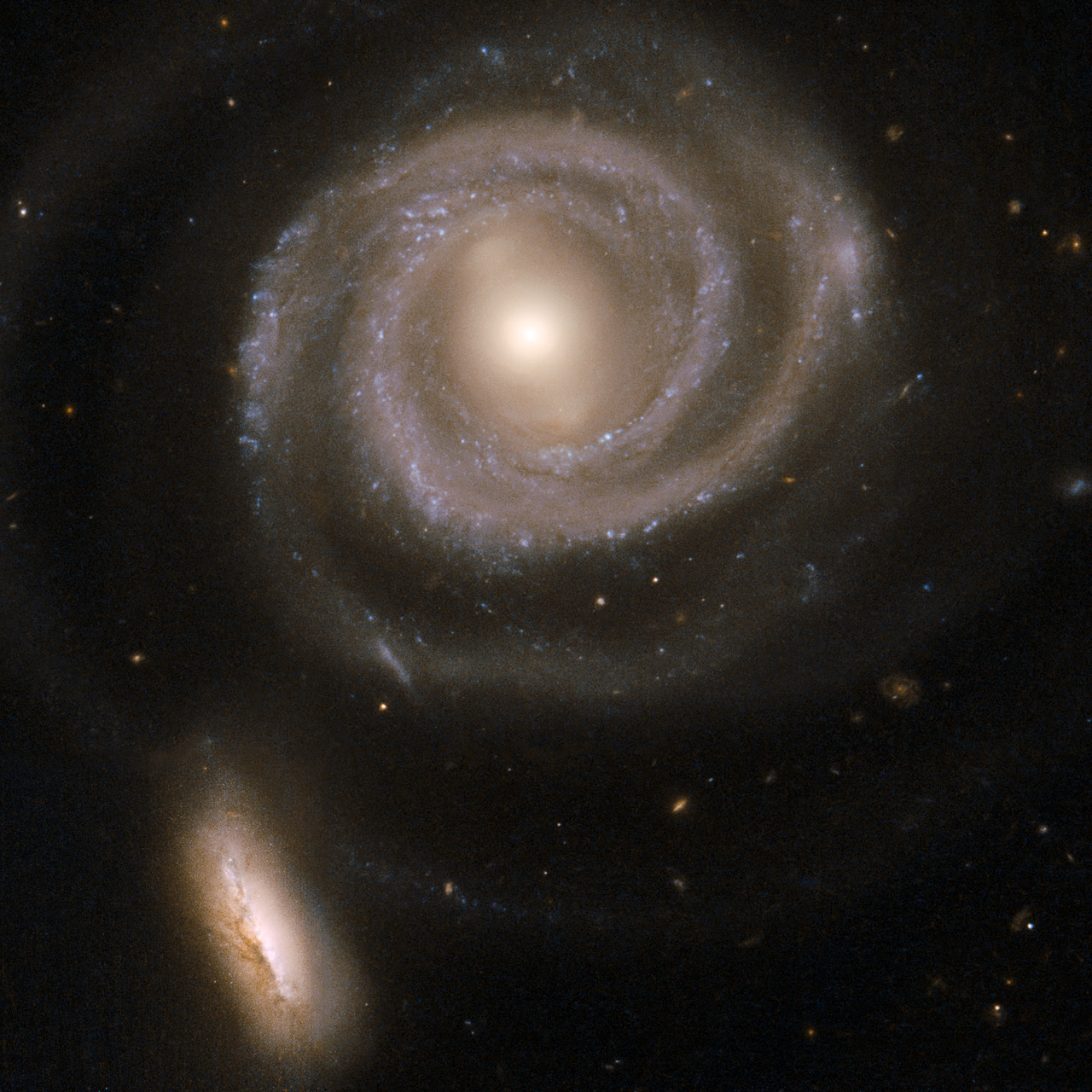
AM 0500-620 includes a pair of galaxies engaged in a gravitational dance, with one spiral galaxy seen nearly face-on that is partially backlit by a bright background galaxy positioned almost directly behind it. This fortuitous cosmic alignment creates a natural silhouette effect — the foreground spiral galaxy's dust lanes, which would normally be difficult to detect, are dramatically highlighted against the glow of the background galaxy like ink stains on a lampshade. These interacting galaxies are located 350 million light-years away in the constellation Dorado, and their overlapping configuration provides astronomers with a rare opportunity to study the distribution and properties of interstellar dust in the foreground galaxy with unprecedented clarity. Such overlapping galaxy pairs are exceedingly rare treasures that transform the normal challenge of studying dust into an advantage, using one galaxy as a cosmic backlight to illuminate the other's hidden features.
Scientific Significance
AM 0500-620 belongs to a select class of overlapping galaxy pairs that provide the most direct and unambiguous measurements of interstellar dust properties in external galaxies. Normally, measuring the amount and distribution of dust in a galaxy is extremely challenging because dust both absorbs starlight and emits its own thermal radiation, creating degeneracies between dust mass, temperature, and geometry that are difficult to disentangle. In overlapping pairs, the background galaxy provides a smooth, well-characterized backlighting source against which the foreground galaxy's dust absorption can be directly measured, analogous to holding a stained-glass window up to a uniform light source. This technique has revealed that dust in spiral galaxies extends much farther from the center than previously thought, with detectable dust absorption reaching well beyond the visible stellar disk. The detailed dust maps produced from overlapping galaxy studies have significantly revised estimates of how much starlight is absorbed by dust in normal galaxies — a correction that directly impacts calculations of galaxies' true luminosities, star formation rates, and stellar masses. AM 0500-620's geometry, with the foreground spiral seen nearly face-on, provides particularly clean measurements of the radial distribution of dust across the galaxy's disk.
Observation Details
This image was obtained using Hubble's Wide Field and Planetary Camera 2 (WFPC2) in broadband visible-light filters. The observations were designed to measure the attenuation of the background galaxy's light as it passes through different regions of the foreground spiral galaxy's disk, producing a two-dimensional map of dust optical depth. Multiple filters at different wavelengths allowed measurement of the wavelength dependence of dust absorption (the extinction curve), which provides information about the size distribution and composition of the dust grains. The WFPC2's angular resolution was sufficient to resolve individual dust lanes and arm-interarm contrast in the foreground galaxy, enabling detailed comparison between the dust distribution and the locations of star-forming regions in the spiral arms.
Location in the Universe
Constellation
Dorado
Distance from Earth
350 million light-years
Fun Facts
- 1
Overlapping galaxy pairs like AM 0500-620 are extremely rare — only a few dozen are known — because they require a chance alignment where two galaxies at different distances happen to lie along nearly the same line of sight, allowing one to backlight the other.
- 2
The silhouette technique used with this galaxy pair can measure dust properties far more accurately than traditional methods, because the background galaxy provides a known, smooth illumination against which the foreground dust's absorption can be precisely quantified.
- 3
AM 0500-620 is cataloged in the Atlas of Peculiar Southern Galaxies compiled by Arp and Madore, which documented unusual galaxy morphologies visible primarily from the Southern Hemisphere — a complement to Halton Arp's better-known northern atlas.
Image credit: NASA, ESA, Hubble Space Telescope