About This Image
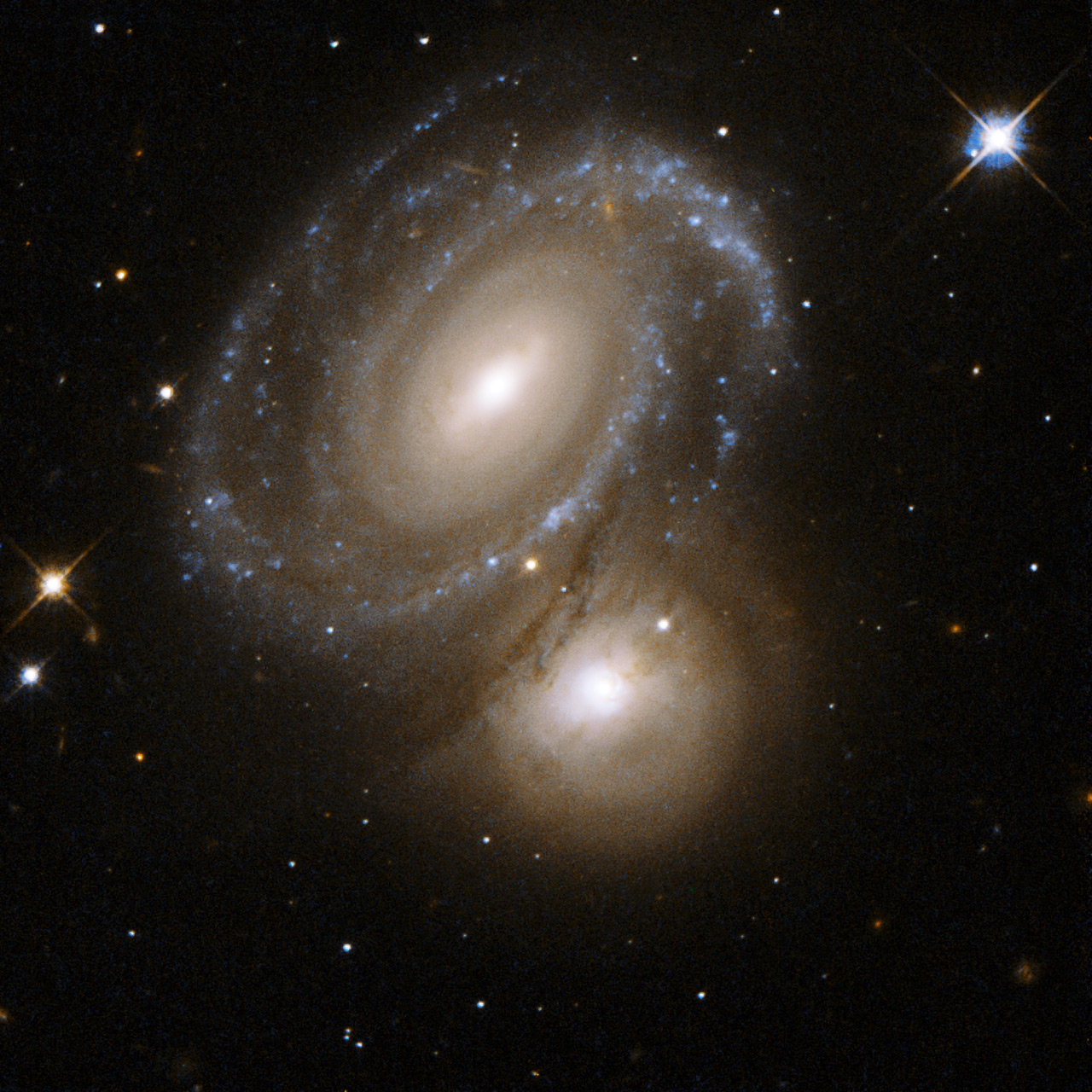
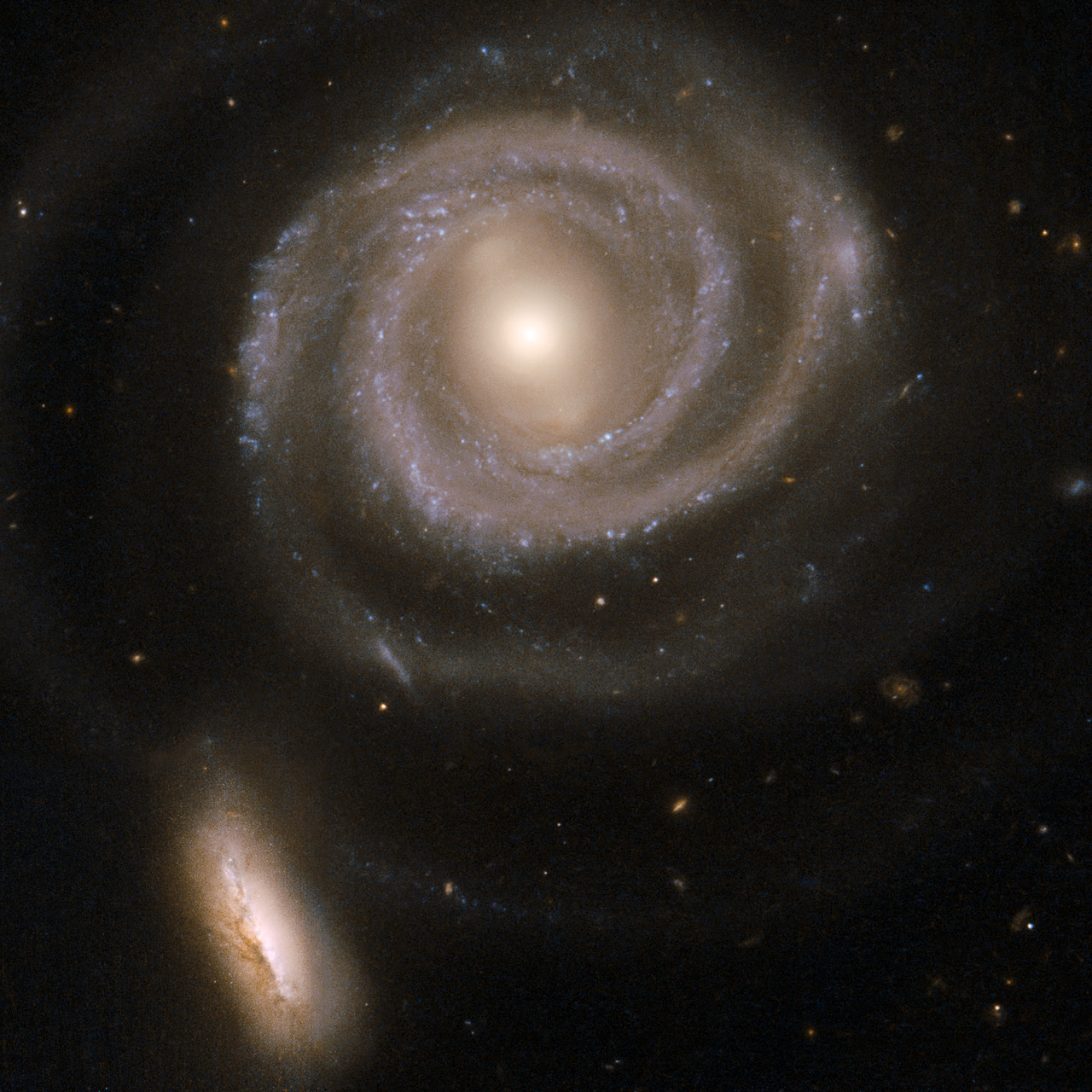
Arp 297 is a pair of interacting galaxies that consists of NGC 5754, the large spiral at the top, and NGC 5752, the smaller companion at the bottom left. NGC 5754's internal structure has hardly been disturbed despite the gravitational encounter, retaining its elegant spiral pattern with only subtle distortions, but it does have some kinked arms just beyond its inner ring — telltale signatures of the gravitational tug from its smaller companion. The interaction between these two galaxies demonstrates that not all galactic encounters are violent, cataclysmic events; some are gentle gravitational dances where the larger galaxy maintains its composure while the smaller companion bears the brunt of the tidal forces, slowly being stretched and distorted by its larger partner's gravitational field.
Scientific Significance
Arp 297 provides an important data point in the spectrum of galaxy interaction strengths, representing a relatively mild encounter where the larger galaxy's disk structure remains largely intact. This contrasts with more violent mergers like the Antennae Galaxies, where both galaxies are severely disrupted. By studying systems across this full range of interaction intensities, astronomers can calibrate numerical simulations of galaxy mergers and understand how parameters like mass ratio, orbital geometry, and gas content determine the outcome of galactic encounters. NGC 5754's kinked spiral arms offer a particularly clean test case for tidal perturbation theory, as the modest distortions can be directly compared to predictions from gravitational interaction models. The enhanced star formation observed along NGC 5752's tidal bridge connecting the two galaxies demonstrates that even mild interactions can trigger localized starbursts in the regions of strongest gravitational compression, contributing to our understanding of how galaxy interactions drive the evolution of star formation rates across cosmic time.
Observation Details
This image was obtained using Hubble's Wide Field and Planetary Camera 2 (WFPC2) in multiple visible-light filters. The observations targeted the interaction region between the two galaxies to search for evidence of tidally triggered star formation in the bridge connecting them. The WFPC2's field of view was sufficient to capture both galaxies and the connecting tidal features in a single pointing. Color information from the multiple filters enabled identification of young blue star-forming regions associated with the interaction, distinguishing them from the older red stellar populations in the undisturbed portions of the galaxies.
Location in the Universe
Constellation
Boötes
Distance from Earth
200 million light-years
Fun Facts
- 1
Arp 297 is part of Halton Arp's Atlas of Peculiar Galaxies, a catalog of 338 unusual-looking galaxies published in 1966 that became one of the most influential resources for studying galaxy interactions and mergers.
- 2
NGC 5754's spiral arms show subtle kinks and asymmetries beyond its inner ring — these minor distortions are the gravitational fingerprints of NGC 5752's influence, demonstrating that even a relatively mild interaction leaves measurable marks on a galaxy's structure.
- 3
Computer simulations suggest that NGC 5752 has already made at least one close passage by NGC 5754 and will eventually merge with its larger companion over the next several hundred million years, ultimately forming a single larger galaxy.
Image credit: NASA, ESA, Hubble Space Telescope