About This Image
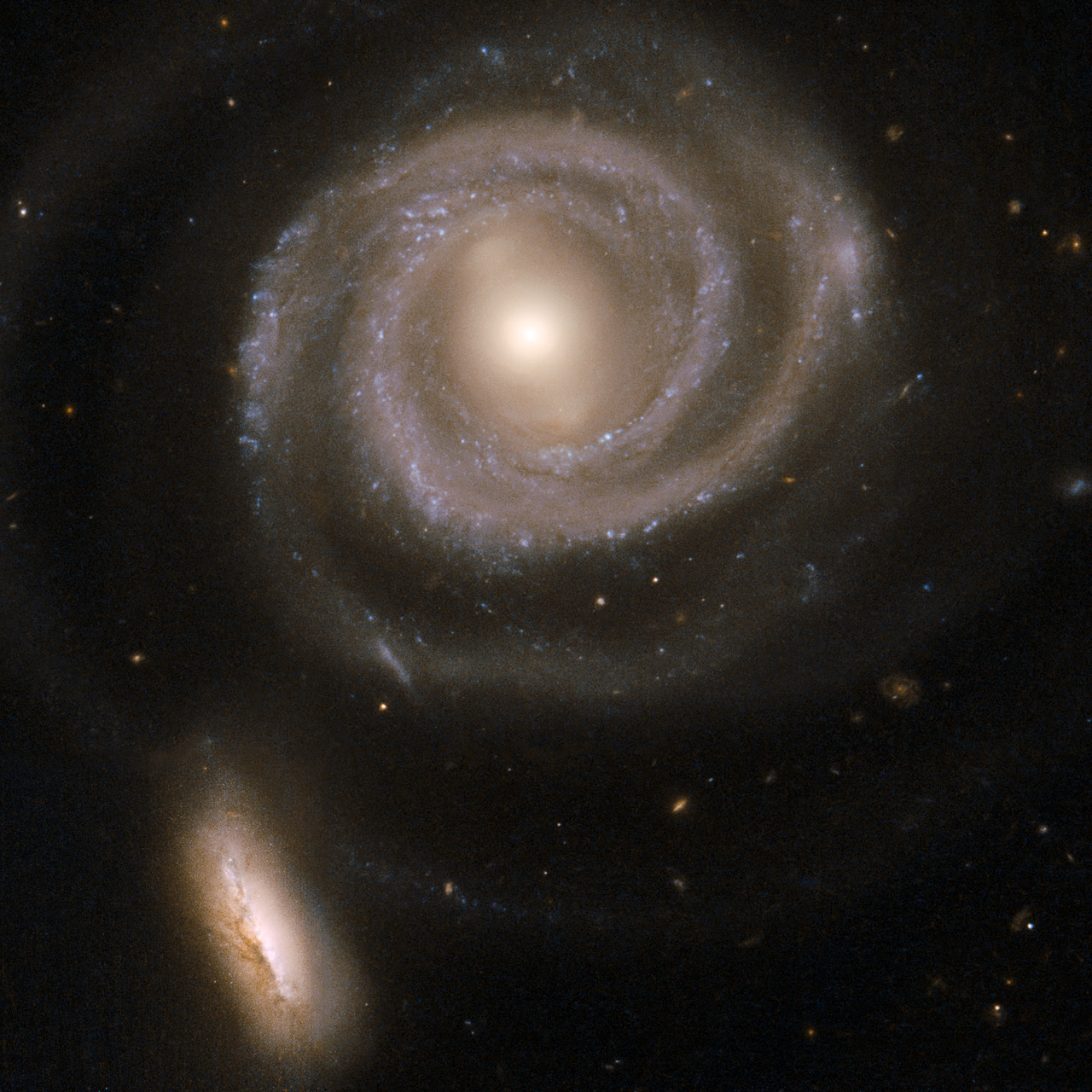
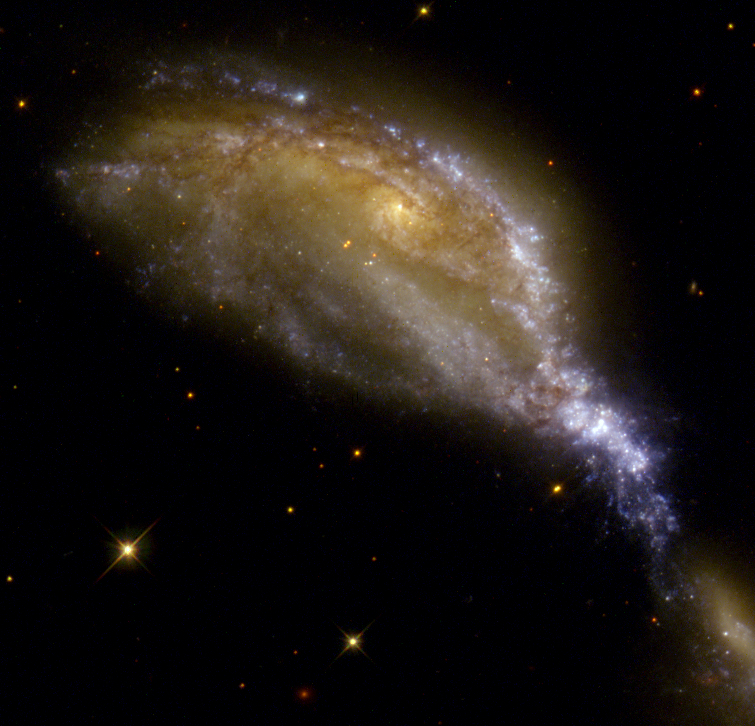
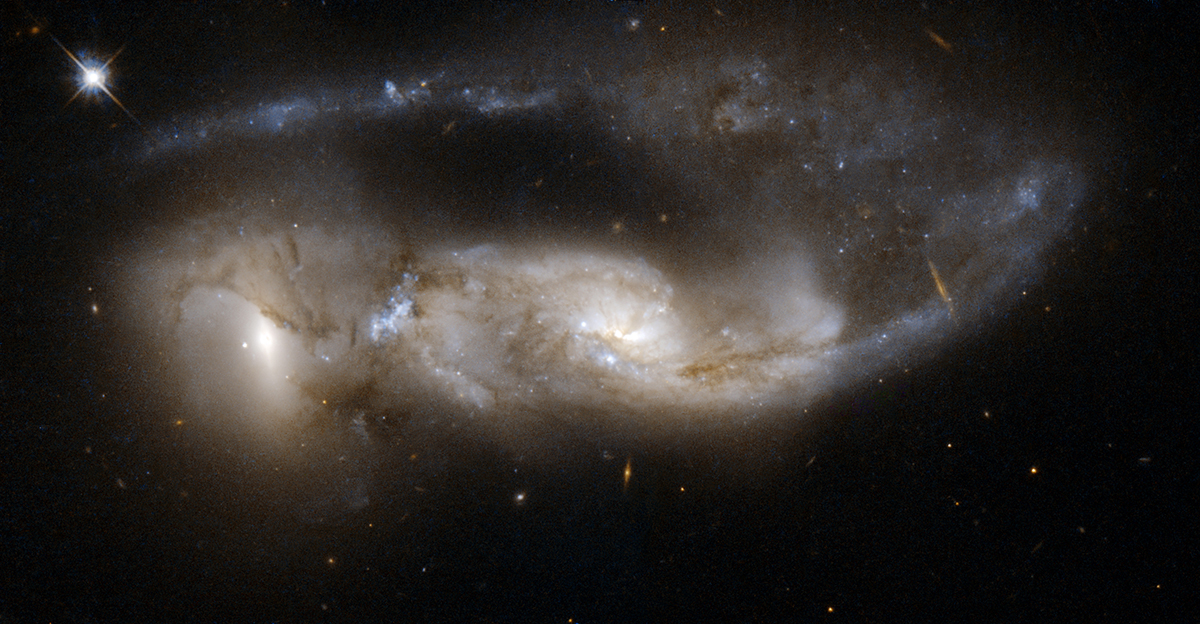
Arp 81 is a pair of interacting galaxies consisting of NGC 6621 (center) and NGC 6622 (left), locked in a cosmic collision that has dramatically transformed both participants. The encounter has pulled a long tidal tail out of NGC 6621 that has now wrapped behind the pair, creating a sweeping arc of stars and gas that extends tens of thousands of light-years beyond the visible galaxies. This spectacular tidal feature is a direct consequence of the differential gravitational pull across the galaxy — stars on the side nearest the companion are pulled forward while stars on the far side lag behind, stretching the galaxy into an elongated stream. The interaction has also triggered intense star formation in both galaxies, visible as bright blue knots scattered along the tidal features and in the compressed regions between the two galactic cores.
Scientific Significance
Arp 81 is an excellent example of a galaxy merger in its intermediate stage, where the two galaxies have already experienced their first close passage and are now approaching for a second encounter that will eventually lead to coalescence. The prominent tidal tail of NGC 6621 provides a textbook illustration of how tidal forces during galaxy interactions extract material from galactic disks and redistribute it over vast volumes of space. The tail's morphology — its length, curvature, and surface brightness profile — encodes information about the orbital parameters of the encounter, including the relative velocities, impact parameter, and mass ratio of the two galaxies. Numerical simulations of this system have been used to constrain these parameters and predict the future evolution of the merger. The vigorous star formation observed in both the tidal features and the nuclear regions demonstrates the dual mechanisms by which interactions enhance star formation: gravitational compression of gas in tidal features and funneling of gas toward the nuclear regions through angular momentum transfer.
Observation Details
This image was captured using Hubble's Wide Field and Planetary Camera 2 (WFPC2) in broadband optical filters. The observations resolved the complex morphological structure of the interacting pair, including the extended tidal tail, the bright star-forming knots, and the faint connecting bridge between the two galaxies. The multi-filter imaging enabled color analysis to identify regions of recent star formation (appearing blue from hot, young stars) versus older stellar populations (appearing red-yellow). Ground-based H-alpha imaging complemented the Hubble data by mapping the distribution of ionized gas associated with the most intense star-forming regions.
Location in the Universe
Constellation
Draco
Distance from Earth
280 million light-years
Fun Facts
- 1
The long tidal tail extending from NGC 6621 contains enough gas and young stars to form a small galaxy on its own — in fact, some tidal tails in other interacting systems have been observed to collapse and form independent 'tidal dwarf galaxies.'
- 2
NGC 6621 and NGC 6622 will likely merge completely within the next 500 million years, their combined stars and gas settling into a single, larger elliptical galaxy — a process that our own Milky Way will undergo when it collides with the Andromeda Galaxy in about 4.5 billion years.
- 3
Arp 81 is entry number 81 in Halton Arp's Atlas of Peculiar Galaxies — Arp noted its remarkable long tail and classified it among his examples of galaxies with 'large high-surface-brightness companions on arms.'
Image credit: NASA, ESA, Hubble Space Telescope