About This Image
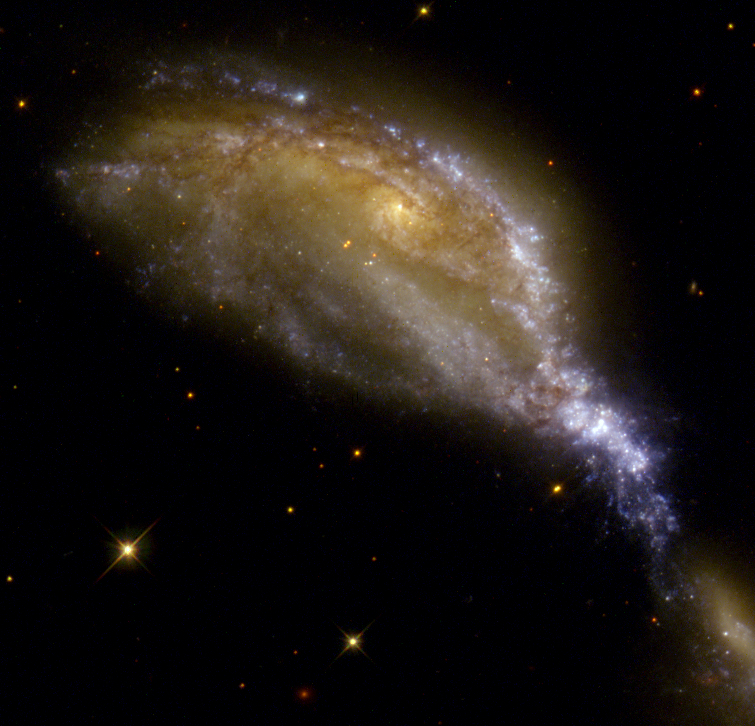
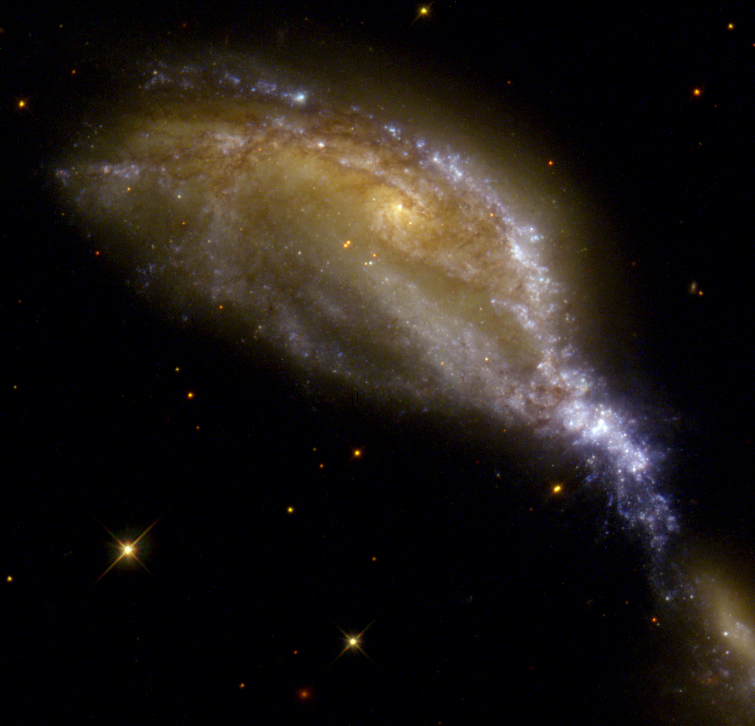
This view of the colliding galaxy system NGC 6745 highlights the aftermath of a dramatic galactic encounter that has reshaped both participants. The larger spiral galaxy, NGC 6745, maintains an intact but visibly distorted nucleus while the smaller, denser passing galaxy exits the frame to the lower right, pulling behind it a luminous bridge of stripped gas and newly formed stars. The collision has left an indelible mark on NGC 6745's structure — its once-symmetric spiral arms have been warped and stretched by tidal forces, and intense bursts of star formation blaze across regions where interstellar gas has been violently compressed. This image captures a snapshot of galactic evolution in action, demonstrating that the seemingly static universe visible through a telescope is in fact a dynamic arena where galaxies collide, merge, and transform one another across timescales of hundreds of millions of years.
Scientific Significance
NGC 6745 is significant for studying the physics of gas dynamics during galaxy collisions, particularly the contrast between how stars and gas behave during such encounters. While stars act as collisionless particles that simply change orbits under the influence of the combined gravitational field, interstellar gas is collisional and subject to shocks, compression, and radiative cooling. The interface between these two behaviors drives many of the most visible effects of galaxy collisions, including triggered star formation and the creation of tidal tails. NGC 6745's relatively clean geometry — with a well-defined intruder trajectory visible in the tidal streamer — makes it an excellent target for hydrodynamic simulations that aim to reproduce the observed morphology and star formation patterns. The system also provides constraints on the role of ram pressure in stripping gas from the smaller galaxy during its passage through the larger galaxy's interstellar medium, a process analogous to the ram-pressure stripping that affects galaxies falling into massive clusters.
Observation Details
This image was obtained using Hubble's Wide Field and Planetary Camera 2 (WFPC2) in multiple broadband optical filters. The high angular resolution of Hubble was essential for resolving the individual star-forming complexes within the collision zone and distinguishing the fine morphological details of the tidal features. The observations captured both the bright central regions of NGC 6745 and the fainter tidal bridge extending toward the smaller companion. Post-processing techniques were used to enhance the contrast of the faintest tidal features while preserving the photometric accuracy of the bright star-forming regions necessary for age-dating the young stellar populations.
Location in the Universe
Constellation
Lyra
Distance from Earth
206 million light-years
Fun Facts
- 1
Despite the apparent violence of this collision, individual stars within the two galaxies almost never physically collide with each other — the spaces between stars are so vast that the galaxies pass through each other like two swarms of bees, with the gravitational field rather than direct impacts causing the visible damage.
- 2
The gas and dust between the stars, unlike the stars themselves, does collide directly during galaxy interactions — this is what triggers the intense bursts of star formation visible as bright blue regions, as the gas is shock-heated and compressed to extreme densities.
- 3
Computer simulations suggest the smaller galaxy likely approached NGC 6745 from above or below the disk plane, punching through at an angle that created the asymmetric tidal features visible in the image.
Image credit: NASA, ESA, Hubble Space Telescope