About This Image
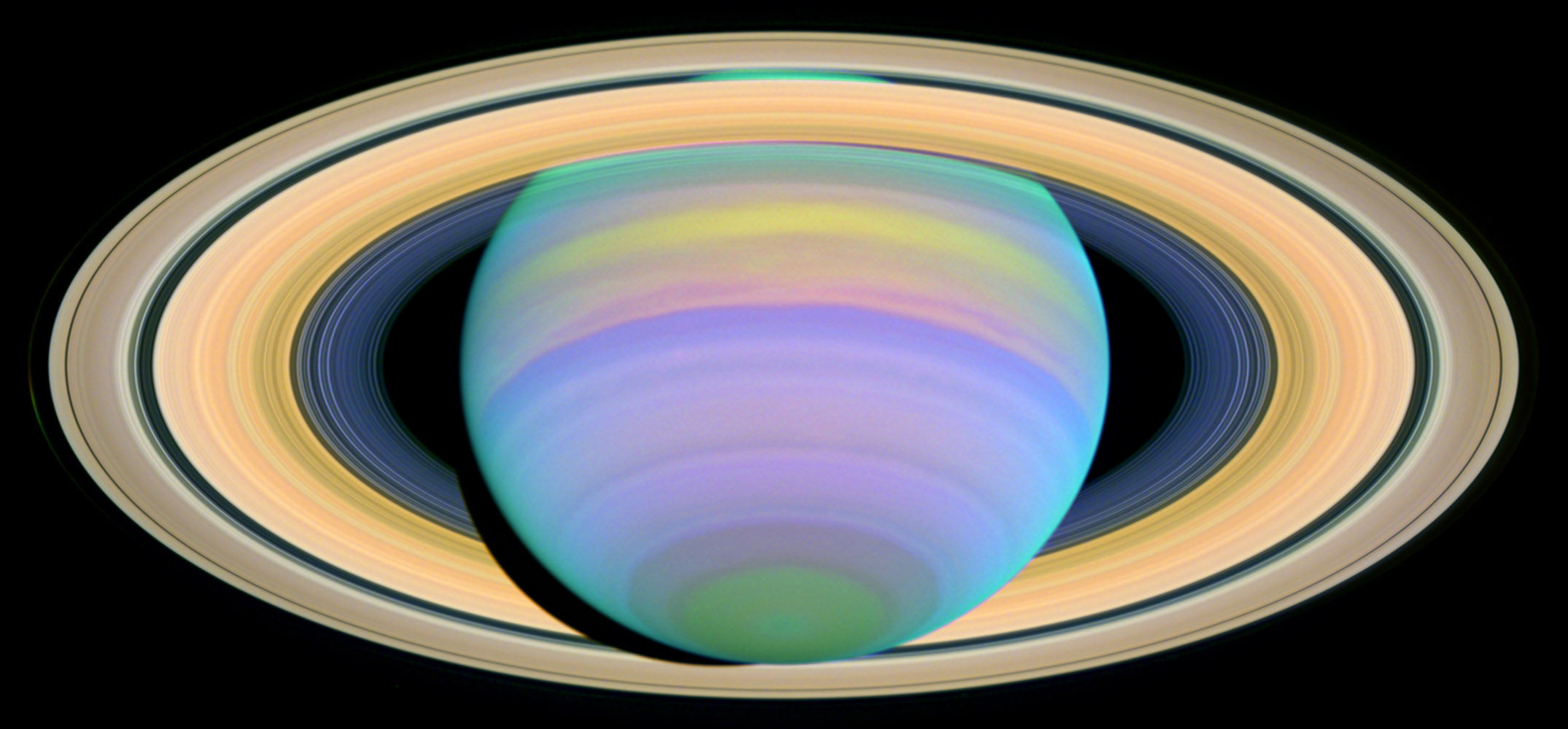
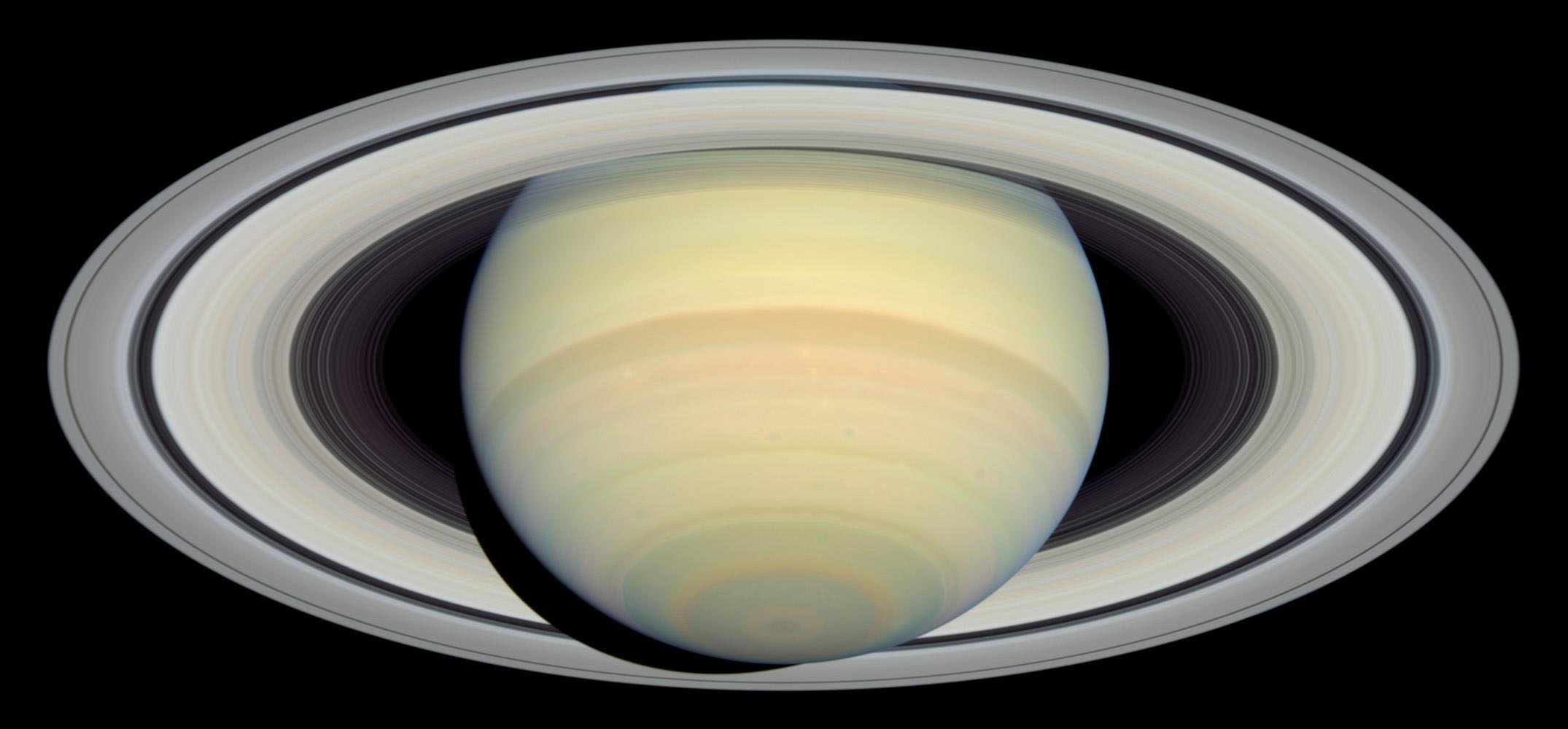
This image of Saturn captures exquisite details in the hazes and clouds of the planet's atmosphere with a clarity that reveals the subtle banding, storm features, and color variations across the gas giant's disk. The view is so sharp that it also reveals individual ringlets within Saturn's magnificent ring system, resolving the fine structure that makes these icy rings one of the most complex and beautiful features in the solar system. The Cassini Division — the prominent dark gap separating the bright A and B rings — is clearly visible, along with subtler gaps and variations in ring brightness that reflect differences in particle density and composition. Saturn's shadow falls across the rings behind the planet, while the rings in turn cast a thin shadow line across Saturn's equatorial region, creating an interplay of light and geometry that showcases the three-dimensional nature of this extraordinary planetary system.
Scientific Significance
Hubble's high-resolution visible-light observations of Saturn provide essential long-term monitoring of the planet's atmospheric dynamics and ring system that complements the data collected by spacecraft missions. While the Cassini mission provided unparalleled close-up views of Saturn from 2004 to 2017, Hubble continues to observe the planet in the years between dedicated missions, maintaining continuity of the atmospheric record across Saturn's 29.5-year orbital period. These observations track seasonal changes in atmospheric banding, the formation and evolution of major storm systems, and variations in the ring brightness that may indicate changes in particle properties over time. Hubble has documented several significant atmospheric events, including the massive northern hemisphere storm of 2010-2011 that encircled the entire planet. The telescope's ability to observe Saturn in ultraviolet wavelengths inaccessible from the ground provides unique data on the photochemistry of the upper atmosphere and the aurora, while its stable, diffraction-limited imaging enables precise measurements of ring features that constrain models of ring dynamics and evolution.
Observation Details
This image was captured using Hubble's Advanced Camera for Surveys (ACS) in visible-light filters during Saturn's 2004 opposition, when the planet was nearest to Earth and fully illuminated by the Sun. The ACS provided sufficient angular resolution to resolve individual ringlets within the main ring system and to detect subtle atmospheric features including small-scale storm systems and variations in the zonal wind bands. The observations were timed to maximize ring visibility, as Saturn was near its maximum ring opening angle. Color information was assembled from multiple filter exposures to create a natural-color portrait that closely approximates what Saturn would look like to the human eye through a sufficiently powerful telescope.
Location in the Universe
Constellation
N/A (Solar System)
Distance from Earth
746 million to 1 billion miles (varies)
Fun Facts
- 1
Saturn's ring system, while spanning up to 282,000 kilometers in diameter, is astonishingly thin — averaging only about 10 meters thick in most places, giving it proportions comparable to a sheet of paper spread across a football field.
- 2
Hubble's 2004 observations of Saturn captured the planet near its maximum ring tilt, when the rings were angled about 26 degrees toward Earth, providing one of the best views of the ring system's full extent and fine structure.
- 3
The individual ringlets visible in this image are composed of countless particles ranging from tiny grains of ice smaller than a sugar cube to house-sized boulders, all orbiting Saturn independently like a vast collection of tiny moons.
Image credit: NASA, ESA, Hubble Space Telescope