About This Image
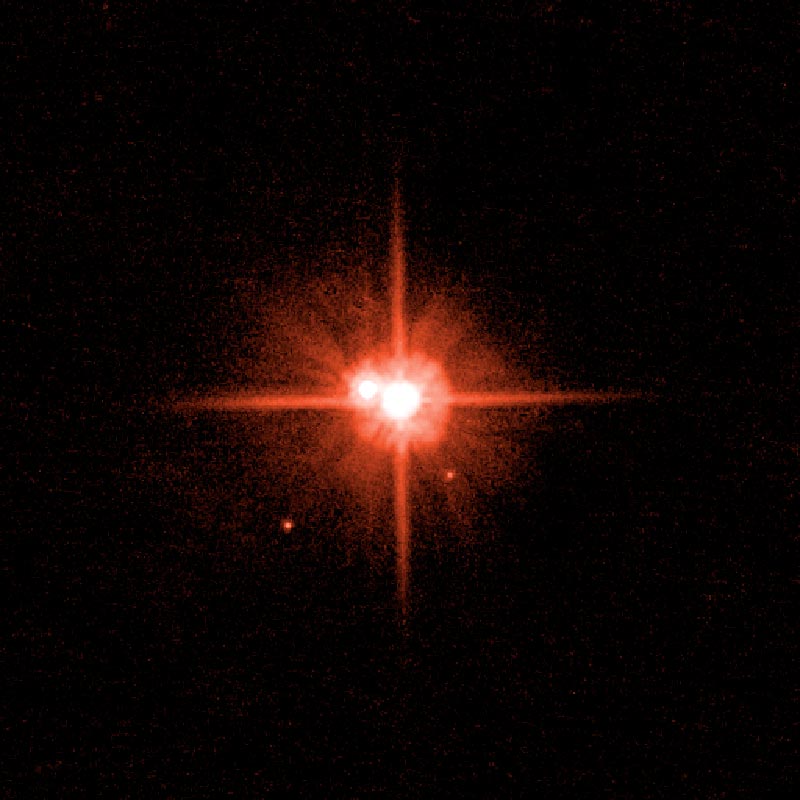
This image, taken through a red filter, captures Pluto and three of its satellites in a remarkable family portrait of the solar system's most famous dwarf planet. The largest object in the image is Pluto itself, and the second largest is its giant moon Charon, which is so large relative to Pluto that the two are sometimes considered a binary system. Two smaller moons appear below them, revealed by Hubble's keen vision. This observation was part of an extensive campaign to map the Pluto system before NASA's New Horizons spacecraft arrived for its historic flyby, providing crucial data for mission planning and demonstrating that even objects at the very edge of our solar system hold surprises waiting to be uncovered.
Scientific Significance
Hubble's observations of the Pluto system were essential for planning and executing NASA's New Horizons mission, which performed a historic flyby in July 2015. Before New Horizons arrived, Hubble was the only instrument capable of resolving Pluto's satellite system in sufficient detail to identify potential hazards and interesting targets. The discovery of small moons Nix and Hydra (2005), Kerberos (2011), and Styx (2012) by Hubble revealed a surprisingly complex satellite system that challenged existing models of how objects form in the Kuiper Belt. The orbital dynamics of this multi-body system provided constraints on the giant impact that likely created Charon and the smaller moons billions of years ago. Hubble's surface maps of Pluto, though limited in resolution, correctly predicted the dramatic contrasts in terrain and composition that New Horizons later confirmed, including the now-famous heart-shaped nitrogen ice plain known as Tombaugh Regio.
Observation Details
This image was captured using Hubble's Advanced Camera for Surveys (ACS) through a red filter (F606W). The observations required extremely precise pointing and long exposure times to detect the faint moons against the glare of Pluto itself. At Pluto's enormous distance — over 3 billion miles at the time — even Hubble could only resolve Pluto as a small disk a few pixels across, yet its superior angular resolution was sufficient to clearly separate Charon and the smaller satellites from the primary body. Multiple exposures were combined to improve signal-to-noise and suppress cosmic ray artifacts.
Location in the Universe
Constellation
N/A (Solar System)
Distance from Earth
2.66 to 4.67 billion miles (varies)
Fun Facts
- 1
Charon is so large compared to Pluto — about half its diameter — that the two actually orbit a common center of gravity located in the space between them, making them the only known binary dwarf planet system.
- 2
Hubble discovered two of Pluto's smaller moons, Nix and Hydra, in 2005, and later found two more tiny moons, Kerberos and Styx, bringing the total to five known satellites orbiting this distant world.
- 3
At the time this image was taken in 2006, Pluto was still classified as a planet — the International Astronomical Union reclassified it as a dwarf planet later that same year, sparking one of astronomy's most passionate public debates.
Image credit: NASA, ESA, Hubble Space Telescope