About This Image
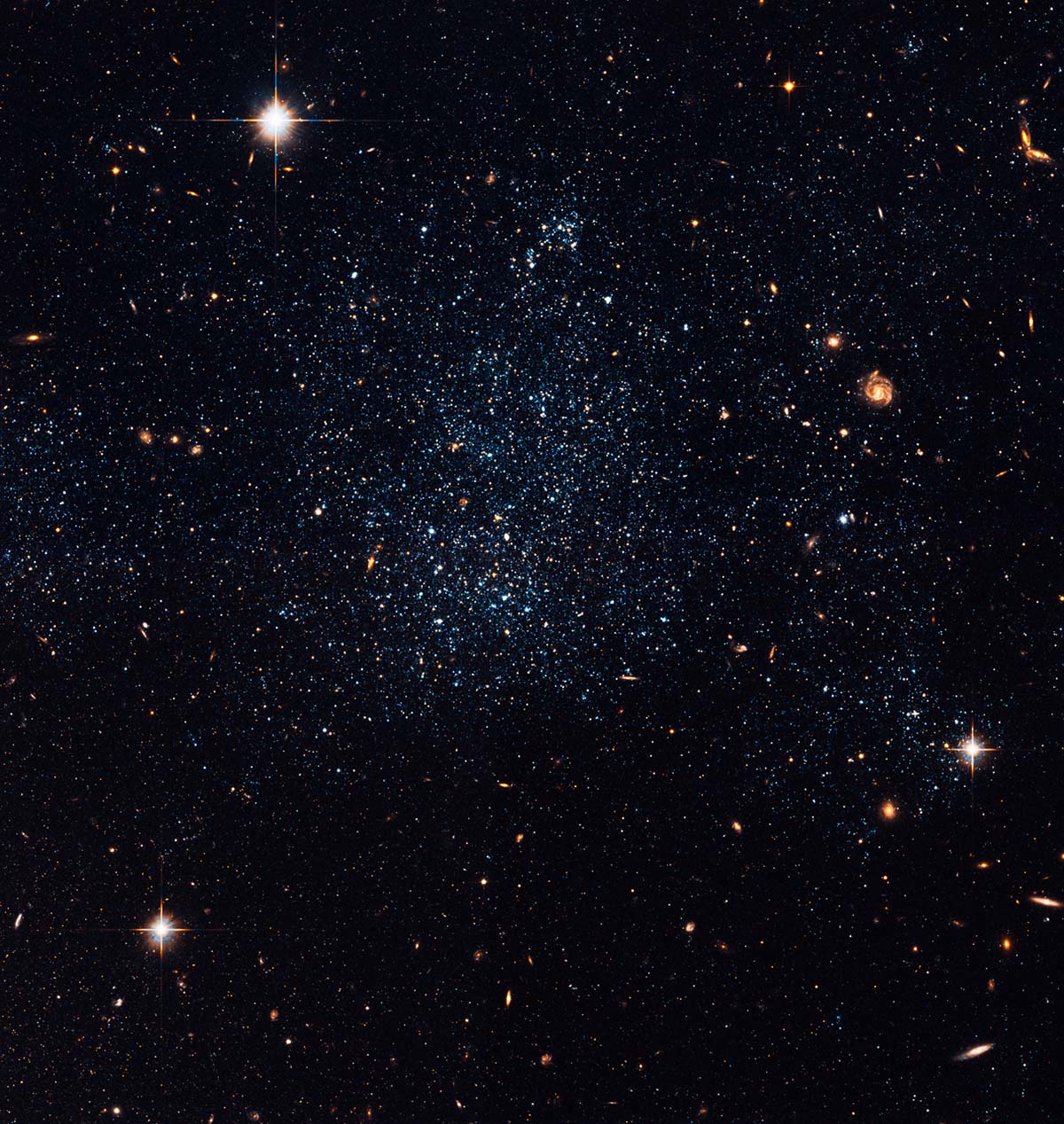
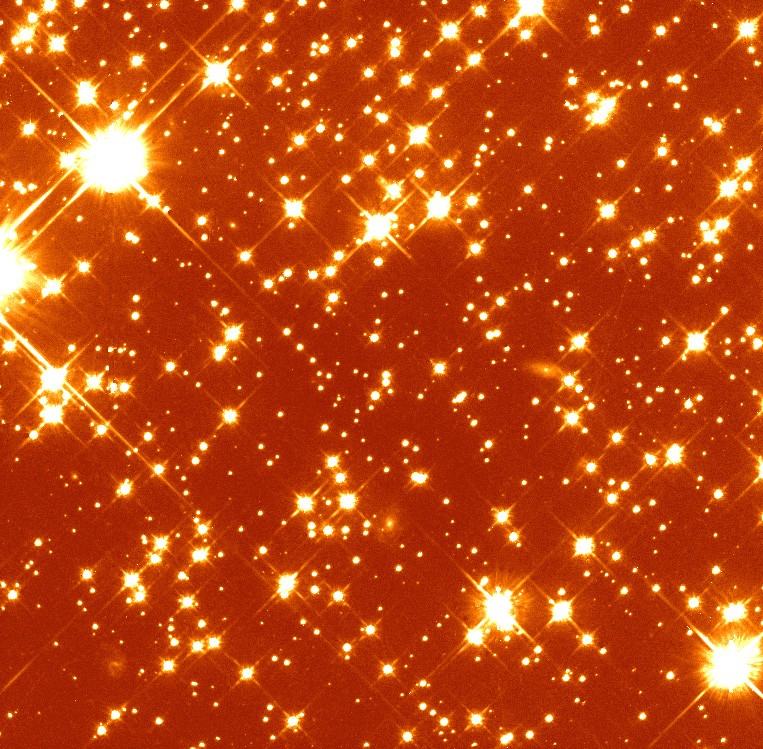
This image captures about 200 stars in the globular cluster NGC 6397, one of the closest globular clusters to Earth. The density of this particular star cluster is remarkably low compared to its more tightly packed cousins, allowing Hubble to see right through the cluster and resolve far more-distant background galaxies behind it. This transparency provides a rare clear view through what is normally an impenetrable wall of stellar light. NGC 6397 is an ancient stellar metropolis, home to hundreds of thousands of stars that formed together approximately 13.4 billion years ago, making it nearly as old as the universe itself. These primordial stars serve as cosmic fossils, preserving information about the conditions of the early universe in their chemical compositions.
Scientific Significance
NGC 6397 has been a cornerstone target for studies of stellar evolution, white dwarf cooling sequences, and the age of the universe. As one of the nearest globular clusters, it allows Hubble to resolve individual stars down to very faint magnitudes, including the coolest and faintest white dwarfs. The temperature and luminosity of these ancient white dwarfs provide an independent method for estimating the age of the cluster — and by extension, a lower limit on the age of the universe. Hubble observations determined that NGC 6397's white dwarfs have been cooling for approximately 12 billion years, consistent with other age estimates from cosmological measurements. The cluster's core-collapsed structure also makes it a natural laboratory for studying stellar dynamics, including the formation of exotic binary star systems, blue stragglers created by stellar mergers, and millisecond pulsars spun up by mass transfer from companion stars. The low metallicity of NGC 6397's stars indicates they formed from nearly pristine hydrogen and helium, preserving the chemical signature of the early universe.
Observation Details
This image was obtained using Hubble's Wide Field and Planetary Camera 2 (WFPC2) in multiple broadband filters spanning visible wavelengths. The relatively sparse outer regions of the cluster were targeted to enable resolution of individual stars without the severe crowding that plagues observations of the dense core. By combining images in different filters, astronomers constructed color-magnitude diagrams that map out the evolutionary stages of the cluster's stellar population, from bright red giants at the top to faint white dwarfs at the bottom. The background galaxies visible through the cluster provided serendipitous targets for extragalactic studies.
Location in the Universe
Constellation
Ara
Distance from Earth
7,800 light-years
Fun Facts
- 1
NGC 6397 is one of the two closest globular clusters to Earth, making it an ideal laboratory for studying the ancient stellar populations that formed in the first billion years after the Big Bang.
- 2
Hubble observations of NGC 6397 discovered a population of faint blue stars that turned out to be helium-core white dwarfs — the burned-out remnants of ancient stars that lost their outer layers to companion stars in close binary systems.
- 3
The cluster has undergone 'core collapse,' meaning its central stars have gravitationally sunk inward over billions of years, creating an extremely dense stellar core despite the overall loose appearance of its outer regions.
Image credit: NASA, ESA, Hubble Space Telescope